

In 1990 the town of Norwood was on the cusp of a significant change in its educational system. The school administration, led by Superintendent Louis J. Taris, had been studying ways to improve academic standards for over a year and a half. The result of this study was a proposal to double the number of courses students in grades 9 through 12 must pass.
This proposal was announced at the school committee meeting on July 18, 1990, and it sent shockwaves throughout the community. The proposed new requirements were designed to be more demanding, with the goal of producing better-prepared graduates. According to Taris, “We have a good system here, but we want to make it even better by being even more demanding.”
The proposal outlined several key changes to the existing curriculum. Firstly, students would now be required to pass English courses in grades 9 through 12. Currently, students only had to pass two English courses in high school. Secondly, students would have to pass two math courses, whereas previously they were only required to take one year of math but not necessarily pass it.
Thirdly, students would have to pass two years of social studies, rather than just one year as was currently the case. Finally, students would have to pass two years of science, a requirement that did not exist before. Additionally, students in grades 7 through 12 would have to obtain 20 credits instead of the present 17 credits to be promoted to the next grade.
The increase in credits was equivalent to an elective course, and it marked a significant shift in the way students were expected to perform academically. Students who did not meet these new requirements would have to attend summer school, which added an extra layer of pressure on those struggling with their coursework.
Several members of the school committee were eager to make the new requirements even tougher. Chairman William F. Pudsey suggested that students should be required to pass English in every grade, starting from kindergarten. Members Rudith Berkowitz and Joan H. Cuff also advocated for junior high school students to be required to pass certain subjects, rather than just getting 20 credits.
Berkowitz pointed out that a student could fail English and still get 35 credits, highlighting the need for more stringent requirements. However, Assistant Superintendent James Donovan countered that junior high students were not mature enough to be expected to pass certain courses, particularly English and math.
The proposal was met with a mix of reactions from the community, with some welcoming the idea of tougher standards while others expressed concerns about the potential impact on students. The school committee would continue to study the proposals further before deciding whether to approve them.
In the end, the decision to implement these new requirements would depend on various factors, including the availability of resources and the willingness of teachers and administrators to adapt to the changes. However, one thing was clear: the town of Norwood was about to embark on a significant journey towards improving its educational system.
Archival Note: This article has been dynamically reconstructed from the original public record print archives of the Patriot Ledger
-
School Committee Discloses Closed-Session Debate Over Elementary School Principalship Merger-August 25, 1967
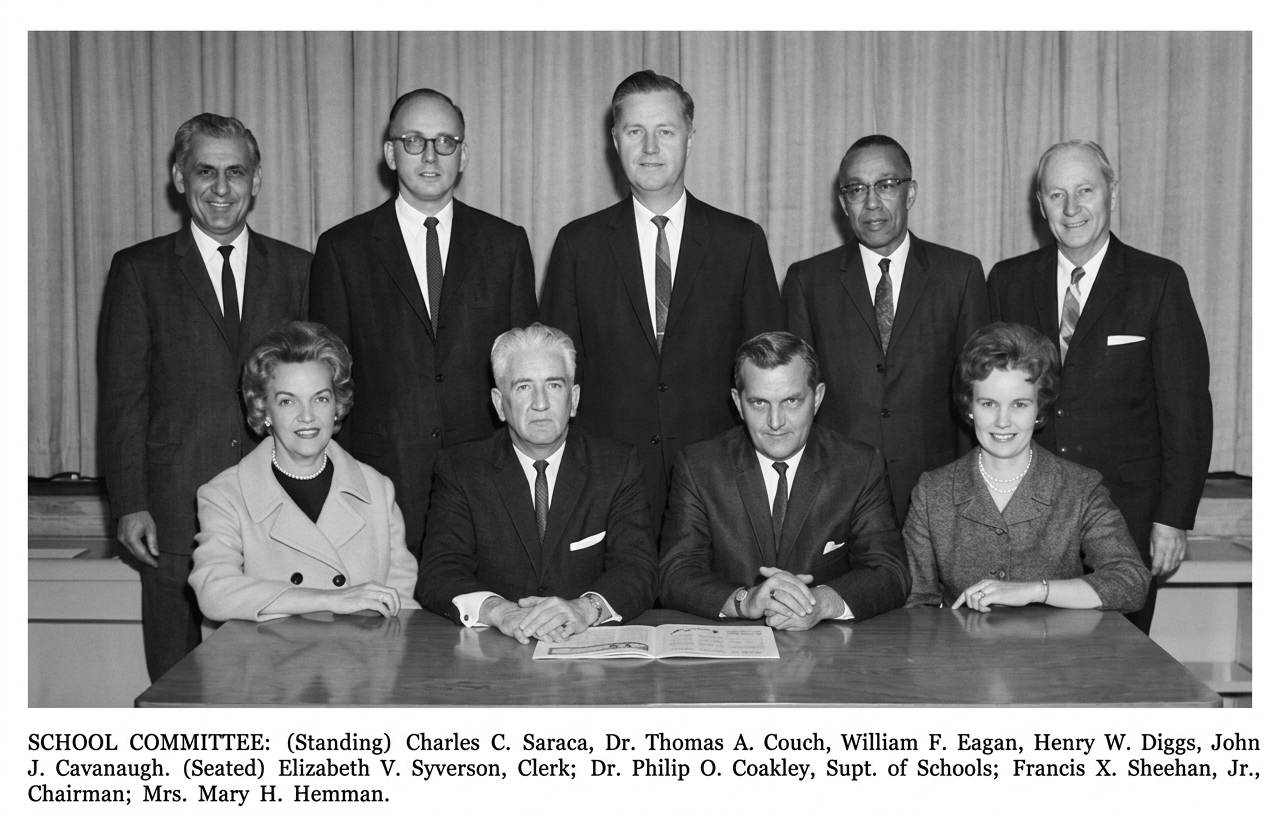
School committee minutes revealed a shelved plan to merge Shattuck and Winslow schools
-
School Committee Considers Sweeping Administrative Reorganization Plan-August 24, 1967
School Committee Chairman Francis X. Sheehan Jr. proposed a sweeping administrative reorganization creating an associate superintendent to streamline Norwood school management
-
Schools Prepare for 5th Annual New Teacher Orientation-August 22, 1967

Superintendent Dr. Philip O. Coakley welcomed 58 incoming educators at the fifth annual teacher orientation institute at Prescott School, introducing new faculty across secondary and elementary schools.
-
School Committee Inspects “Deplorable” Balch School, Demanding Immediate Repairs-October 27, 1966

Following a 90-minute inspection revealing rotting windows, cracked ceilings, and decaying staircases, the School Committee ordered immediate priority repairs for the 50-year-old Balch Elementary School.
-
Norwood Teachers Association Submits $1,000 Pay Increase Proposal-August 18, 1966

The Norwood Teachers Association submitted a $1,000-plus pay raise proposal as the school committee signed its first collective bargaining agreement amid debate led by John J. Cavanaugh and William Egan.
-
Andrew J. Ciarletta Jr. Appointed Principal of Winslow Elementary School-July 27, 1966

The Norwood School Committee appointed Andrew J. Ciarletta Jr. as principal of Winslow Elementary School, succeeding Alan R. Wonson.
-
“Middle School” Configuration Proposed to Address School Overcrowding-November 4, 1965

Norwood School Committee member William Egan proposed establishing a sixth-grade “middle school” and a 2,000-pupil high school to address surging enrollment pressures.
-
Retired Norwood Junior High Vice-Principal Mildred I. O’Donnell Honored at Testimonial Dinner-October 30, 1965
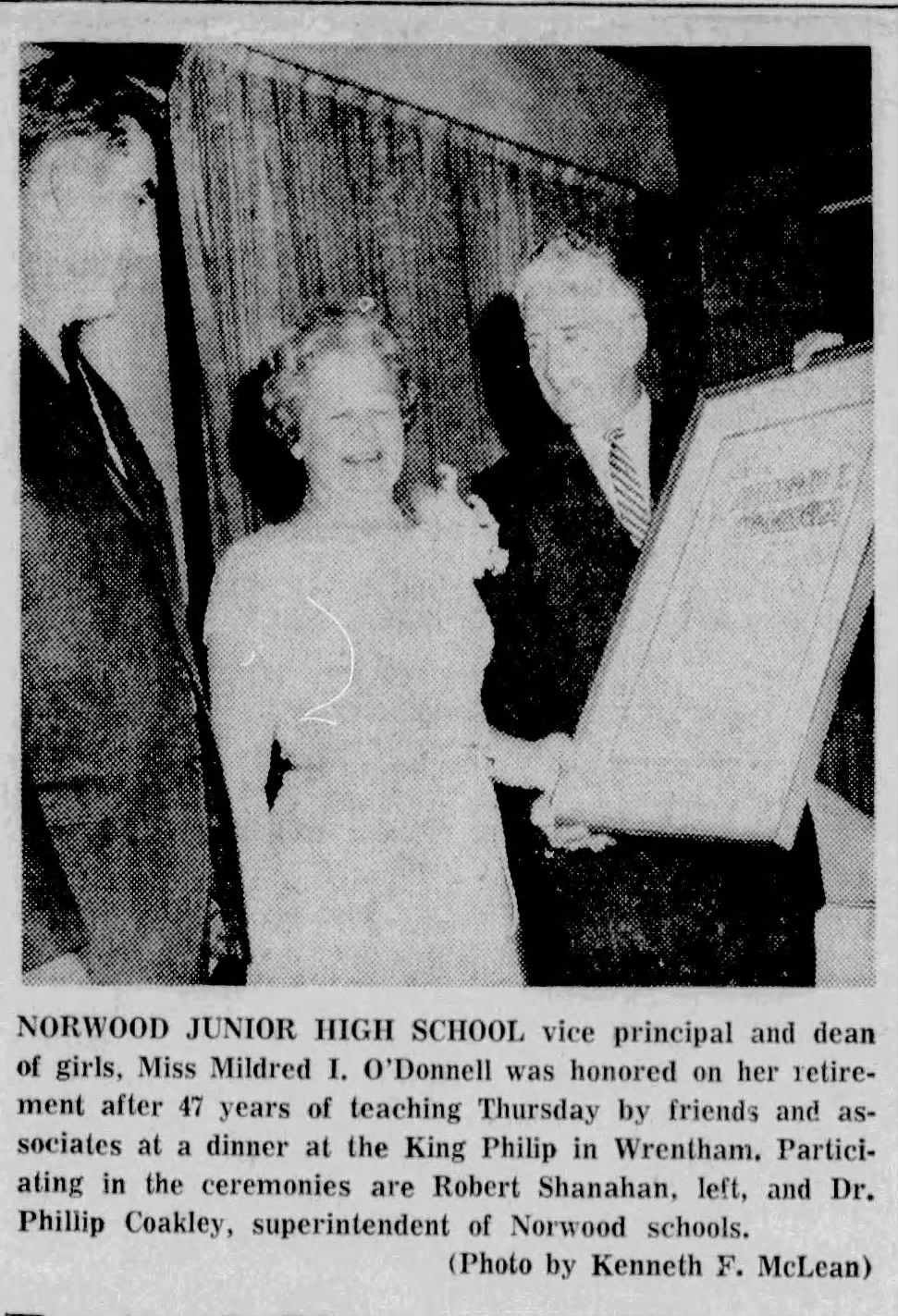
Celebrating a 47-year teaching career, retired Norwood Junior High vice-principal and dean of girls Mildred I. O’Donnell was honored during a testimonial dinner at the King Philip in Wrentham.
-
Superintendent Coakley Tells PTA Council That $4 Million in New School Construction Is Mandatory-September 10, 1965

Dr. Philip O. Coakley tells the PTA Council that $4 million in new school construction—including a new elementary and junior high—is mandatory to handle over-capacity enrollment.
-
Norwood School Committee Reviews Summer School Program and Proposes Token Fees-September 3, 1965

Following the successful completion of Norwood’s first town-sponsored summer school program—which enrolled approximately 330 local students in remedial coursework—the Norwood School Committee is evaluating future administrative structures, including a proposal to institute a nominal student fee. Superintendent Philip O. Coakley presented a comprehensive report detailing the inaugural summer session, noting that progress reports for every…
Discover more from Norwood Historical Society
Subscribe to get the latest posts sent to your email.