More Than Forty Citizens Protest Two-Mile High-Voltage Line Route at Selectmen’s Hearing
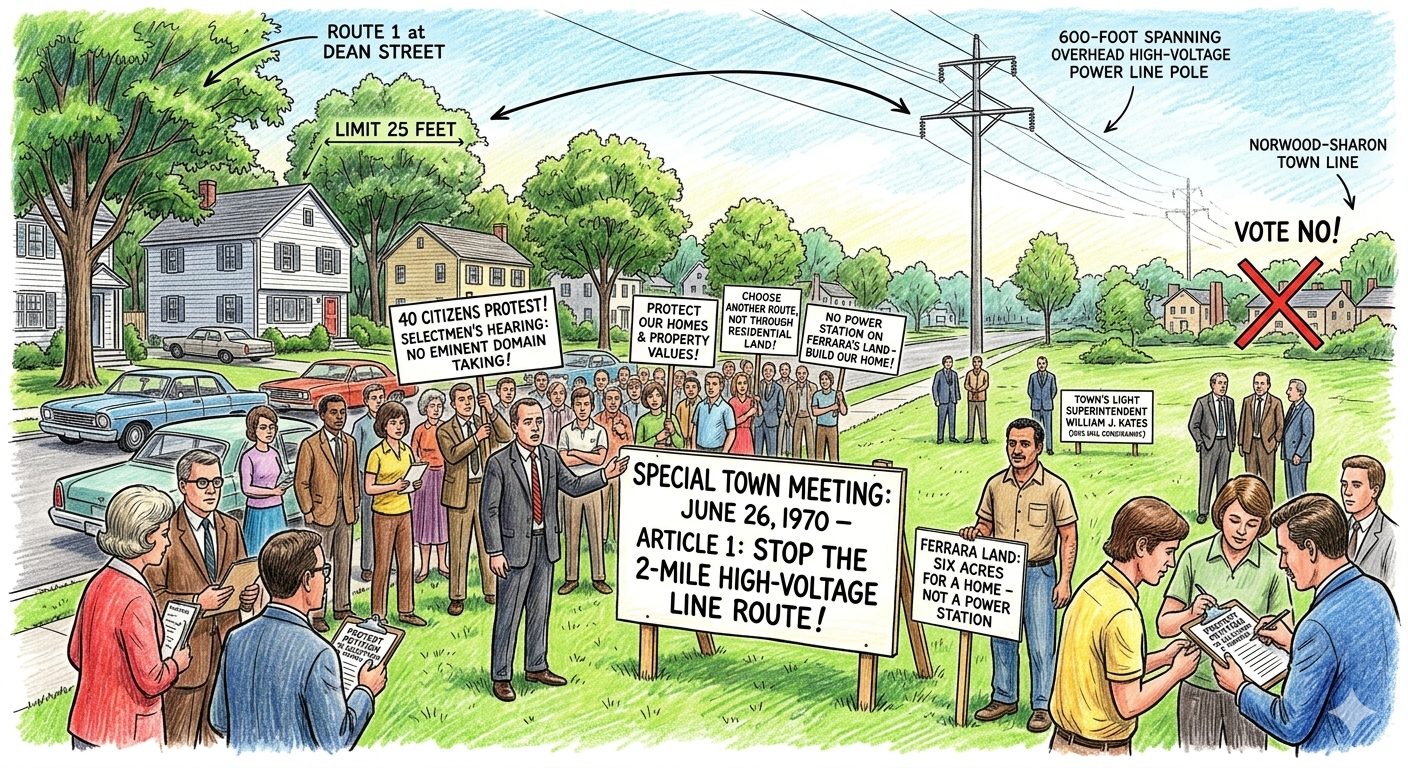
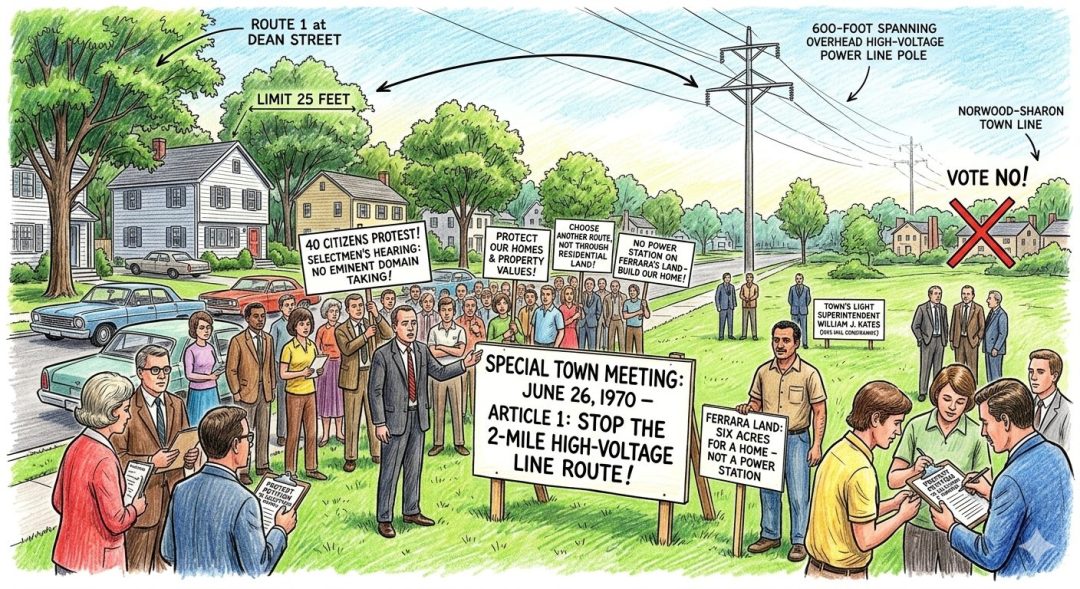
More than 40 residents attended the selectmen‘s meeting last night to protest a $2.3-million proposal to erect high-voltage lines extending two miles from the Norwood-Sharon town line to Route 1 at Dean Street. The program, explained last night by William J. Kates, Norwood light superintendent, would require the purchasing or taking by eminent domain of some 55 acres for the proposed right of way. The majority of residents protested the fact that the proposed right of way would cut through their property and therefore lower its value. Others protested the location of poles and high voltage wires near their homes.
Mr. Kates explained that in the long run, the program, which will appear as Article 1 of the June 26 special town meeting warrant, will result in saving to the town as far as the cost of electricity is concerned. He pointed out that under the present rates, the electricity bill for the town in 1970 will be $1,796,370. If the proposed program is implemented, this will be reduced to $1,615,536, a savings of $180,834. “Since the program is to be paid by a bond issue floated over a 20-year period, the annual payment will be $178,815. It is therefore pointed out that the annual payment is lower than the annual savings,” he stated. He argued that the service will be needed in the future, and if the program is put off, construction costs will increase rapidly.
The biggest area of controversy was the location of the poles, which will be spaced some 600 feet apart along the two-mile proposed right of way. Edward L. Collins of 220 Richland Road stated the right of way would cut through his property and therefore would adversely affect the value of his property. Mr. Collins noted that it was inevitable that some property would be damaged by the proposal but that the owners would be compensated for this. “What I consider the damage and what someone else considers to be damage are two different things,” Mr. Collins answered. Mr. Kates emphasized that the selected route was the “one that did the least harm to the least amount of people, including Factory Mutual Engineering Co., whose land will be affected.”
Robert L. Roy of 144 Richland Road stated he thought the outlined route was a “poor choice.” “Why when you can run the lines on industrial land on the opposite side of the river, did you choose a route affecting residential property,” he asked. Several residents suggested that underground wires be used instead of stringing poles up along the route. Mr. Kates said construction costs would be too high to attempt to place the cables underground. Mr. Collins declared that “we do not want these nuisances on our land. Why can’t you choose another route, why do you have to pick one which will cause the residents to suffer so much?”
It was noted that trees higher than 25 feet will have to be cut down along the proposed route. The high-voltage wires will come within 70 feet of some houses, it was noted by another resident. The possibility of electrical interference from the high voltage lines was also discussed. Mr. Kates stated that “there will be no interference, and if by some chance there is, the town of Norwood will be responsible for correcting it.” Mario Ferrara of 24 Tophill Ave., Dedham, who owns six acres of land along the right of way, complained that his land was designated as the site for the power station. “For many years, I have been planning to build a home on this site for my wife and kids, and now you tell me that I am going to lose it all. I turned down some very high offers for this land, but how much will I get back from the town if it is taken by eminent domain?” he asked. Selectman Chairman Harry B. Butters, assured the residents that they would get a “fair and equitable” settlement for any damage incurred from the project.
Discover more from Norwood Historical Society
Subscribe to get the latest posts sent to your email.