
🏡 From Victory Gardens to Red Cross Drives: Norwood’s Homefront in 1943
In the summer of 1943, while battles raged overseas, Norwood’s citizens waged their own quiet war—one of resilience, resourcefulness, and civic pride. From fuel conservation campaigns to Red Cross mobilizations, the town’s homefront efforts reflected a community deeply committed to the national cause.
🌱 Cultivating Patriotism: Victory Gardens and Fuel Conservation
With rationing in full effect, Norwood residents turned to their backyards. Victory Gardens flourished across town, transforming idle plots into productive spaces. These gardens weren’t just about food—they were symbols of self-reliance and unity.
Meanwhile, fuel conservation became a civic duty. Local officials urged residents to reduce consumption, and carpooling was promoted as both patriotic and practical. The Eastern Massachusetts Street Railway Company adjusted its services to support wartime transit needs, reinforcing the town’s commitment to shared sacrifice.
🩸 Mobilizing Mercy: The Red Cross Motor Corps
One of the most visible symbols of Norwood’s wartime spirit was the Red Cross Motor Corps. In August 1943, the Norwood chapter received a new station wagon, enabling volunteers to transport blood donors to Boston hospitals more efficiently. The vehicle, a gift from the Red Cross War Fund, was a testament to the town’s generosity and logistical ingenuity.
The Motor Corps also played a vital role in emergency services and civil defense drills, often working in tandem with local police and fire departments. Their presence on the roads was a reminder that war work didn’t only happen in factories—it happened in the everyday movements of ordinary citizens.
🧵 Sewing, Saving, and Serving: Civilian Contributions
Norwood’s women were especially active in wartime service. Red Cross sewing circles produced bandages and garments for soldiers, while local churches hosted fundraisers and bazaars to support relief efforts. The town’s civic calendar was filled with events that blended community spirit with national purpose—from penny carnivals to patriotic pageants.
🕊️ A Legacy of Local Heroism
Though the headlines of 1943 often focused on distant fronts, the Norwood Free Press captured the heartbeat of a town determined to make a difference. The homefront was not a place of passive waiting—it was a theater of action, where every garden planted, every ride shared, and every dollar donated became part of the war effort.
Perfect follow-up, George. Here’s a draft for your second WordPress article titled “From Sicily to the Skies: Norwood’s Sons in World War II”, designed to honor local servicemen with vivid storytelling and archival fidelity:
✈️ From Sicily to the Skies: Norwood’s Sons in World War II
In August 1943, the battlefronts of World War II stretched from the beaches of Sicily to the skies over Europe—and Norwood’s young men were there. Through letters, promotions, and solemn announcements, the Norwood Free Press offered glimpses into the lives of those who served, reminding readers that the war was never far from home.
🇮🇹 Sgt. John Leahy: In the Thick of Sicily’s Campaign
Sgt. John Leahy, serving with the U.S. Army in Sicily, wrote home describing the intensity of combat and the camaraderie among troops. His letter, published in the local paper, painted a picture of dusty roads, long marches, and the resolve of soldiers pushing through one of the war’s most pivotal campaigns.
Leahy’s words resonated with Norwood readers, offering both pride and perspective. His account was more than a military update—it was a bridge between the front lines and the front porches of his hometown.
🛩️ Pvt. Naimi Bader: Taking Flight with the Army Air Forces
Pvt. Naimi Bader’s promotion to the Army Air Forces marked a new chapter in Norwood’s wartime narrative. Stationed at a training base, Bader was preparing for aerial missions that would take him far from Massachusetts. His advancement was celebrated in the Free Press, a reminder of the town’s growing presence in the skies.
These stories of flight and formation training underscored the technological evolution of warfare—and Norwood’s role in it.
🎖️ Promotions, Transfers, and Sacrifice
The August 20, 1943 edition also chronicled other servicemen’s movements: transfers to new bases, promotions in rank, and, in some cases, injuries sustained in battle. Each name carried weight. Each update was a thread in the tapestry of Norwood’s wartime experience.
Families hung flags in their windows, wrote letters daily, and gathered around radios hoping for good news. The community’s collective heartbeat pulsed with concern, pride, and unwavering support.
🕯️ Remembering the Fallen
While many stories celebrated progress and promotion, others carried the somber news of loss. The paper’s respectful tone and careful reporting reflected the gravity of war’s cost. Memorial services, Gold Star acknowledgments, and quiet tributes ensured that sacrifice was never forgotten.
Absolutely, George. Here’s a draft for your third WordPress article titled “Norwood’s Women in the Ranks: Nurses, WAVES, and WACs”, spotlighting the trailblazing roles local women played in 1943:
👩⚕️ Norwood’s Women in the Ranks: Nurses, WAVES, and WACs
In 1943, as Norwood’s men shipped out to battlefronts abroad, the town’s women stepped into new uniforms—and new roles. From military commissions to Red Cross service, Norwood’s daughters were reshaping the meaning of patriotism, proving that courage wore many faces.
🩺 Dr. Nersessian: A Commissioned Healer
One of the most notable announcements in the Norwood Free Press was the commissioning of Dr. Nersessian into the U.S. Army Medical Corps. Her appointment marked a significant milestone—not just for Norwood, but for women in medicine. As a physician, she would serve wounded soldiers with skill and compassion, embodying the quiet heroism of wartime caregivers.
Her story reflected a broader shift: women weren’t just supporting the war effort—they were leading it in critical fields.
⚓ WAVES and WACs: Breaking Military Barriers
Norwood women also joined the ranks of the Navy’s WAVES (Women Accepted for Volunteer Emergency Service) and the Army’s WACs (Women’s Army Corps). These roles, once unimaginable, became vital to military operations. From clerical work to communications, these women freed up men for combat and proved indispensable to the war machine.
The Free Press celebrated their enlistments with pride, often listing names, training locations, and letters home. These updates served as both inspiration and affirmation: Norwood’s women were answering the call.
🚗 Red Cross Motor Corps: Driving Change
Beyond formal military service, many women volunteered with the Red Cross Motor Corps. In August 1943, the Norwood chapter received a new station wagon, enabling female drivers to transport blood donors and assist in emergency drills. These women navigated wartime roads with precision and purpose, often coordinating with civil defense teams.
Their work blurred the lines between civilian and military service, showing that patriotism wasn’t confined to the battlefield.
🧵 Sewing, Organizing, Leading
Norwood’s women also led sewing circles, organized fundraisers, and hosted community events to support troops and their families. Churches and civic groups became hubs of activity, where women stitched bandages, packed care kits, and raised funds for war relief.
These efforts, though quieter than enlistments, were no less vital. They sustained morale, built community, and ensured that Norwood remained a town united in purpose.
🚌 Buses, Bases, and Blockades: Norwood’s Wartime Transit Story
In the thick of World War II, Norwood’s roads, rails, and runways became arteries of both civilian life and military strategy. The August 20, 1943 edition of the Norwood Free Press reveals a town adapting its transit systems to meet the demands of war—from decommissioned naval bases to rerouted bus lines.
⚓ Squantum Naval Base: A Strategic Shift
One of the most significant updates was the decommissioning of the Squantum Naval Air Station. Once a bustling hub for naval aviation, the base’s closure signaled a strategic realignment. Its operations were absorbed into larger facilities, reflecting the Navy’s evolving priorities.
For Norwood, this shift meant fewer military flights overhead—but also a reminder that wartime logistics were constantly in motion.
🛫 Norwood Airport Lease: Civilian Airspace Reclaimed
In a parallel development, the Norwood Airport was leased to a private operator. This move returned a portion of the town’s airspace to civilian use, opening the door for local aviation training and small-scale transport.
The lease reflected a balancing act: supporting the war effort while preserving local infrastructure for postwar growth.
🚌 Eastern Mass Bus Service: Keeping the Town Moving
On the ground, the Eastern Massachusetts Street Railway Company adjusted its bus routes and schedules to accommodate wartime needs. Fuel conservation, labor shortages, and increased demand led to tighter timetables and more strategic stops.
Despite these constraints, the buses remained lifelines—connecting workers to factories, families to hospitals, and volunteers to Red Cross stations. The Free Press reported on service updates with urgency, knowing that every route mattered.
🚧 Blockades, Drills, and Civil Defense
Transit wasn’t just about movement—it was about preparedness. Civil defense drills occasionally blocked roads, simulating air raids or emergency evacuations. These exercises, often coordinated with the Red Cross Motor Corps and local police, trained residents to respond swiftly and safely.
Norwood’s streets became rehearsal spaces for resilience, where every detour had a purpose.
Here’s your fifth WordPress article draft, George, titled “Victory Pageants and Penny Carnivals: Wartime Childhood in Norwood”. This one captures the spirit of youth, creativity, and community resilience during 1943:
🎠 Victory Pageants and Penny Carnivals: Wartime Childhood in Norwood
While the world was at war, Norwood’s children found joy, purpose, and pride in playgrounds, pageants, and penny carnivals. The Norwood Free Press from August 20, 1943 paints a vivid picture of how wartime shaped childhood—not through fear, but through imagination and civic engagement.
🎭 Victory Pageants: Patriotism in Costume
Local playgrounds hosted elaborate victory pageants, where children dressed as Liberty, Uncle Sam, and Allied soldiers. These performances weren’t just entertainment—they were educational, instilling values of unity and sacrifice through song, skits, and storytelling.
Parents and neighbors gathered to watch, turning public parks into stages of hope. The pageants served as gentle reminders that even the youngest citizens had a role to play in the national effort.
🎪 Penny Carnivals: Small Coins, Big Impact
One of the most charming traditions was the penny carnival—a child-led fundraiser where games, crafts, and homemade treats raised money for war relief. Kids organized booths, designed posters, and counted coins with pride, knowing their efforts helped buy bandages, books, or even war bonds.
These events blended play with purpose, teaching children that generosity could be joyful.
🧸 Doll Shows and Playground Contests
The Free Press also reported on doll shows, costume contests, and athletic competitions held across Norwood’s playgrounds. These activities offered normalcy in uncertain times, giving children a chance to shine, compete, and connect.
Judges awarded ribbons, local businesses donated prizes, and the community rallied around its youngest members with enthusiasm and affection.
🕊️ Childhood in Wartime: Resilience and Ritual
Despite rationing, blackouts, and air raid drills, Norwood’s children experienced a childhood rich in ritual and resilience. Their games echoed the headlines, their drawings depicted tanks and nurses, and their questions—though sometimes difficult—were met with honesty and care.
The town’s investment in youth programs ensured that wartime didn’t steal childhood—it reshaped it into something meaningful.
-
SSgt. Ahti Wuori, Aerial Gunner On U. S. Bomber, Missing-This Day in Norwood History-December 22, 1944
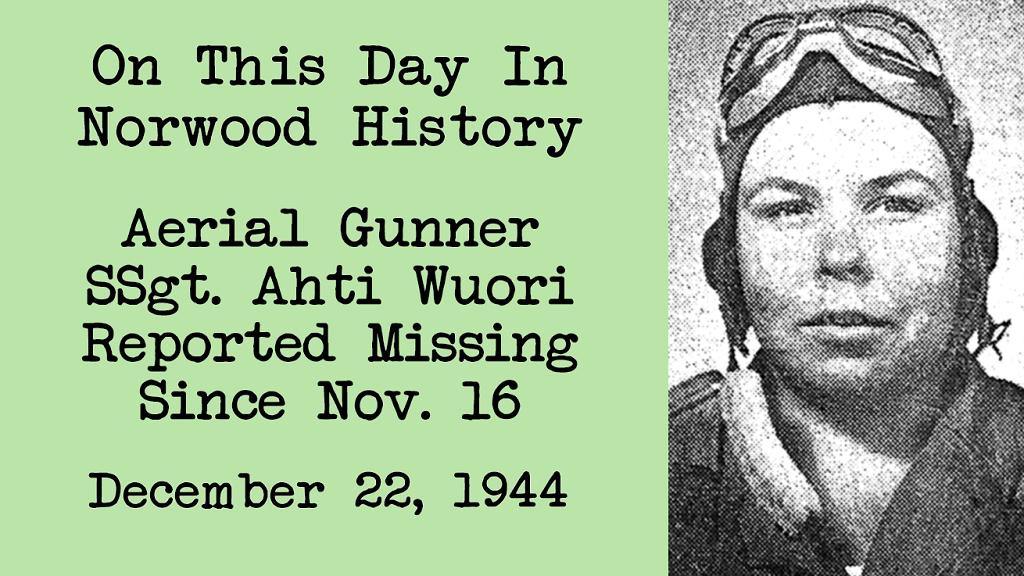
Veteran Of 30 Missions Missing In Pacific Theatre Since Nov. 16 Staff Sgt. Ahti J.. Wuori, only child of Mr. and Mrs. John Wuori of 90 East Cross street, Norwood, has been missing in action in the Pacific theater since November 16th, his parents have been informed in a War Department telegram. Sgl. Wuori has…
-
Norwood Veterans Return From War In Time For Holidays-This Day in Norwood History-December 22, 1944

Home After 22 Months Overseas Home after 22 months overseas is Russell I. Richwcin, QM, USN, son of Mrs. Emma Rowell of 392 Pleasant street. On the crew of an LST. Russell has taken part in four major invasions. North Africa, Sicily, Italy and Normandy. Russell, a graduate of Norwood schools, has been in the…
-
Pvt. Horace Webber Reported Missing In Siegfried Assault-This Day in Norwood History-December 7, 1944

Pvt. Horace G. Webber, 34-year-old Norwood Infantry soldier, is missing in action in Germany, it was learned last night following the receipt of a War Department telegram by his wife, Mrs. Margaret Webber of 32 Melville avenue. Pvt. Webber is one of five brothers in the service, two of whom have been wounded in battle.…
-
SSgt. Dominic Gemelli Awarded 2nd Battle Star-This Day in Norwood History-December 5, 1944
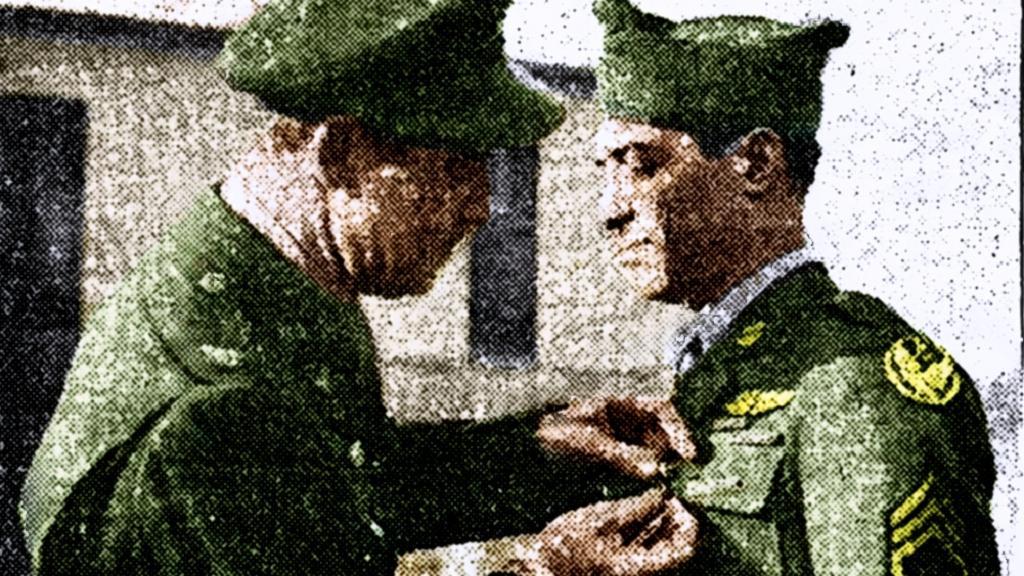
15TH AAF IN ITALY .. Ssgt Dominic Gemelli, 24. of 284 Lenox street. Norwood, aerial gunner, has been awarded the second battle star, according to an announcement by the 15th AAF in Italy. He received the award as a member of a veteran 15th AAF Liberator Bomber group which has flown numerous bombing missions in…
-
Pfc. Angelo Antonelli And Pfc. Charles Henry Wounded-This Day in Norwood History-December 5, 1944
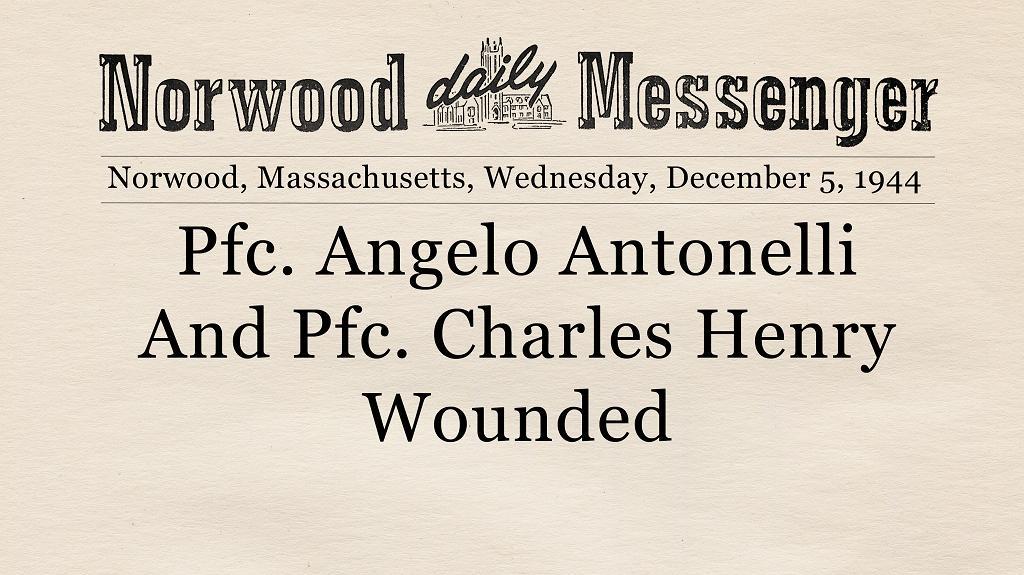
Norwood’s list of war casualties mounted higher today when it was learned that two more local servicemen have been wounded in action in France, both seriously. They are Pfc. Charles Robert Henry and Pfc. Angelo Antonelli. WITH RANGERS Mrs. David Henry of Prospect avenue reported today that she received a War Department telegram Sunday informing…
-
Thomas Connelly To Appear On ’Double Or Nothing’-This Day in Norwood History-December 5, 1944

Readville Car Shops To Be Scene Of Popular Radio Show On Friday Thomas Connelly of 285 Nahatan street. Norwood, carpenter and carman, will be in the radio spotlight as one of the contestants when the metallic din. of the New Haven railroad’s huge locomotive shop at Readville is hushed long enough on Friday. December 8,…
-
Pfc. Russell Webber in Hospital At San Diego-This Day in Norwood History-December 4, 1944

Mr. and Mrs. Edgar Webber of 906 Washington street, Norwood, have received word from their son. Pfc. Russell H. Webber, a fleet Marine who was wounded in the Palau invasion, that he is back in the States and is now confined to a hospital in San Diego. Cal. He writes that he hopes to be…
-
Pvt. James Keady Listed Missing; Pfc. William Fitzgerald, Pfc. Robert Flaherty Reported Wounded-This Day in Norwood History-December 4, 1944

One Norwood man is missing in action in France and two more have been wounded in that theatre, one seriously, according to War Department telegrams received by their families 1 over the weekend. They are: Pvt. James Kcady of 35 Mountain Avenue, missing in action. Pfc. William J. Fitzgerald of 260 Lenox Street, seriously wounded.…
-
Pvt. Charles F. Lydon Loses Life November 11-This Day in Norwood History-November 28, 1944
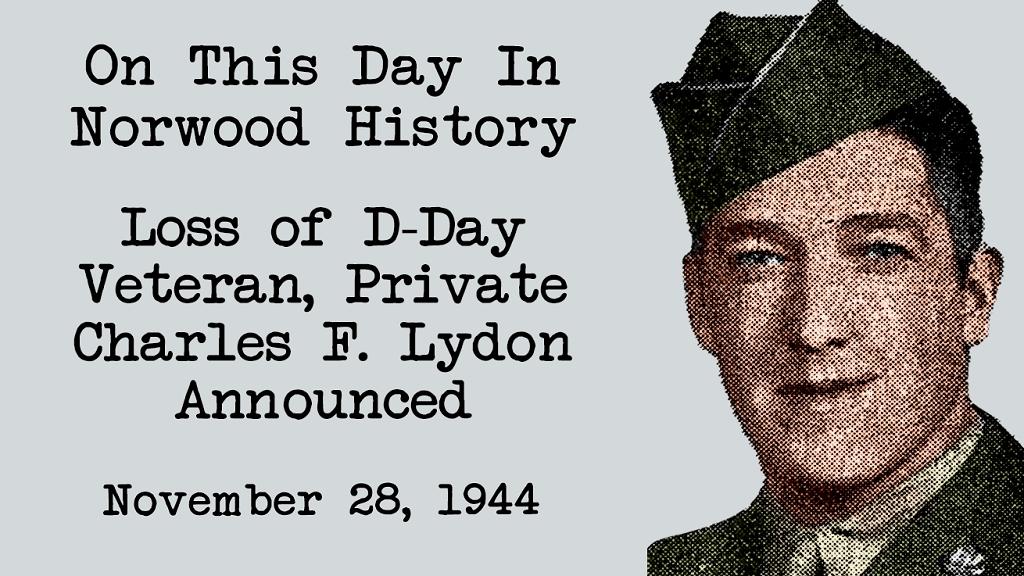
Norwood Army Engineer In Service Less Than Year; Fought On D-Day Pvt. Charles Frances Lydon, 25, of 24 Cottage street, Norwood, was killed in action in France on November 11th, it was reported by the War Department in a telegram received yesterday afternoon by his wife, Mrs. Agnes Lydon. He is the third Norwood man…
-
Lt. Edmund Mulvehill Stationed In Atlantic City-This Day in Norwood History-November 27, 1944

ATLANTIC CITY, N. J.. Nov. 27 —A veteran of 31 missions as a Flying Fortress pilot with the 8th Air Force in England. First Lieutenant Edmund W. Mulvehill. of 23 Cottage street, Norwood, is now assigned to the AAF Redistribution Station here as an interviewing officer. In his new position, Lt. Mulvehill will interview other…
Discover more from Norwood Historical Society
Subscribe to get the latest posts sent to your email.