

“Generally, the program this year is running much more smoothly than last year,” administrative assistant for student affairs George Usevich said of Norwood High School’s open campus system as it enters its second year.
To an outside observer, the school of 1,724 students appears to be operating efficiently, with pupils busily moving between classes or congregating on the front steps. However, whether the term “open” accurately applies to the campus is increasingly debatable as administrators tighten regulations and structure.
Tightened Rules and Corridor Restrictions
Last year’s open campus plan—an extended-day arrangement designed to maximize facility use by adding two daily periods and granting students greater responsibility for their personal and educational development—encountered growing pains, particularly regarding hallway congestion.
To combat this, the school administration compiled some 65 improvement proposals over the summer, several of which have already been implemented:
- Corridor Bans: Main corridors are now strictly off-limits to students except for a five-minute window at the beginning and end of each class period. Teachers are assigned specific corridor duty to challenge lingering students. The rule is partially lifted only during inclement weather. Usevich noted that this policy has successfully resulted in “less commotion, less distraction to teachers.”
- Sophomore Restrictions: Sophomores have been virtually eliminated from open campus privileges by having their classes scheduled exclusively during periods three through nine, though they may attend morning school activities. A special orientation day was held for sophomores this year, featuring addresses by faculty, student council members, and guidance officers, alongside a detailed review of the mandatory student-parent open campus contracts.
- Discipline and Attendance: While disciplinary restriction times have been reduced in some cases, a strict new attendance policy denies course credit to any student missing 25 percent of class meetings unless absences are explicitly substantiated by a doctor. The policy has created a heavy record-keeping load currently under review by assistant principals.
Student reaction to the tightened controls is mixed. While some appreciate the order, a senior remarked, “The kids think it’s stupid,” while a junior added, “I kind of resent it because I don’t really need to be controlled like that. But I guess it is easier on the teachers.”
Parking remains an ongoing headache, with student parking restricted to an inadequate area near the tennis courts. Nonetheless, Usevich expressed sympathy for student drivers: “With 1,724 kids, an element in the school population definitely needs cars, for work, to get home, to do errands.”
Expanded Seminars, Film Programs, and Community Involvement
Despite increased regulation, the academic and enrichment programs have expanded significantly:
- Seminars Replacing Minicourses: Last year’s minicourses have returned under the new name “seminars,” running continuously during periods three through eight. Offerings include an accounting seminar featuring Gus Sacre of Bird and Son, a stock market investing seminar paired with economics, a law enforcement seminar linked with law and sociology, and an auto mechanics course in conjunction with industrial arts.
- Cultural and Contemporary Programs: A packed schedule of enrichment events includes a visit from a United Farm Workers speaker and the screening of “Decision at Delano”, musical performances by the Navy and Army bands, and informational visits from all military branches on Armed Forces Day. Film programs shown in the auditorium feature sports, travel, and animal shorts—though a classic Charlie Chaplin movie proved to be the most popular drawing card.
- Student Council Reform: Student council elections have been modified so that all delegates are elected at large, with any interested student permitted to place their name in nomination—a change Usevich said has fostered a more committed council membership.
As part of the state Department of Education’s annual evaluation mandate, the school has formed 12 committees to review various aspects of the program. The first Open Campus Evaluation Day is scheduled for October 20 from 1:00 to 3:00 p.m. at the high school, with history teacher Theodore A. Curtin serving as evaluation day chairman.
Archival Note: This article has been dynamically reconstructed from the original public record print archives of the Patriot Ledger
-
School Committee Considers Sweeping Administrative Reorganization Plan-August 24, 1967
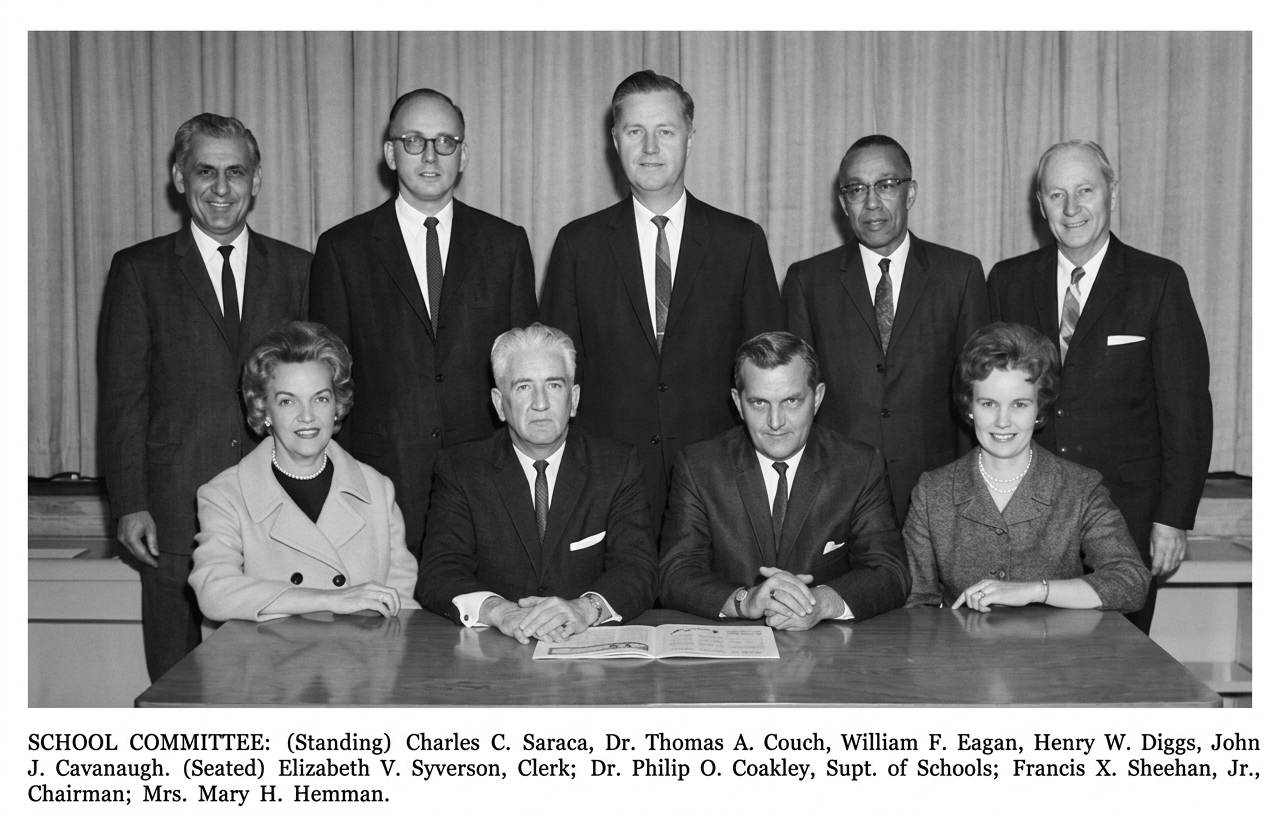
School Committee Chairman Francis X. Sheehan Jr. proposed a sweeping administrative reorganization creating an associate superintendent to streamline Norwood school management
-
Schools Prepare for 5th Annual New Teacher Orientation-August 22, 1967

Superintendent Dr. Philip O. Coakley welcomed 58 incoming educators at the fifth annual teacher orientation institute at Prescott School, introducing new faculty across secondary and elementary schools.
-
School Committee Inspects “Deplorable” Balch School, Demanding Immediate Repairs-October 27, 1966
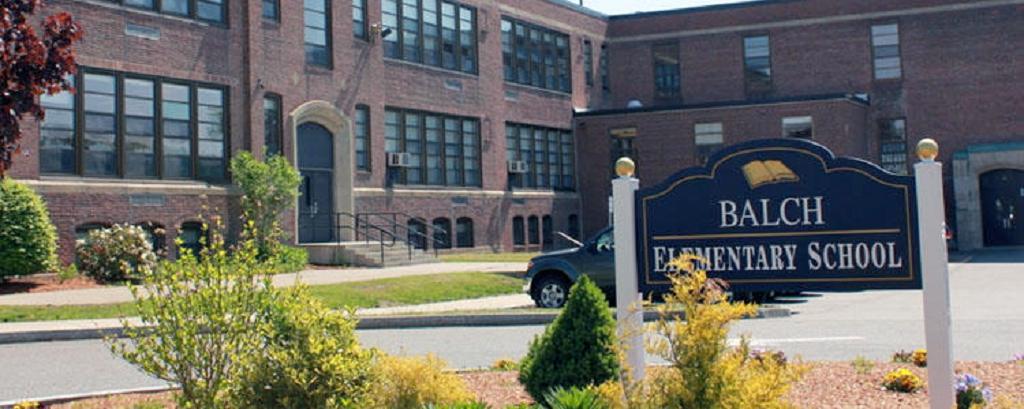
Following a 90-minute inspection revealing rotting windows, cracked ceilings, and decaying staircases, the School Committee ordered immediate priority repairs for the 50-year-old Balch Elementary School.
-
Norwood Teachers Association Submits $1,000 Pay Increase Proposal-August 18, 1966

The Norwood Teachers Association submitted a $1,000-plus pay raise proposal as the school committee signed its first collective bargaining agreement amid debate led by John J. Cavanaugh and William Egan.
-
Andrew J. Ciarletta Jr. Appointed Principal of Winslow Elementary School-July 27, 1966

The Norwood School Committee appointed Andrew J. Ciarletta Jr. as principal of Winslow Elementary School, succeeding Alan R. Wonson.
-
Thirteen Norwood High Class of 1965 Graduates Earn College Advanced Placement Honors-November 20, 1965
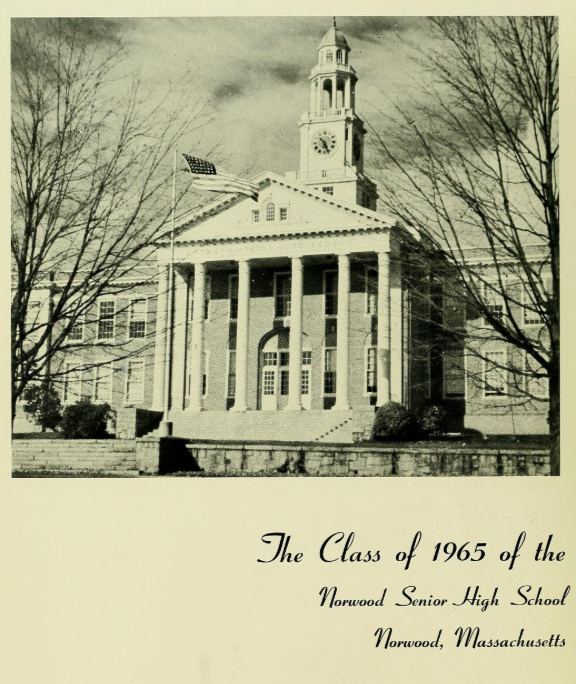
Twelve Norwood High Class of 1965 freshmen at the University of Massachusetts received advanced placement in November 1965, while Gerald Belastock earned sophomore math standing and 20 credits from Carnegie Institute of Technology.
-
“Middle School” Configuration Proposed to Address School Overcrowding-November 4, 1965

Norwood School Committee member William Egan proposed establishing a sixth-grade “middle school” and a 2,000-pupil high school to address surging enrollment pressures.
-
Retired Norwood Junior High Vice-Principal Mildred I. O’Donnell Honored at Testimonial Dinner-October 30, 1965
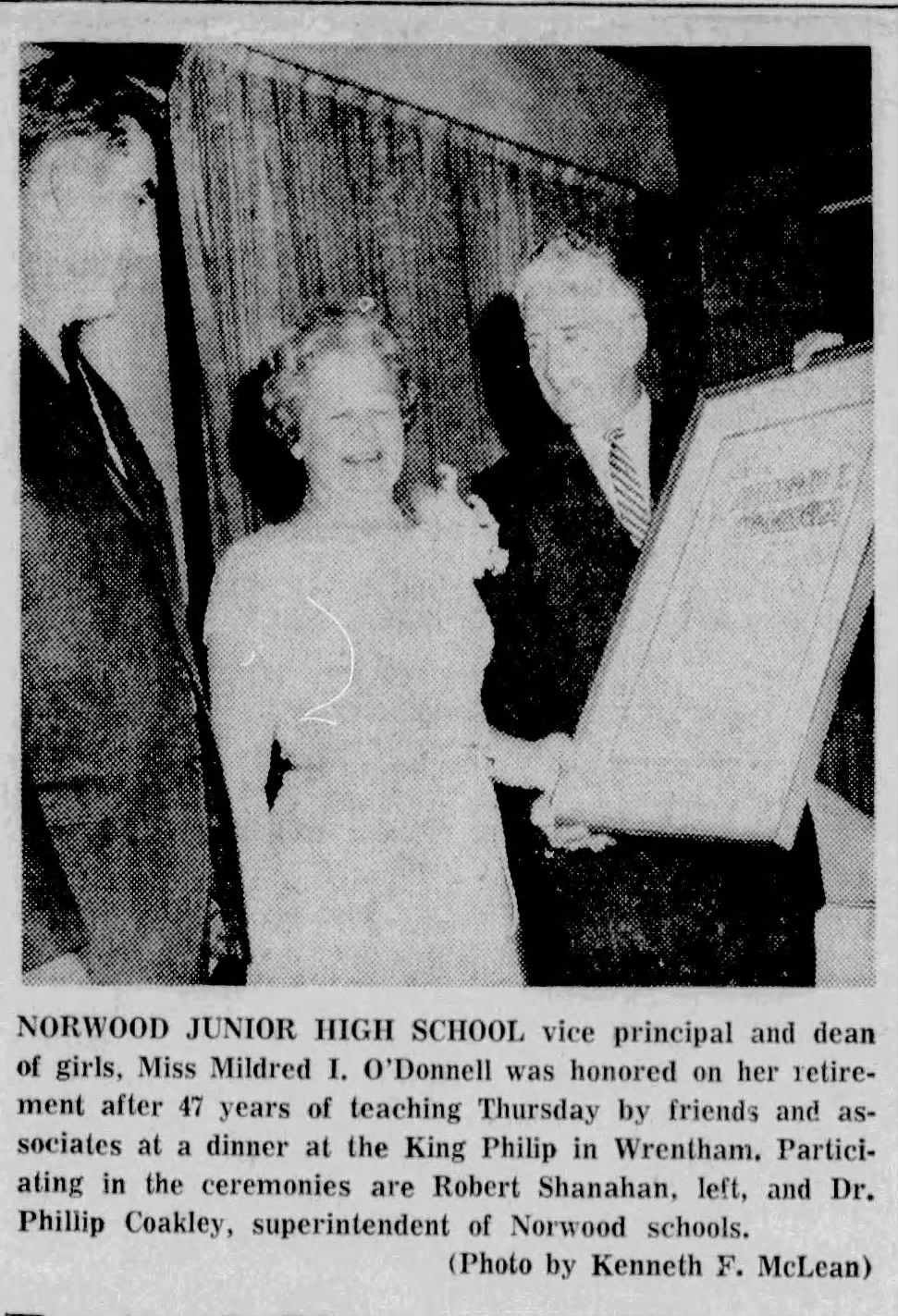
Celebrating a 47-year teaching career, retired Norwood Junior High vice-principal and dean of girls Mildred I. O’Donnell was honored during a testimonial dinner at the King Philip in Wrentham.
-
Superintendent Coakley Tells PTA Council That $4 Million in New School Construction Is Mandatory-September 10, 1965

Dr. Philip O. Coakley tells the PTA Council that $4 million in new school construction—including a new elementary and junior high—is mandatory to handle over-capacity enrollment.
-
Norwood School Committee Reviews Summer School Program and Proposes Token Fees-September 3, 1965

Following the successful completion of Norwood’s first town-sponsored summer school program—which enrolled approximately 330 local students in remedial coursework—the Norwood School Committee is evaluating future administrative structures, including a proposal to institute a nominal student fee. Superintendent Philip O. Coakley presented a comprehensive report detailing the inaugural summer session, noting that progress reports for every…
Discover more from Norwood Historical Society
Subscribe to get the latest posts sent to your email.