Norwood’s Planning Board Unveils an Ambitious Vision for a “Town Beautiful”
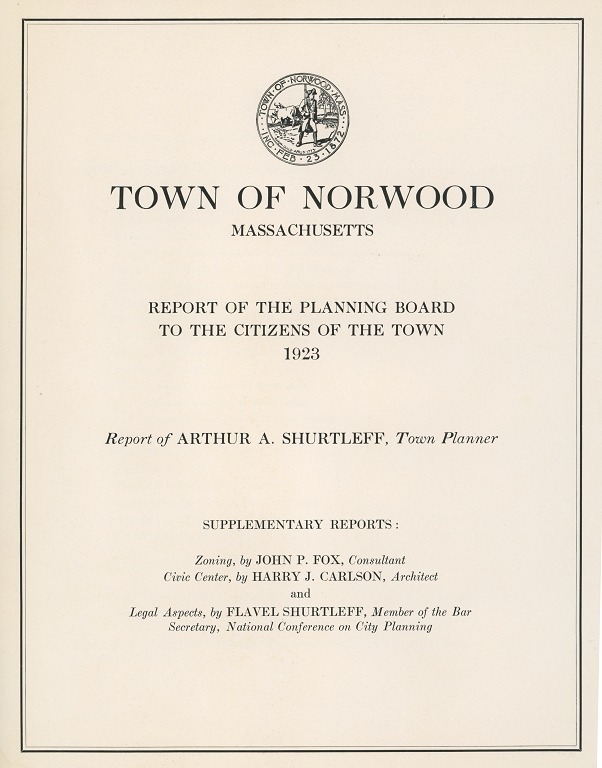
In the spring of 1923, Norwood residents were invited to look toward the future with the release of the most comprehensive Planning Board report the town had ever produced. The document celebrated more than a decade of civic improvement and laid out an ambitious blueprint for what Norwood could become.
Norwood had been only the second town in Massachusetts to establish a Planning Board, and by 1923 the committee had accumulated 11 years of continuous work, study, and consultation. Chairman George F. Willett emphasized that the report represented the combined efforts of local citizens passionate about Norwood’s appearance and nationally respected planning experts brought in to guide the town’s growth. Town planner Arthur A. Shurtleff, one of the most influential landscape architects of his era, noted that the plan reflected “the best ideas evolved from all sources, through painstaking conferences.”
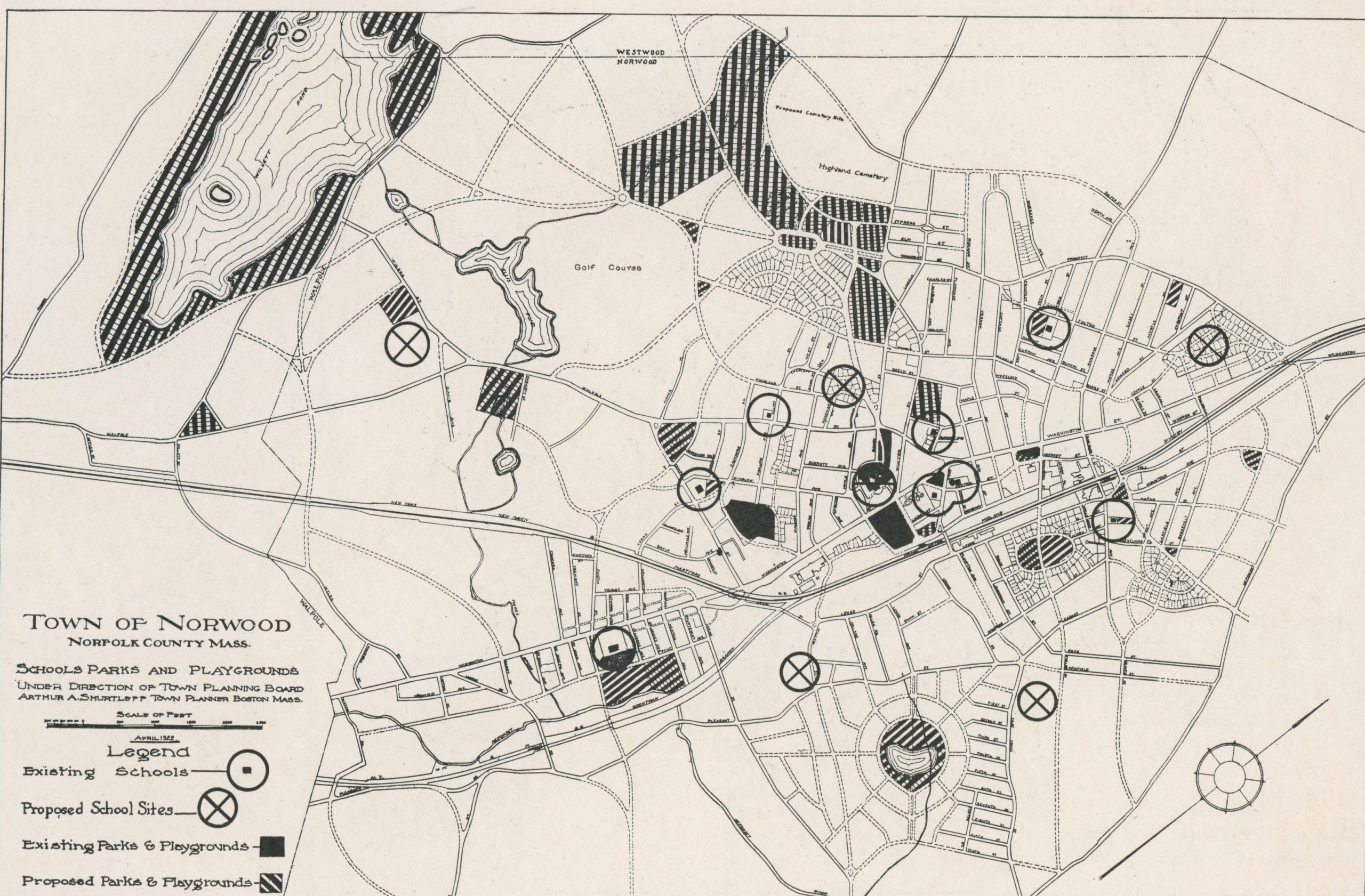
The Board—comprised of Willett, Frank B. Coughlin (secretary), William G. Upham, J. Conrad Johnson, and John E. Folan—produced a beautifully assembled report filled with photographs of Norwood’s principal streets, public buildings, and a series of detailed maps showing both completed improvements and those still on the horizon.
A Town Reimagined: Schools, Streets, and Neighborhoods

One major section of the 1923 report focused on school planning, identifying proposed sites for new school buildings and forecasting the neighborhoods that would grow around them. The accompanying maps—now historical artifacts—reveal a Norwood that was still largely open land, especially in the areas surrounding Willett Pond, Westover, and the southern reaches of town.
Westover & Willett Pond Area
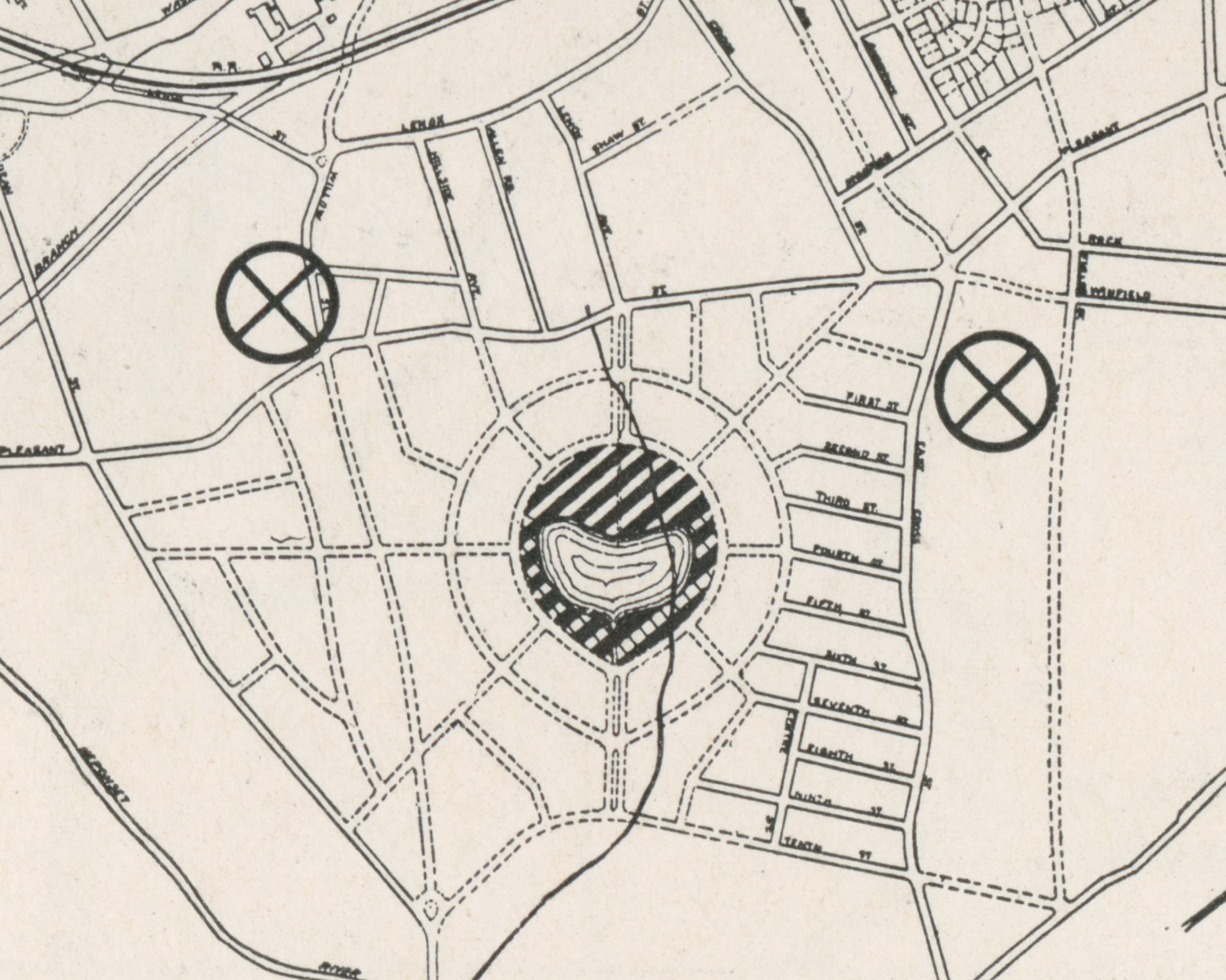
In 1923, Willett Pond (then often called New Pond) dominated the landscape. Much of the surrounding land was undeveloped, with only penciled‑in proposals hinting at future neighborhoods. Among the plans:
- Two triangular islands and three new roads south of the pond
- A major road that would have run through what is now Windsor Gardens, under the New York & New Haven Railroad, and into Endean—near today’s Coakley Middle School (The “South Norwood Highway”)
- A proposed school on Wilson Street, never built
- A rotary connecting Westover to Prospect Street (not Nichols Street as today)

The Future Norwood High School Area
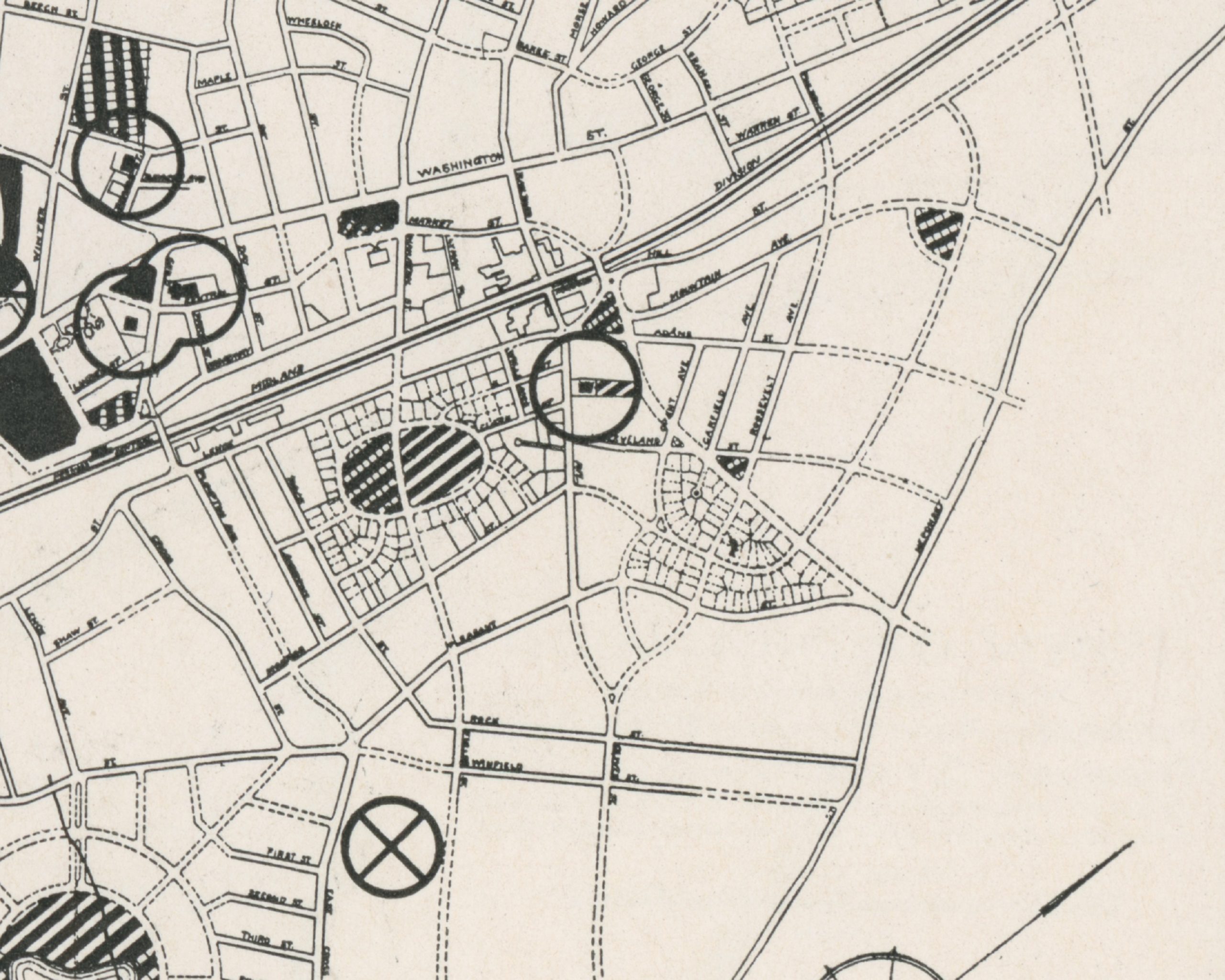
A striking feature on the map is a large elongated rotary—located almost exactly where the Norwood High School track and football field sit today. In 1923, this land was envisioned as a residential neighborhood. Other proposals included:
- Extending Nichols Street only as far as Berwick Place, ending at a triangular park
- Linking parts of Highland Cemetery to Shattuck Park to form an “Emerald Necklace” of green space
- Extending Silver Street from Nahatan Street through conservation land, across Winter Street, and all the way into Westwood
- A proposed school site near Bond Street and Highland Street, never constructed
West of Washington Street
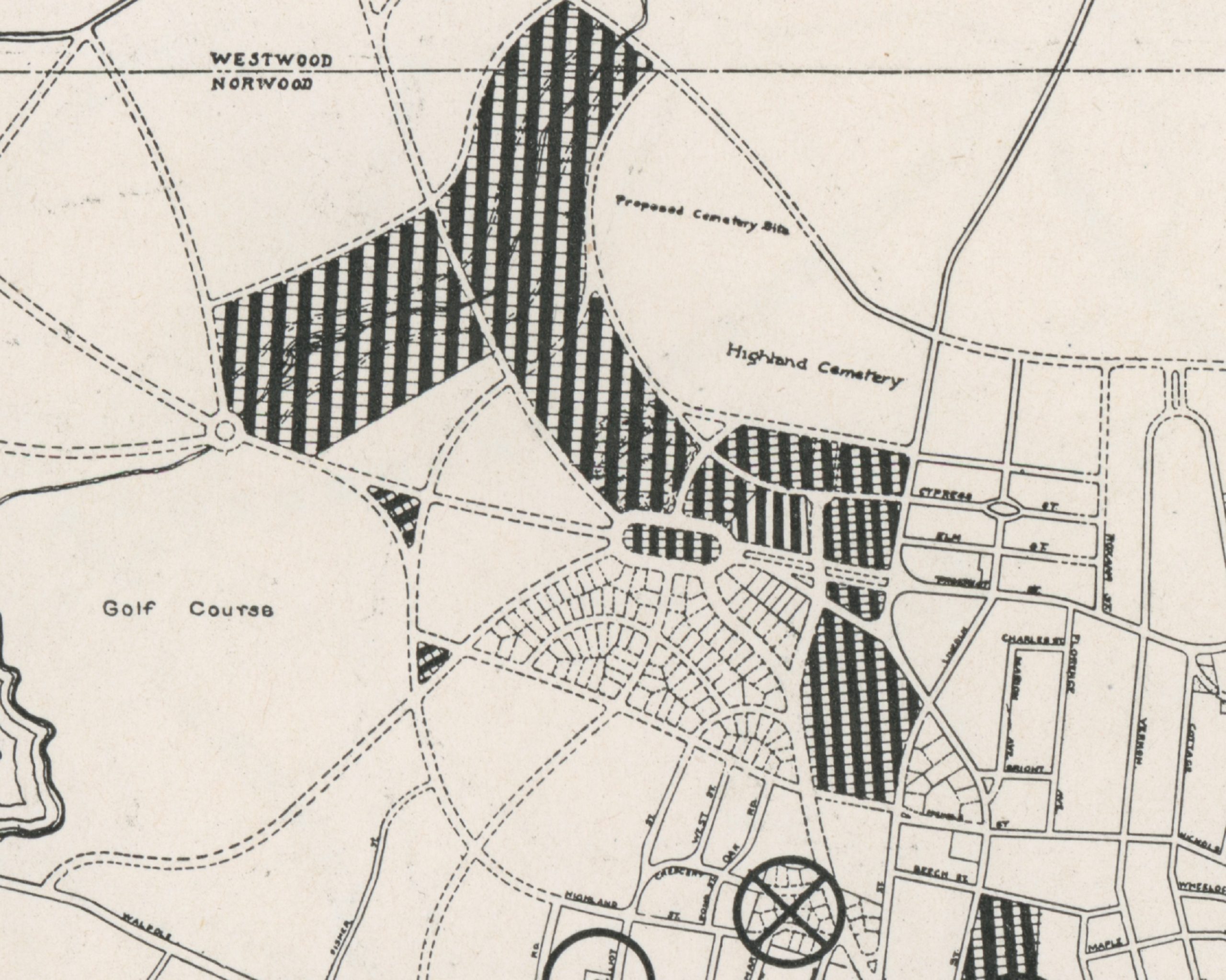
This section of the map shows:
- The full proposed extension of Silver Street
- Vast undeveloped land owned by W. Cameron Forbes
- A major planned intersection where extensions of Fulton, George, and Philbrick Streets would have converged
- A new housing development where Fulton would be extended to Upland Rd/Washington St.
- A potential school site near the Fulton Street extension
Although the intersection plan was abandoned, Fulton Street still shows a widened curve today—a ghost of the original proposal.

South Norwood
The 1923 plan imagined dramatic changes:
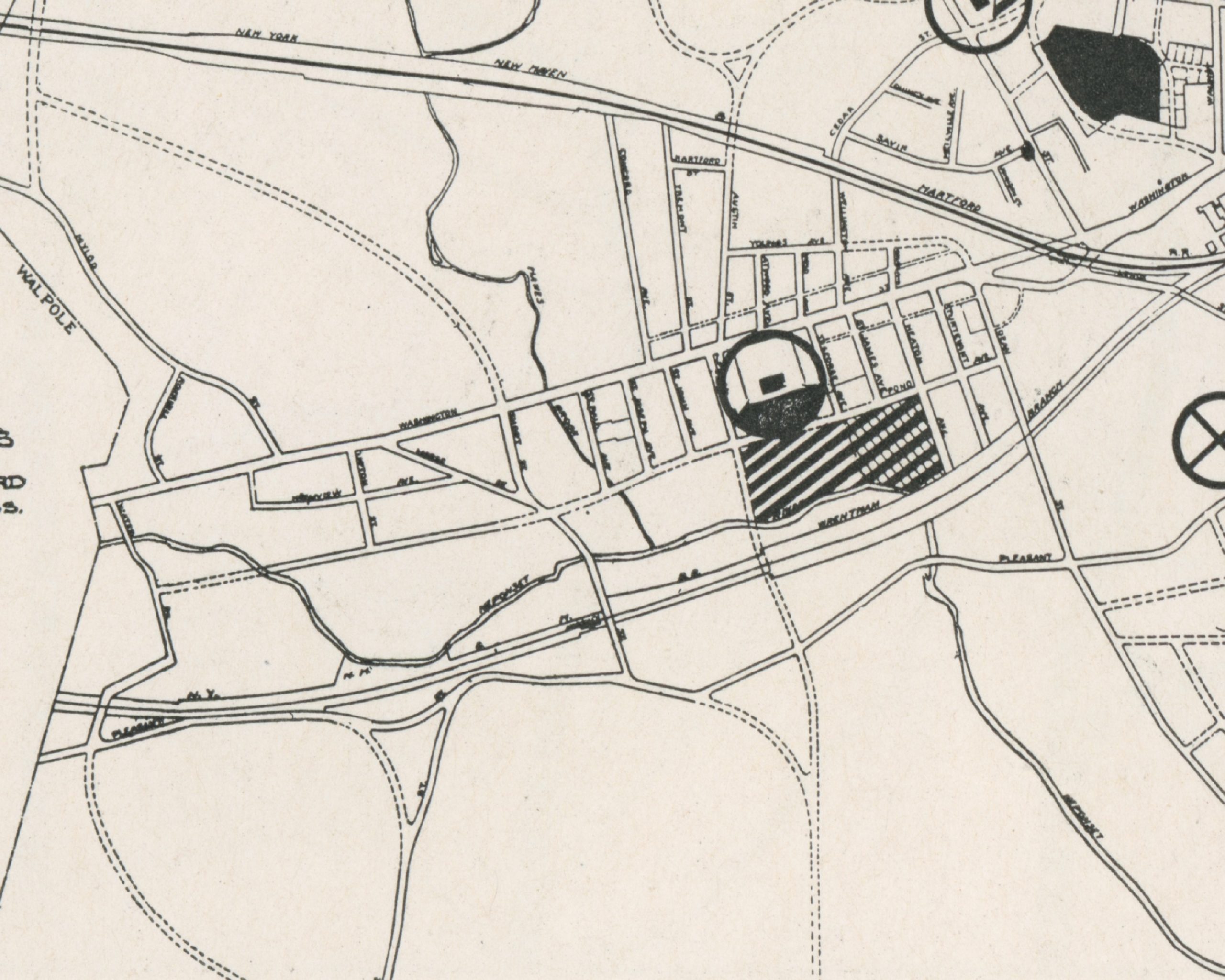
- Austin Street extended under the railroad toward Chapel and Walpole Streets
- Short Street crossing Washington Street near today’s Hawes Pool and continuing through Endean Farm
- Folan Avenue running under the Wrentham Railroad and across Pleasant Street toward present‑day Route 1
- Numerous new streets east of Pleasant Street
The later construction of Route 1 altered many of these plans, though First through Sixth Streets and the curved alignments of Gay and Arnold Streets were built as envisioned.
Downtown Norwood
The map shows a dense cluster of schools:
- Beacon School beside the Morrill Memorial Library
- Everett and Guild Schools near today’s Aaron Guild Park
- East School on Railroad Avenue
Between Neponset and Hill Streets, the Board proposed a network of new streets and a large central park. Today, this area contains Nahatan Place, Nahatan Plaza, banks, Dunkin’, and the Public Safety Building—very different from the single‑family neighborhood once envisioned.
A Vision That Shaped—and Sometimes Missed—Norwood’s Future
The 1923 Planning Board Report stands as one of the most ambitious civic documents in Norwood’s history. Some of its ideas became reality; others remained lines on paper. But together, they reveal a moment when Norwood imagined itself as a carefully planned, beautifully connected, forward‑looking community.
It was, as Willett and Shurtleff intended, a blueprint for a “Town Beautiful.”
Text and images may have been created, edited, colorized, or digitally restored using AI tools such as Microsoft Copilot or Google Gemini. All content is reviewed for accuracy and historical integrity before publication by the Norwood Historical Society
Discover more from Norwood Historical Society
Subscribe to get the latest posts sent to your email.