
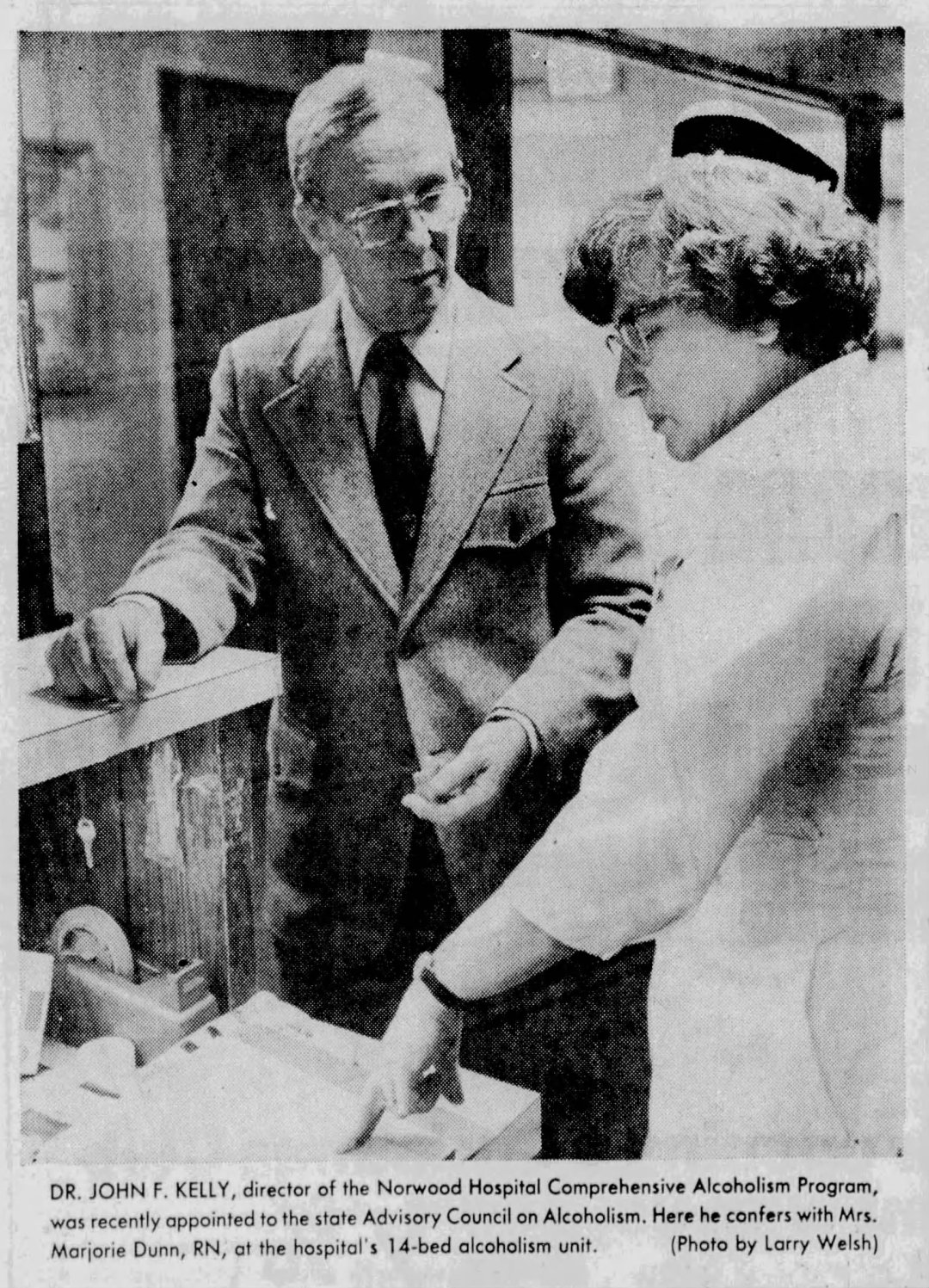
Appointed by Gov. Michael S. Dukakis to the State Advisory Council on Alcoholism, the Norwood Hospital Program Director Urges School Education and Family Therapy
NORWOOD – Alcoholism—what Dr. John F. Kelly called “this horrible disease”—was no longer an illness that society could afford to sweep under the rug, and as administrative director of the Norwood Hospital Comprehensive Alcoholism Program, Dr. Kelly was working to make it a priority of public concern through classroom education and expanded therapy. Featured in The Patriot Ledger on Friday, November 25, 1977, by staff reporter Nona Dearth—accompanied by a photograph by Larry Welsh showing Dr. Kelly conferring with Mrs. Marjorie Dunn, RN, inside Norwood Hospital’s 14-bed alcoholism unit—the report examined Kelly’s mission following his appointment by Governor Michael S. Dukakis to the Massachusetts Advisory Council on Alcoholism.
Bringing local clinical leadership to the statewide council, Dr. Kelly emphasized both the massive economic burden of alcohol abuse and its far deeper human toll. Nationally, alcoholism was estimated to cost American industry at least $8 billion annually in lost productivity through absenteeism, inefficiency, and workplace accidents, with 5 to 10 percent of the workforce experiencing an alcohol problem. Yet as Dr. Kelly noted, financial figures told only part of the story; the human cost in fractured families, broken homes, and lost personal pride was immeasurable. Across Massachusetts, roughly 300,000 individuals suffered from alcoholism—representing approximately one million residents when including family members needing support to rebuild their lives—a figure growing as teenagers and youngsters as young as the sixth grade increasingly turned to alcohol “for kicks.”
“To make any inroads into this problem of alcoholism, we have to get into primary prevention,” Dr. Kelly stated. “This means going into the schools, training teachers how to handle it, reaching the kids even down to kindergarten. It’s a very subtle program.” Alongside primary prevention in public schools, Kelly advocated vigorously on the state council for early intervention—reaching individuals with drinking problems and their relatives long before family life became unbearable. In doing so, he sought to dispel pervasive myths surrounding alcoholism, particularly the belief that a person had to “hit bottom” before stopping drinking.
“In 90 percent of the families that come to us at Norwood Hospital the alcoholic is still drinking and functioning to a degree,” Dr. Kelly explained. “But early intervention is not a question of just reaching the drinker but also reaching the family so they can cope with this horrible disease.” Whereas earlier generations of medical and social professionals focused almost solely on “treat[ing] the casualties,” Norwood’s comprehensive approach treated the physical and emotional injuries suffered by family members as an equally urgent priority. “Early intervention can prevent a lot of suffering,” Dr. Kelly observed. “But the long range effort has to be a decrease in drinking problems. You have to teach the youngsters the importance of responsible drinking, if they are going to drink.”
Although the 1973 decriminalization of alcoholism in Massachusetts had opened the door for the Advisory Council to introduce modern treatment programs, Dr. Kelly pointed out sharp funding constraints. For 1978, the council operated on an $8.2 million budget, with $5.8 million directed toward statewide detoxification centers—where patients remained for an average of three days to “dry out,” an approach Kelly warned held limited long-term value without a structured, family-involved outpatient program—and the balance funding halfway houses and similar facilities. Almost no funding remained for primary prevention after state officials turned down a $95,000 primary prevention request. “Compared to the taxes the state takes in on the sale of alcohol, what we get is peanuts,” Dr. Kelly commented. Despite the funding shortfall, having witnessed genuine rehabilitation among patients treated at Norwood Hospital’s 14-bed alcoholism unit through therapy and compassionate support, he remained optimistic and determined not to give up on conquering “this horrible disease.”
Source: The Patriot Ledger • Friday, November 25, 1977 • Byline: Nona Dearth • Photo: Larry Welsh
“In 90 percent of the families that come to us at Norwood Hospital the alcoholic is still drinking and functioning to a degree. Early intervention is not a question of just reaching the drinker but also reaching the family so they can cope with this horrible disease.”
| 1977 Public Health & Budget Figure | 1977 Amount | 2026 Equivalent |
|---|---|---|
| Estimated Annual U.S. Industrial Losses From Alcoholism | $8,000,000,000 | ~$42,400,000,000 |
| 1978 Massachusetts Advisory Council on Alcoholism Budget | $8,200,000 | ~$43,460,000 |
| State Allocation for Detoxification Centers (1978 Budget) | $5,800,000 | ~$30,740,000 |
| Rejected State Primary Prevention Program Request | $95,000 | ~$503,500 |
Archival Note: This article has been dynamically reconstructed from the original public record print archives of the Patriot Ledger
More Norwood Hospital Stories
-
One Hurt, 14 Flee As Flames Sweep Apartment And Business Block-This Day in Norwood History-October 23, 1944
One Hurt, 14 Flee As Flames Sweep Apartment And Business Block-This Day in Norwood History-October 23, 1944
-
Navy Plane Crashes In Norwood-This Day in Norwood History-August 5, 1944
Poet Coffin’s Son Parachutes to Safety in Norwood Crash Sun, Aug 6, 1944 – 15 · The Boston Globe (Boston, Massachusetts) · Newspapers.com NORWOOD. Aug. 5—A Navy fighter plane which exploded after developing trouble in its oil line and crashed a few yards beyond Winslow playground where 200 children were playing at noon today, was…

-
Norwood Hospital Women’s Aid Celebrates Twenty-Fifth Anniversary With Meeting at Day House-This Day in Norwood History-June 10, 1944
June 10, 1944-Norwood Hospital Women’s Aid Celebrates Twenty-Fifth Anniversary With Meeting at Day House The trustees of the Norwood Hospital, at a meeting held in April 1919 voted that an organization of women from Norwood, Walpole, and Westwood be formed as an auxiliary or aid to the hospital. In June of that year, the Norwood…
-
Hospital Handles More Cases in 1942-This Day In Norwood History-February 5, 1943
44% Of Patients Prove To Be Norwood Residents Topping all previous years in the number of cases handled, the total of 4066 individuals who were treated at the Norwood Hospital in 1942 was greater by 500 than the number treated in any other year, it was revealed in the annual report of Administrator Robert Brown…
-
Hospital Addition Opens On Weekend-This Day in Norwood History-December 25, 1942
Christmas—and Norwood and surrounding communities will this year get about as fine a Christmas present as could be. It comes beautifully packaged, too. To be sure the wrappings are not white paper and red ribbon with a touch of gay holly. They are more. The wrappings are the most modern, up-to-date hospital unit one could…
-
Skidding Autos, Coasting Injury Keep Police Busy-This Day In Norwood History-December 14, 1942
LABOR SHORTAGE SLOWS SNOW CLEARANCE Norwood Police Aid Family Of Eleven Escape In Dedham Fire Sub-freezing weather accompanied winter’s first onslaught In Norwood that left four inches of snow and brought out a depleted war-lime crew of snow shovelers to clean the streets. There were accidents reported to the police and early this morning the…

-
New Blood Bank Located In Basement Of Norwood Hospital-This Day In Norwood History-December 10, 1942
“Best In The Country” For Towns Of Same Size In one of the most progressive medical steps made In the town in years, a blood bank was completed at the Norwood Hospital yesterday and is ready for service, matching anything in the country for a municipality of comparative size. The bank came about as the…
-
Parade Marks Armistice Day-This Day In Norwood History-November 11, 1942
Veterans organizations Honor Dead Comrades Marching Units In Flag-Draped Streets Inspiring Spectacle Norwood, along with the rest of this warring nation, observed the 21th anniversary of the signing of the Armistice that put an end to World War I, while many of the onlookers at the parade yesterday morning are warriors of World War II…
-
New Emergency Ward Added To Hospital-This Day In Norwood History-September 25, 1942
New Emergency Ward Added To Hospital-This Day In Norwood History-September 25, 1942

-
Norwood Fireman John F. Lydon Dies at Controls of Ladder Truck-This Day In Norwood History-January 1, 1942
Fatally Stricken From Smoke Inhaled at Dwelling Blaze NORWOOD. Jan. 1—Stricken suddenly from smoke inhaled at a fire a short time previously. Ladderman John F. Lydon, 41, of 38 Press av., a member of the local fire department, died early today at the controls of a ladder truck as he was driving back to the…

Discover more from Norwood Historical Society
Subscribe to get the latest posts sent to your email.