
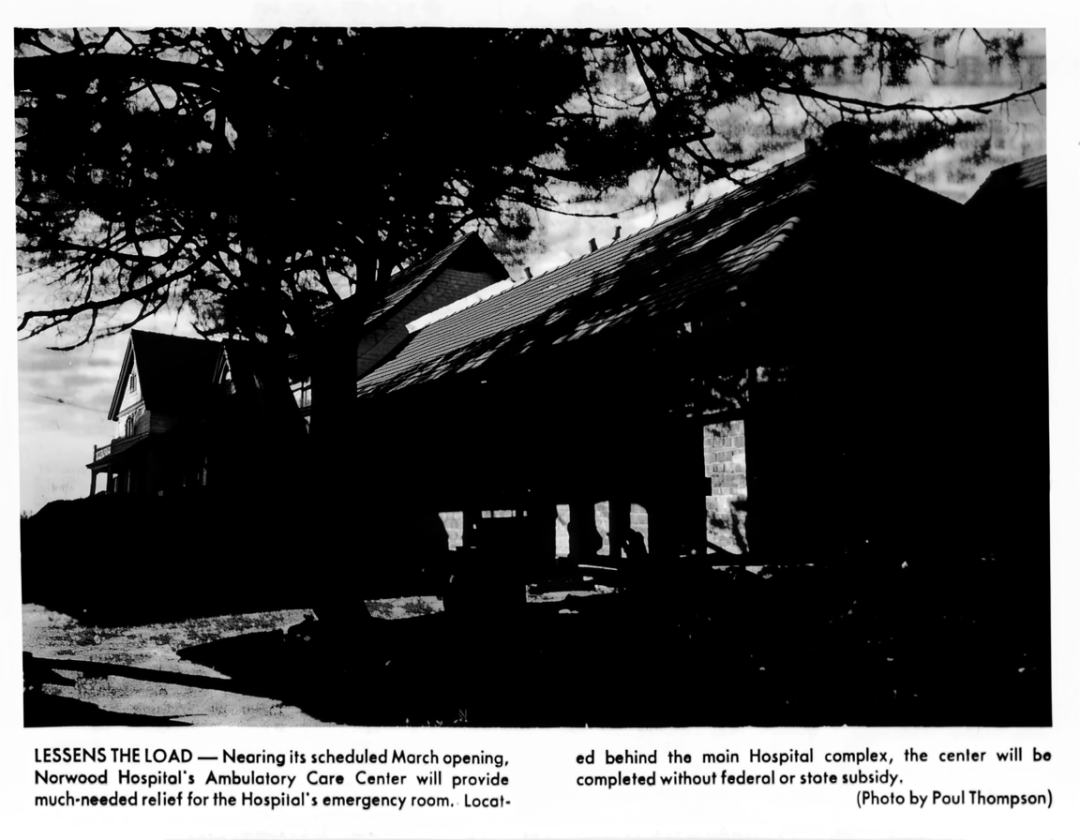
Locally Funded Two-Story Facility Will House Family Practitioners and Alcoholism Rehabilitation Unit to Ease Record 75,000-Visit Emergency Room Load
NORWOOD – Contractors were putting the finishing touches in November 1974 on a major new addition to Norwood Hospital designed to transform primary health care delivery across Norwood and surrounding communities. Reported by Patriot Ledger correspondent Kathy Salzberg on Monday, November 18, 1974, the two-story building—constructed between two wooden frame houses on quiet Linden Street behind the main hospital complex—was slated to house Norwood Hospital’s Ambulatory Care Center on its first floor alongside an alcoholism rehabilitation unit on its top floor when it opened early in 1975.
Built at a cost of $350,000 and designed by Norwood architectural firm Korslund, LeNormand and Quann, the facility was financed entirely without state or federal subsidies. Norwood Hospital Executive Director Charles A. Richardson described the center as a “home-grown product,” noting that seed funding came directly from the hospital’s development fund. Connected to the main hospital via a first-floor corridor and joined to the two hospital-owned wooden structures housing the nursing education department, personnel offices, and blood bank, the building had risen almost unnoticed behind the main complex—with hospital staff projecting construction readiness by January and Richardson targeting a March 1, 1975 opening date.
The facility was conceived by the hospital’s comprehensive health planning committee, appointed by the Board of Trustees four years earlier, to solve a pressing healthcare bottleneck: Norwood Hospital’s emergency room was on pace to treat a record 75,000 patients in 1974 alone, many of whom were using the emergency room as a substitute family doctor for routine colds, viruses, and minor ailments—creating long waits and standing-room-only conditions. Simultaneously, Norwood Hospital was establishing a satellite health facility in Foxboro staffed by family practitioners to relieve emergency room congestion there as well. (A November 26 hearing before the state Public Health Council was scheduled to secure a Certificate of Need for both the Norwood and Foxboro facilities after hospital officials had initially been misinformed that the step was unnecessary.)
Richardson explained that the new center would revive the traditional general practitioner model under modern “family practitioner” terminology—employing full-time hospital staff physicians who would not maintain private practices, addressing a severe shortage of primary care doctors amid rapid regional population growth. By shifting non-emergency cases into the ambulatory center, the hospital could deliver faster attention to true emergencies while freeing local medical specialists to focus on their specialties rather than routine primary care. Equally important for patients, Richardson projected an average ambulatory center visit cost of approximately $12.50—substantially lower than an emergency room visit, where patients faced separate charges from both the hospital and the attending physician. “It will greatly improve our health care delivery system,” Richardson enthused.
1974 Norwood Hospital Figures Adjusted to 2026 Dollars & Site Legacy
Inflation-adjusted using U.S. Bureau of Labor Statistics CPI data ($1.00 in Nov. 1974 ≈ $6.46 in 2026)
| 1974 Hospital Project / Patient Fee | 1974 Amount | 2026 Equivalent |
|---|---|---|
| Ambulatory Care Center Construction Cost (Linden St.) | $350,000 | ~$2,261,000 |
| Projected Average Ambulatory Clinic Visit Fee | $12.50 | ~$80.75 |
564 Questionnaire Responses Spur Meals-on-Wheels Planning, Geriatric Clinic Research, and Expanded Lenox Street Parking
NORWOOD – Transportation gaps, housing availability, property taxes, rising food prices, and nutritional support emerged as the top concerns of Norwood’s older residents in a comprehensive community survey conducted in November 1974 by the extended restorative care committee of Norwood Hospital. Reported by Patriot Ledger correspondent Kathy Salzberg on Monday, November 18, 1974, the six-member subcommittee of Norwood Hospital’s comprehensive health planning committee—chaired by hospital trustee Doris M. Heffernan—received an encouraging 564 completed questionnaires from Norwood seniors, prompting a parallel survey in neighboring Sharon to gather comparative regional data.
Heffernan noted that findings from the Norwood study were already being shared with town officials, church and civic organizations, and the Norwood Council on Aging, noting that “we are usually concerned with what happens to people after they receive acute medical care.” Several concrete community initiatives were already taking shape in response to the feedback:
- Nutrition & Meals-on-Wheels: Working alongside several Norwood churches, the committee was helping organize a local Meals-on-Wheels program, while Norwood Hospital’s dietary department offered individual dietetic counseling and prepared educational nutrition booklets for seniors.
- Geriatric Clinic & Walwood Facility: The committee was actively researching the feasibility of a dedicated geriatric clinic, though Hospital Executive Director Charles A. Richardson noted such a clinic would likely await completion of the hospital’s planned multi-million-dollar Walwood complex across the town line in Walpole in the 1980s.
- Senior Housing & Home Health Aides: Committee members studied Highland Heights in Fall River—a supervised medical apartment complex featuring wheelchair-accessible ramps, elevators, and adapted fixtures—and highlighted the work of Norwood’s visiting nurses (who billed on a sliding scale) alongside patient services director Louise Hankin’s push to recruit more students into the home health aide training course offered at the Henry O. Peabody School.
- Taxes, Referral Line & Parking: Researching local property tax relief, Heffernan noted that elderly abatements were available to residents over age 70 with assets of $40,000 or less and annual incomes of $6,000 or under. She also promoted Norwood Hospital’s new 24-hour Aid Line referral service (
762-1910), reported that new patient parking had recently been added on nearby Lenox Street, and noted that in response to a resident’s complaint about smoking in public spaces, Richardson confirmed Norwood Hospital no longer sold cigarettes and actively encouraged visitors to refrain from smoking.
Through the Council on Aging newsletter, Heffernan also alerted seniors to the hospital’s new Linden Street Ambulatory Care Center, while hosting guest speakers including Council on Aging Executive Director Patricia Arsenault and local physician Dr. Charles Lynch.
Archival Note: This article has been dynamically reconstructed from the original public record print archives of the Patriot Ledger
More Norwood Hospital Stories
-
Break Ground On New Norwood Hospital Unit-This Day in Norwood History-January 21, 1948
Norwood Hospital trustees after their meeting last week broke ground for the new $200,000 power plant which will be erected as part of the $400,000 expansion program of the hospital. Shown in the picture are (left to right): Arthur P. Allen, Guido Stuntzner, Robert Brown, Axel H. Anderson, Charles J. Prescott, Jr., and Dr. V.…

-
Norwood Historian, Willard “Win” Everett, Dies-This Day In Norwood History-November 9, 1947
Norwood Historian, Willard “Win” Everett, Dies-This Day In Norwood History-November 9, 1947
-
75th Anniversary Parade Seen by 20,000 in Norwood-This Day In Norwood History-November 1, 1947
75th Anniversary Parade Seen by 20,000 in Norwood This Day In Norwood History-November 1, 1947
-
9 Nurses Flee Norwood Fire Near Hospital-October 28, 1947
NORWOOD, Oct. 28 — Nine nurses were forced to flee from the Norwood Hospital Nurses Home at 5:25 tonight when a fire started on the first floor of the two-and-a-half-story wooden building. The home is attached to the hospital but the 300 patients were not disturbed. Flames were discovered in the walls of the first…

-
Aerial Photo of Norwood Hospital-This Day In Norwood History-October 3, 1947
Aerial Photo of Norwood Hospital-This Day In Norwood History-October 3, 1947
-
Norwood Hospital Benefits From Charles Smith Estate-This Day In Norwood History-August 29, 1947
This Day In Norwood History-August 29, 1947-Norwood Hospital Benefits From Charles Smith Estate
-
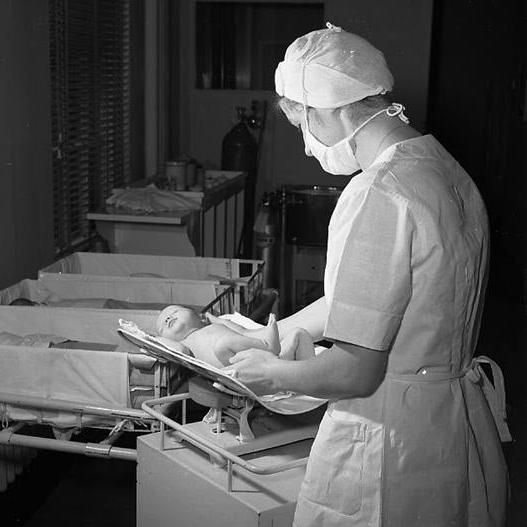
Norwood Hospital Crowded; Baby Sleeps in Drawer-This Day In Norwood History-February 27, 1947
NORWOOD, Feb. 27—A newborn baby had to be placed in a bureau drawer, and three others in incubators instead of bassinets because of overcrowded conditions at Norwood Hospital, its administrator, Robert Brown, disclosed here tonight. The stork, he said, has been doing a rushing business, bringing more new arrivals than the hospital has places to…
-
Morrill Memorial Library Extends Service To Norwood Hospital-This Day In Norwood History-April 29, 1945
The Morrill Memorial Library officially extended its reach beyond its stone walls and into the wards of Norwood Hospital.

-
First Sgt. Leonard J Masino Enjoys First Holidays Home In Four Years-This Day in Norwood History-December 29, 1944
After four years of overseas service, First Sgt. Leonard J Masino was able this year to spend the first Christmas during that tune with his parents. Mr. and Mrs. Michael Masino of 10 Park street. The long-awaited family reunion was not complete, however, because Leonard’s sister, Miss Arlene Masino, art supervisor of the East Hampton…

-
One Hurt, 14 Flee As Flames Sweep Apartment And Business Block-This Day in Norwood History-October 23, 1944
One Hurt, 14 Flee As Flames Sweep Apartment And Business Block-This Day in Norwood History-October 23, 1944
Discover more from Norwood Historical Society
Subscribe to get the latest posts sent to your email.