
Housing Authority Presses Scattered-Site Plans Amid Severe Neighborhood Real Estate Opposition
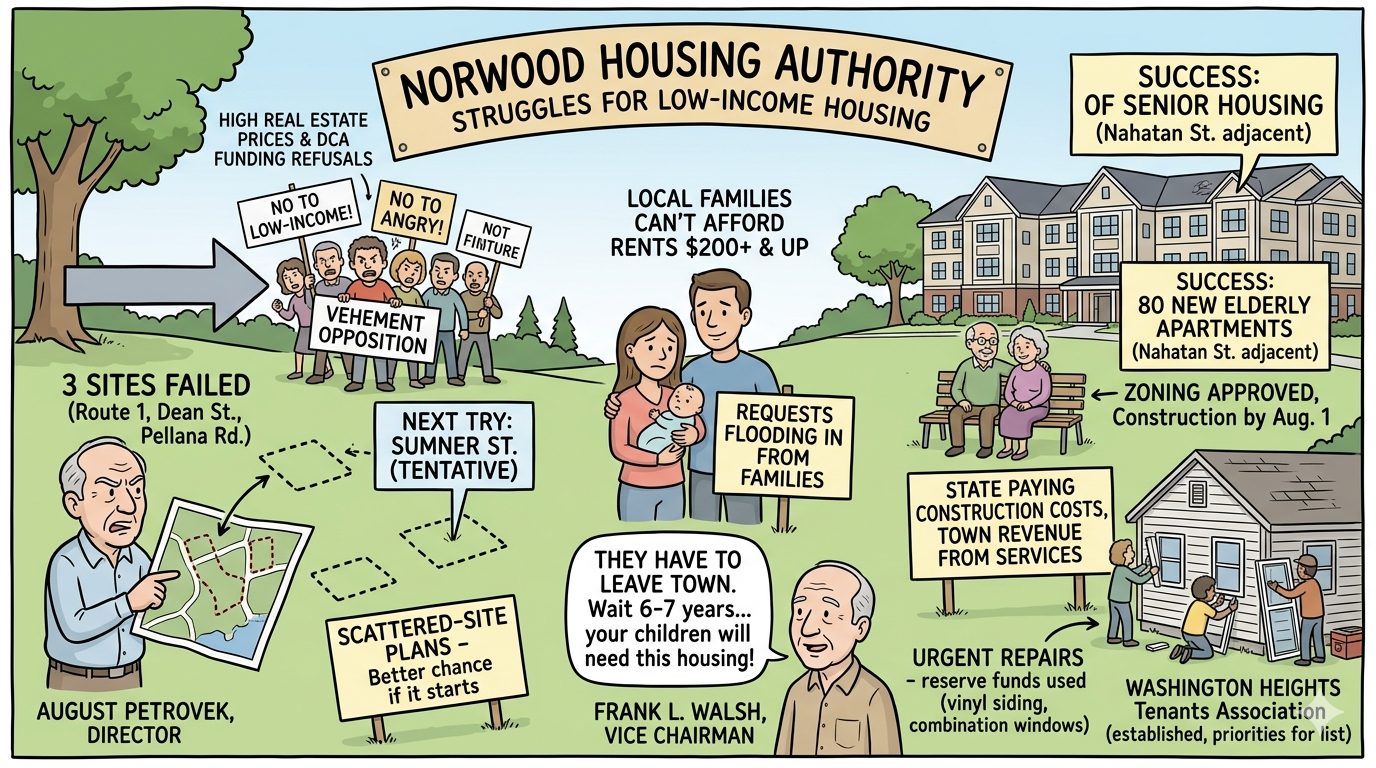
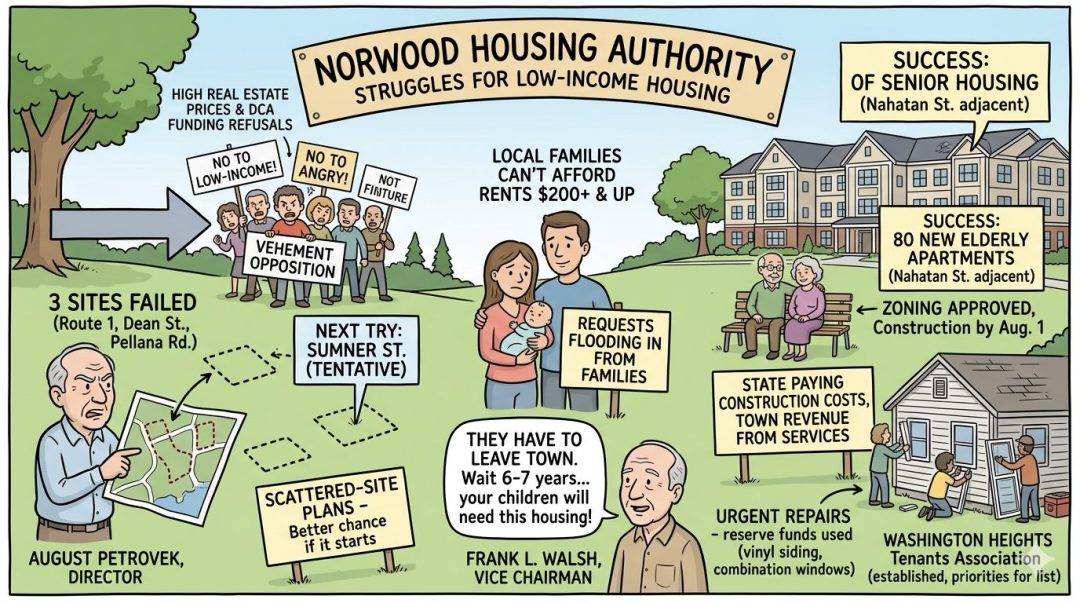
The Norwood Housing Authority has not abandoned hope of seeing low-income housing units developed in town, despite experiencing three consecutive failures in its search for a viable site. “Housing authority Director August Petrovek Jr. reported on the ongoing friction, stating, “We are still looking. We are very much interested in the program, but wherever we go we meet opposition.” Mr. Petrovek explained that the scattered-site development currently proposed by the authority would have a far better chance of public approval if the program could initially get off the ground. Scattered-site construction involves locating small numbers of low-income units on several separate pieces of property, as opposed to building one single, large housing project complex.
The housing board may next try to secure a location on Sumner Street, according to Mr. Petrovek, though he noted plans remain strictly tentative because land is at a premium in Norwood, and the state Department of Community Affairs (DCA)—the agency responsible for funding the housing program—might reject the property due to high price tags. Other possible sites previously evaluated on Route 1 and Dean Street were subsequently refused by the DCA as being too expensive for the program. The authority’s persistence has been driven by a continuous flood of requests for low-income housing from local families who are unable to afford current average house or apartment costs. “Housing authority vice chairman Frank L. Walsh observed the critical economic trend, noting, “Young couples are really up against it. Young people getting married don’t have a chance of finding housing. They just can’t afford rents that are $200 and up.” Mr. Walsh maintained that young couples caught in this severe financial bind have no choice but to leave town entirely. Ironically, Mr. Walsh predicted that the very same neighborhood residents who are now actively protesting the development of low-income units may find themselves asking for housing assistance in a few years, remarking that in six or seven years, their own growing children will be the ones having difficulty finding a place to live.
The most favorable public housing location, previously pursued in the Pellana Road area, was abandoned after 200 angry neighborhood residents vehemently stormed a meeting of the housing authority last June. Although housing authority executive director Lawrence J. O’Brien pointed out at the time that a much larger veteran’s housing project had already existed in the town for 20 years without adversely affecting adjacent property values, Pellana Road residents successfully pressed heavy tax and property value objections to defeat the plan.
Despite the uncertain status of low-income public housing, other senior construction projects have met with greater success in the community. With the approval of the necessary variances by the zoning board of appeals, the housing authority is proceeding with plans for an additional 80 apartments for the elderly, situated adjacent to the present senior complex on Nahatan Street. Architectural plans are currently being prepared by the firm William Nelson Jacobs Associates, and construction is expected to begin by Aug. 1, Mr. Petrovek reported. “Mr. Petrovek maintained that the town is actively gaining revenue through this senior project, noting, “The state is paying the entire cost of construction, but the town will service the inhabitants with electricity and things like that.”
Concurrently, while the authority has not yet received a formal funding decision from the state on its urgent request for $60,000 for building repairs at the Washington Heights veteran’s project, vinyl siding and combination windows are actively being installed there through the use of reserve funds. The newly formed Washington Heights Tenants Association, established in April to comply with state regulations requiring tenant participation as part of the modernization program, has not yet held a formal meeting, but some members are encouraging repair suggestions from residents. “They haven’t notified us about a meeting,” noted one association member, who was unsure of what duties were actually expected of the group. According to Mr. Petrovek, the tenant association’s structural responsibilities will be to collect complaints and repair requests from residents who formerly presented individual petitions to the housing board. “Mr. Petrovek explained the workflow, noting, “Tenants will bring complaints to the association which will meet periodically to draw up a list of needed repairs, indicating priorities.” Whether the newly organized group will meet once or twice a year or quarterly has not yet been decided, but Mr. Petrovek expects an official joint meeting with the housing authority will be arranged soon.
Archival Note: This article has been dynamically reconstructed from the original public record print archives of the Patriot Ledger
Discover more from Norwood Historical Society
Subscribe to get the latest posts sent to your email.