
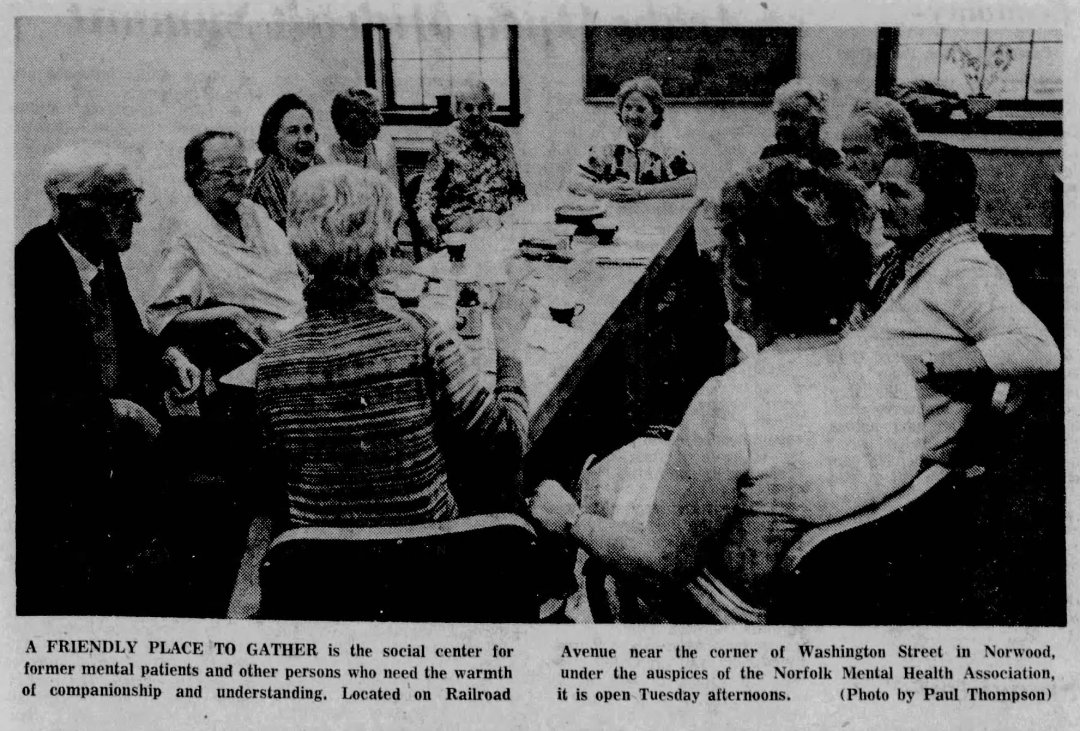
Grassroots Social Center Opens on Railroad Avenue to Support Deinstitutionalized Patients
Stepping in where bureaucratic red tape and slow-moving state agencies have lagged, local volunteers have successfully established a welcoming social center for former mental patients and isolated community members. Located in two modest, comfortably furnished rooms on Railroad Avenue near the corner of Washington Street—sharing quarters with the Massachusetts Rehabilitation Commission—the center provides a vital space for human connection and conversation.
The initiative was conceived and guided by Mrs. Polly O’Neil of Westwood, a volunteer aide at Medfield State Hospital and a board member of the Norfolk Mental Health Association. Prompted by a new state policy that accelerated the release of patients from state psychiatric hospitals without adequate community after-care facilities, Mrs. O’Neil saw an urgent void to fill.
“I think they were let out too fast,” Mrs. O’Neil observed, noting that former patients frequently wandered into welfare offices simply to be around other people. “There were instances of former patients going to welfare offices, not because they were on welfare, but simply because it was a place where they could go and be with other people.”
Collaboration and Community Support
With the backing of Norfolk Mental Health Association Executive Director Ralph Golding, Mrs. O’Neil secured the Railroad Avenue rooms. She was soon joined by Mrs. Anita Kingsbury of Medfield, a licensed practical nurse and former Foxboro State Hospital employee.
The center operates every Tuesday from 2:00 to 4:30 p.m., drawing more than 30 visitors a week. While games and refreshments—funded by a modest $12 monthly stipend from the mental health association—are available, socialization remains the primary focus. The center serves a diverse group, including senior citizens seeking companionship, alongside middle-aged former mental health patients ranging from their forties to sixties.
Organizers hope to expand operations to include an evening session each week, pending an increase in volunteer support. While the Norwood site primarily serves local residents, Mrs. O’Neil and Mr. Golding expressed readiness to help other towns replicate the model, proving that grassroots volunteerism can effectively bypass bureaucratic delays to support community mental health.
Archival Note: This article has been dynamically reconstructed from the original public record print archives of the Patriot Ledger
More…
-
Legionnaire’s Disease Case Confirmed-July 9, 1977
Discover how local medical professionals successfully identified and treated a rare case of Legionnaire’s Disease in 1977, confirming the effectiveness of erythromycin treatment.

-
23 Positive TB Tests at High School-June 26, 1974
A massive public health sweep down at the high school tags twenty-three cases for clinical follow-up after an initial custodian exposure scare.
Discover more from Norwood Historical Society
Subscribe to get the latest posts sent to your email.