


The proposed September opening of the new Junior High South in Norwood faced significant hurdles on the evening of July 11, 1974, as the building committee struggled to determine whether the facility would be ready for students by the start of the school year. The project, which aimed to end three years of double sessions for junior high pupils—who had been forced to attend the North School following the destruction of the old Junior High South by fire in January 1971—remained stalled by last-minute construction delays. Building Committee Chairman John J. Egan noted that the situation had devolved into a “guessing game,” with the committee weighing the possibilities of a delayed opening, continued double sessions, or partial occupancy of the $4.5 million facility.
According to Superintendent Theodore J. Beaudet, the primary obstacles involved the heating control and electrical systems. While Beaudet expressed optimism that the school could be occupied by the start of the term even if sections like the cafeteria and industrial arts area remained unfinished, he emphasized that completion was contingent upon the delivery of essential materials within the next two weeks. Architect James McGrath reported frustrations in coordinating with the Canton-based subcontractor responsible for the heating units, noting that previous assurances of delivery had been thwarted by the absence of key personnel. “We have no hold on them at all,” McGrath stated, highlighting the lack of control the committee had over the supply chain.
In response to the mounting pressure, the building committee took several corrective actions. They mandated that the construction superintendent be reassigned to the project on a full-time basis, reversing a previous decision to reduce his status to part-time. Furthermore, committee member Richard W. Kief successfully moved to have the architects and the general contractor, Rocheford Construction Co., immediately visit the Canton subcontractor to expedite the delivery of parts. The committee also requested that the architects consult with the state building inspector regarding the feasibility of obtaining a temporary occupancy permit, seeking to distinguish between “mandatory” requirements and flexible building standards.
As the committee scrambled to ensure the school’s opening, secondary issues regarding the site’s development emerged. Recreation Superintendent Robert H. Ivatts complained about the installation of a broken gate near the Hawes Pool area, which had reportedly been damaged by children. Additionally, committee member Ernest G. Paciorkowski raised concerns about the state of the landscaping, noting that ball fields at the rear of the property remained bare and had not been properly seeded. With the opening date fast approaching, the committee remained under intense pressure to navigate these complex logistical snags and fulfill the promise of a functional junior high facility for the town’s students.
Archival Note: This article has been dynamically reconstructed from the original public record print archives of the Patriot Ledger
-
Proposal Would Combine High School and Henry O. Peabody School Facilities-October 4, 1973

The School Committee reviews a preliminary proposal to combine Norwood High School and Henry O. Peabody School facilities for a new career development and vocational program.
-
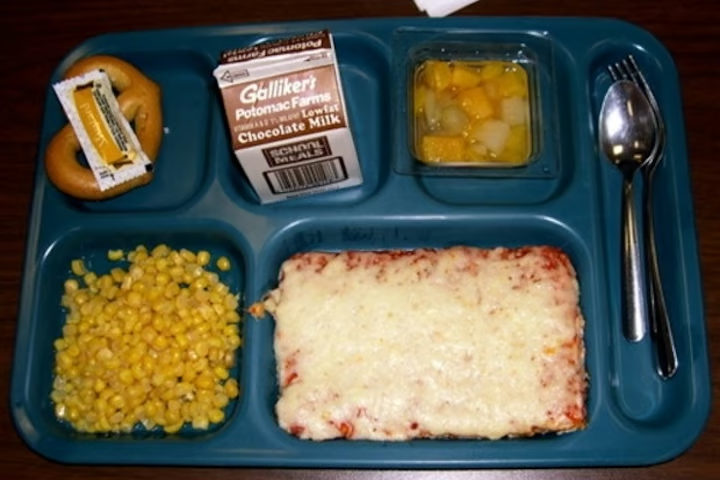
Public Schools Face Delays and Possible State Action on Mandatory Hot Lunch Program-August 31, 1973

Parents of elementary school students in Norwood will need to continue packing brown-bag lunches for the start of the academic year. School Superintendent Philip O. Coakley announced that the town will fail to meet the state-mandated September deadline for implementing a universal public school hot lunch program, exposing the municipality to potential legal action by…
-
Norwood High School Refines Open Campus Program in Second Year of Operation-October 2, 1972

Entering its second year, Norwood High School’s open campus system sees tighter corridor rules, sophomore restrictions, and expanded academic seminars while undergoing state-mandated evaluation.
-
Andy Scafati Recalls 40 Seasons in Athletics Ahead of Norwood Retirement-September 7, 1972

Longtime Norwood High School athletic director Andy Scafati reflects on 40 years in sports and the remarkable expansion of the town’s athletic programs as he prepares to step down.
-
School Board Reverses Vote, Keeps NorWest Woods Pupils at Oldham-August 29, 1972

In a reversal of a previous decision, the School Committee has voted to keep 46 elementary school children from the Nor-West Woods apartment complex at the Oldham School, rescinding a July 5 vote that would have transferred them to the Shattuck School. Superintendent Dr. Philip O. Coakley explained that the committee revoted on the matter…
-
Norwood Sets $38 Tax Rate on Court-Ordered 100% Property Valuation for 1972-August 16, 1972

Announcing a 1972 tax rate of $38 per $1,000 under a court-ordered 100 percent property valuation, Assessor Chairman James J. Drummey concluded a major reassessment by Cole, Layer and Trumble.
-
Norwood Jr. High Offered Land At $9,500 An Acre-September 30, 1971

The Norwood School Committee recommends the Endean area in Walpole as the site for a new junior high school, facing sharp questioning from town meeting members over rising costs and site shifts.
-
Norwood High School Launches Innovative Open Campus Plan for Fall Term-September 8, 1971
Norwood High School opens the fall term by launching an innovative open campus and extended-day program designed by Principal John F. Monbouquette to foster student responsibility.
-
Junior High Alternate Estimates Sought-June 25, 1971

A sharp debate divides Town Manager Walter Blasenak and finance officials over mounting unappropriated architectural fees for Boston design firms.
-
Schools Face Heating Oil Shortage for Upcoming Winter, While Band Camp and Library Art Programs Make Headlines-August 6, 1970

Superintendent Dr. Philip O. Coakley informed the Norwood School Committee that no companies submitted bids to supply 110,000 gallons of No. 5 heating oil for town schools due to quotas, shortages, and environmental regulations.



Discover more from Norwood Historical Society
Subscribe to get the latest posts sent to your email.