
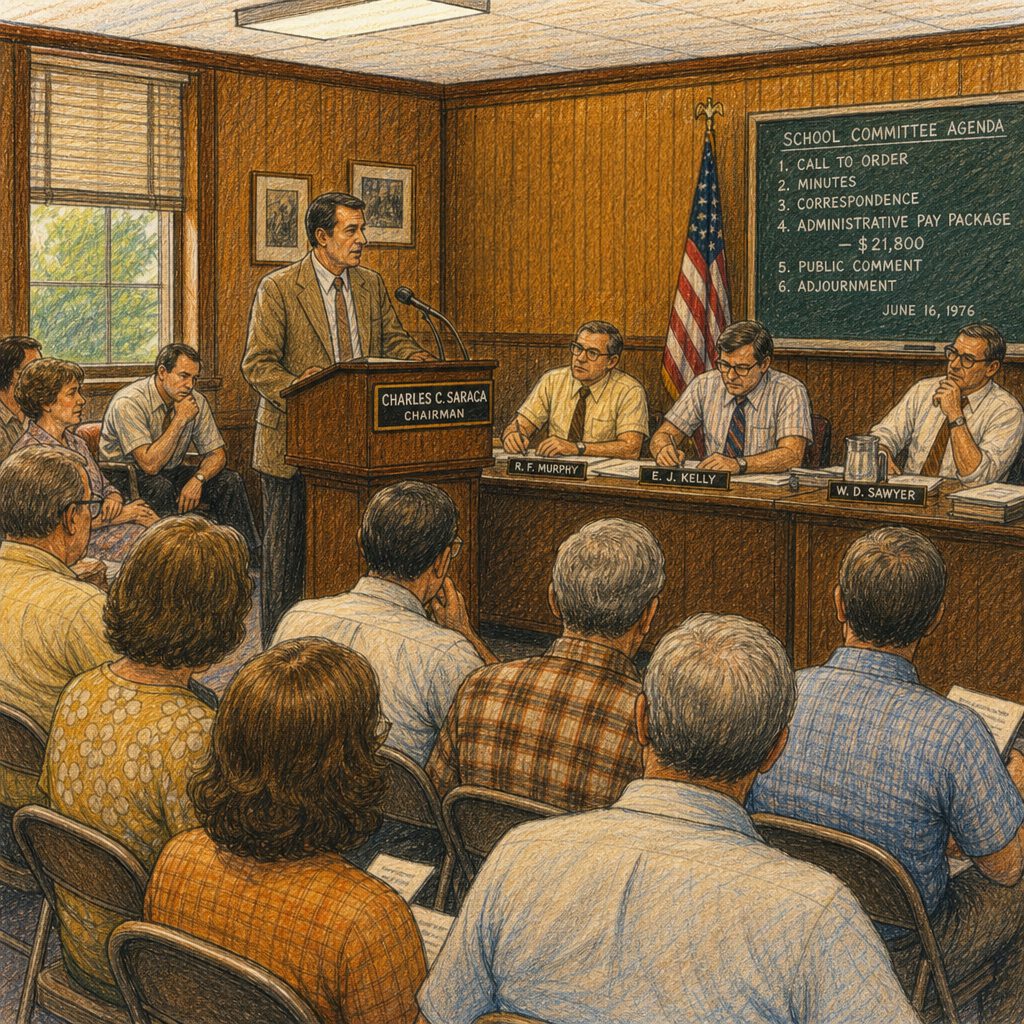
School Committee Seeks to Reintroduce $21,800 Administrative Pay Package at Special Town Meeting
The decision of the Norwood School Committee to reintroduce its administrative pay package at the June 25 special town meeting was defended last night by Charles C. Saraca, chairman. Mr. Saraca said the committee was forced to do this because of contractual agreements already signed by administrators and committee members. He also said that “confusion reigned” at the May 16 session of the annual town meeting that saw the pay plan go down to defeat and a seven per cent pay hike substituted. At the session, Robert B. Bulger, a member of the town’s finance committee, said the proposed pay-hike plan was about 15 per cent over the present scale.
Mr. Saraca last night told some 30 persons attending a public hearing on the decision of the committee to seek reconsideration that “perhaps reconsideration would not now be needed” if the public had been properly informed of negotiations. He said the “closed sessions called for under the collective bargaining law” prevented the public from knowing the facts behind negotiations. Mr. Saraca said the decisions of school committees favoring closed sessions, his own included, hindered the work of the bargaining agents. As a result of the closed sessions, town meeting members were forced to react to a pay plan that was disclosed to them “on a given night.” Town meeting members in Norwood, for example, resented the need for an “instant decision” aground the pay plan that “evolved over countless meetings and many hours” by the school committee.
The committee will ask town meeting at the special session to appropriate $21,800 to meet the difference in the salaries agreed to by the committee in negotiations with 15 administrative personnel. The chairman said that the wage hikes recommended by his committee for administrators were based on wages paid similar personnel in comparable communities. Administrators are paid on a ratio basis set above the $11,800 maximum paid Norwood teachers with a master’s degree. He said the system of paying administrators on a rate above the master’s maximum had evolved in most communities as the most equitable, “recognizing the added responsibilities and expenditure of time” of such administrators over regular teachers.
In addition to assuming the responsibilities inherent in the positions, the administrators work a full 11-month schedule, as opposed to the 38-week schedule contracted by teachers, Saraca said. He warned that teachers and administrators alike in the teaching field are bent on increasing their salaries and said, “For a $200 raise some of them would travel 200 miles additional” a week. The town must be competitive in salaries for both teachers and administrators if it is to maintain “quality education,” he said.
Administrators in Norwood were at the bottom of the listing of Massachusetts communities last year and about the middle of the group this year in terms of salaries, he said. Confusion on the pay bill voted at the annual session also persists, according to the committee chairman who noted that the raise was retroactive for other town employes but, in its letter-ing, appears to become effective for administrators as of September of this year, the date of their new contract. Mr. Saraca, who set the $21,800 addition “as a paltry figure” in the overall $5 million school budget already approved by town meeting, called for restoration of the funds agreed to by the committee so that the committee could meet its contractual obligation.
He also said that his committee’s obligation was “to decide what was needed for our schools” and to act accordingly. The school board’s concern should not necessarily be “concern for the tax rate.” The town is faced with an impending tax hike estimated at $18 over the present $76 per $1000 assessment. Dr. Philip O. Coakley, school superintendent, joined the chairman in arguing for higher pay hikes for administrators. He noted that his pay was not dependent on future town meeting action on the administrative pay raise since he and two assistant superintendents contract on an individual basis with the committee. He said “in today’s market” for administrators, “$15,000 is not too much for an elementary school principal” to expect. A junior high school principal can demand $17,400 and for a senior high school principal “$20,000 is not an unrealistic figure.” In Norwood, none of the principalships carry that kind of money, he said.
Archival Note: This article has been dynamically reconstructed from the original public record print archives of the Patriot Ledger
Discover more from Norwood Historical Society
Subscribe to get the latest posts sent to your email.