
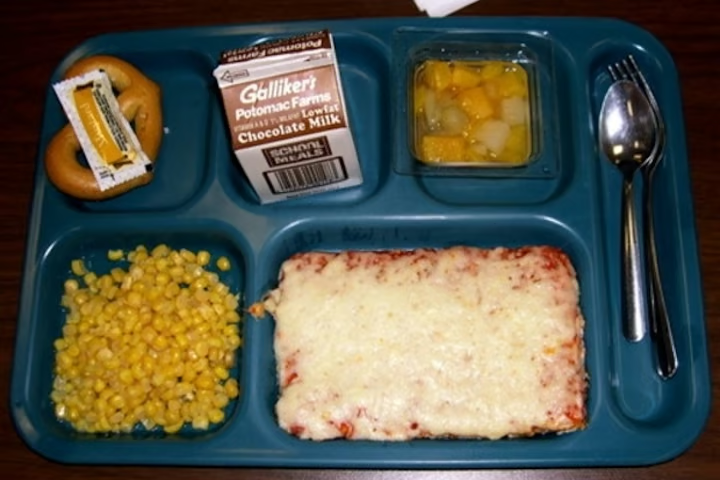
Parents of elementary school students in Norwood will need to continue packing brown-bag lunches for the start of the academic year. School Superintendent Philip O. Coakley announced that the town will fail to meet the state-mandated September deadline for implementing a universal public school hot lunch program, exposing the municipality to potential legal action by the state attorney general’s office.
Supply Delays and Administrative Hurdles
The system-wide lunch initiative—which relies on a satellite system centered at the Balch School, equipped with a walk-in freezer and heating ovens to ferry ready-to-serve meals to other facilities—has stalled due to supply chain issues. A Rhode Island-based firm contracted to supply ovens and refrigerators has experienced severe manufacturing and delivery delays, while the town has yet to officially award a contract to a food service vendor to supply the prepackaged meals.
School Committee Chairman Rudith M. Berkowitz expressed surprise at the equipment delay, speculating that labor strikes or overwhelming regional demand might be to blame. She noted that because the town manager serves as the municipal purchasing agent, the school committee has faced disadvantages in tracking contract bids, despite having completed specifications well before the special town meeting in May appropriated $115,000 for equipment and a transport truck (with 75 percent reimbursable by the federal government, netting a town cost of $29,000).
State Refuses Extensions and Threatens Legal Action
Under a 1970 state law mandating public school lunch programs, John Stalker, food services director for the State Department of Education, stated that the statute contains no provisions for waivers or deadline extensions. Because the law sets a general September target, the department established September 30 as the strict cutoff point.
Stalker warned that names of all non-compliant towns will be forwarded directly to the attorney general’s office for potential legal action. Citing the precedent set with Boston the previous year, Stalker noted the attorney general could threaten a lawsuit or force tardy school systems to purchase cold lunches from outside caterers. Superintendent Coakley confirmed he requested an extension from the state but has received no response.
While existing hot lunch programs at the Senior High School, Junior High North, and Callahan School will resume when classes start on Wednesday, seven elementary schools must wait:
- Winslow School
- Oldham School
- Shattuck School
- Balch School
- Willett School
- Cleveland School
- Prescott School
When asked if parents would be notified of the delay before Wednesday, Chairman Berkowitz remarked, “I hadn’t thought of that. It might be a good idea,” though she expressed belief that most families anticipated packing lunches anyway.
Anticipated Milk Price Hike
Adding to family expenses, Norwood school children who bring lunches from home may face a steep 6-cent increase in the price of milk, jumping from 4 cents to 10 cents per half-pint container. Chairman Berkowitz indicated the hike is driven by rising supplier costs and congressional delays in reauthorizing federal food subsidies, which under current House versions remove price supports for a la carte milk. For a family with two children buying milk daily, the increase would raise annual milk costs from $14.40 to $36.00—or up to $72.00 if recess milk is included. Furthermore, soaring food costs and static federal meal subsidies are forcing Norwood to explore cost-saving measures to preserve the current 30-cent school lunch price.
Archival Note: This article has been dynamically reconstructed from the original public record print archives of the Patriot Ledger
More…
-
Taxpayers Sue to Restore School Budget-July 6, 1978
Seeking to prevent a mid-summer school closure, 36 Norwood taxpayers filed a lawsuit in 1978 to restore $600,000 in education funding.

-
Town Requests Bids for Audio-Activated Alarm System Trial at George F. Willett School-August 31, 1977
Seeking proactive solutions to combat recurring vandalism, the town manager’s office has officially requested bids for furnishing and installing an advanced audio-activated alarm system at the George F. Willett School on Westover Parkway. Trial Security System Specifications According to municipal procurement notices, sealed bids will be publicly opened at 11:00 a.m. on September 14 in…

-
Public Schools Announce 1977-78 Opening Schedules and Projected Enrollment of 5,842 Students-August 31, 1977
Superintendent of Schools Philip O. Coakley has officially announced that all Norwood public schools-covering grades 1 through 12, alongside special education classes-will open for the 1977–78 academic year on Wednesday, September 7. Registration is open daily in each school building from 9:00 a.m. to 3:00 p.m. ahead of opening day, with classrooms prepped for an…

-
State Cites Nine Deficient Areas in Norwood Special Ed-August 16, 1977
A state Department of Education audit of Norwood’s Chapter 766 special education program cited nine minor compliance issues while praising overall staff commitment and progress.

-
Norwood Zeroes In On School Vandals-August 3, 1977
A newly formed blue‑ribbon security committee convened to confront a surge of costly vandalism at Norwood’s public schools. Members reviewed structural, technological, and community‑based deterrents while assigning formal research duties for a comprehensive townwide response.

-
Norwood School Committee Seeks Field Trip Funds and Awards Bus Transportation Contracts-July 29, 1976
Facing budget cuts that eliminated student field trips, the Norwood School Committee voted to appeal to the Finance Commission and special town meeting for restoration funds.

-
Norwood Board Rejects Blue Hills Collaborative-July 29, 1976
The summer of 1976 was a time of great change and uncertainty for the town of Norwood, Massachusetts. As the nation celebrated its bicentennial, local residents were grappling with issues of education, finance, and community involvement. One such issue that dominated the headlines in July 1976 was the proposed Blue Hills Collaborative, a vocational school…

-
Norwood Faces Fiscal Crunch Under Chapter 766 Special Education Mandates-August 28, 1975
School officials report that Norwood’s special education program faces a funding shortfall under state Chapter 766 mandates, prompting legal review and contract awards.

-
Norwood School Committee Approves Balch School Remedial Class and Eight-Period High School Day-July 31, 1975
The Norwood School Committee approved a pilot transitional first grade and modified kindergarten at Balch School to address kindergarten screening results and language needs.
-
School Committee Approves Shortened High School Day Format-July 16, 1975
The school committee of Norwood last night all but formally approved a switch to a shorter, eight-period day for the high school. The decision was made in response to a request from absent member Richard Joseph, who asked that the board defer its official vote on the plan until its next regular meeting in two…


Discover more from Norwood Historical Society
Subscribe to get the latest posts sent to your email.