Recalls Big Band Days
If anybody is interested in a nostalgic session talking about the good old days when the big bands held sway across the country, veteran musician Jack Adams is the man to talk to.
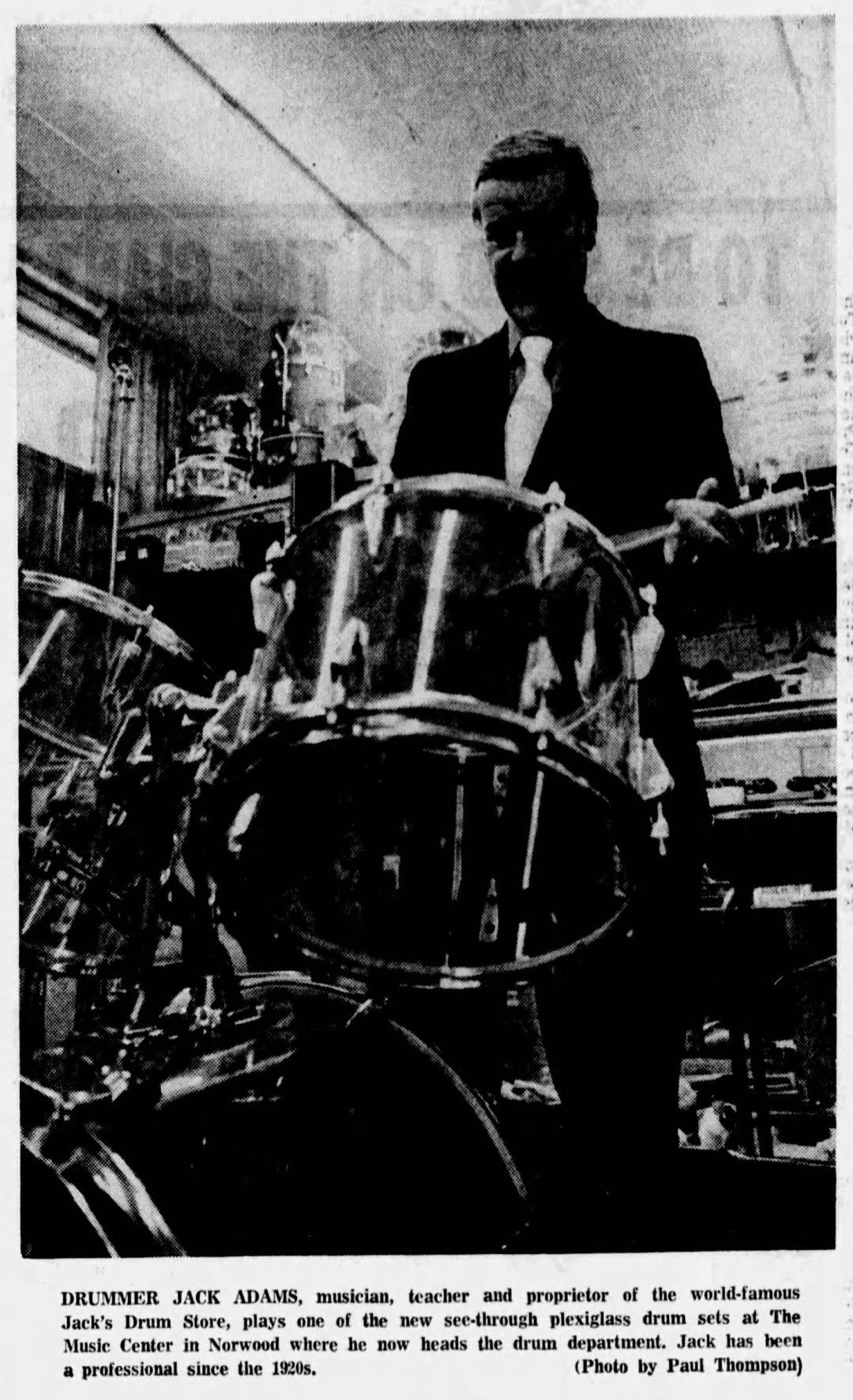
A professional drummer since the 1920s and the renowned owner of the world-famous Jack’s Drum Shop in Boston for 26 years, Adams is now taking life a little easier while heading the drum department at The Music Center located at 638 Boston-Providence Highway (Route 1) in Norwood.
Still Playing Gigs and Mentoring Students
Despite settling into his new role in Norwood, Jack still actively plays professional gigs and teaches private students. Of course, he is also still supplying professional-grade drums and drum accouterments to the biggest names in the business as well as to eager beginners stepping behind a kit for the very first time.
His personal friend group and professional associates comprise an absolute roll call of percussion legends: Buddy Rich, Shelley Manne, Elvin Jones, Louis Bellson, Gene Krupa, Philly Joe Jones, Max Roach, and Jo Jones of Count Basie band fame.
Jack notes that his favorite drummer and close personal friend is Buddy Rich, though he quickly adds, “Bellson is one of the greatest. I have many favorites. Each great drummer has his own distinctive style.” He vividly recalls hosting clinics and exhibitions at his Boston storefront, noting, “Most of them played in my store, putting on exhibitions for drummers who came in.”
Appreciation for Modern Rock and Exceptional Coordination
Given his deep roots in the classic swing era, what does Jack Adams think about today’s contemporary rock music?
“My thing is the big band, but I like good rock,” he says candidly. “Rock drummers have tremendous coordination. They have to have it.”
Adams points to powerhouse contemporary rock drummers such as Danny Seraphine with Chicago, Billy Cobham, Ginger Baker, and Charlie Watts with the Rolling Stones, emphasizing that “they can hold their own with any drummers.”
While rock music is undeniably valid, exciting, and here to stay, Adams admits, “I definitely feel nostalgia for the big band days. I would love to see the big bands come back.” He finds minor encouragement in the observation that modern clubgoers are beginning to dance together again instead of taking up isolated positions on the floor and going separate ways to the music.
Reminiscences of New England’s Golden Era of Swing
Though there are occasional calls for dance bands larger than a standard trio or quartet—and those requests are slowly increasing—Adams doubts the golden age of big bands that thrived through the 1940s will ever truly return. Those were, without a doubt, the good old days.
“I played with all the groups out of New England,” Jack recalls, launching into a nostalgic binge of legendary bandleaders: Tony Bruno, Jack and Harry Marshard at the Oval Room in the Copley Plaza, Rannie Weeks, Ruby Newman, Sammy Eisen, Larry Green, Mal Hallett, Al Donahue, and Jimmy McHale. They played all the major regional hotels, exclusive nightclubs, posh country clubs, and society galas.
“Remember the Latin Quarter, the Westminster Roof, the Brown Derby? The big splash at the Myopia Hunt Club?” he asks. “My favorite gig was with Harry DeAngelis at the Rio Casino back of the old Bradford Hotel.” (Harry DeAngelis has continued fronting the house band at the Monticello in Framingham for several years now.)
The reminiscences pile up effortlessly. “I used to go to the Back Bay station to meet the Paul Whiteman band and help drummer George McDonald get out to Nutting’s on the Charles.” Both Paul Whiteman and the legendary Nutting’s on the Charles ballroom are long gone. “In the late 1920s, I sat in with McKinney’s Cotton Pickers, an all-black group. What a great band that was.” Vintage recordings of McKinney’s Cotton Pickers remain treasured collectors’ items today.
“And I sat in with Sabby Lewis at the old Savoy on Massachusetts Avenue.” That memory brings back reflections on the safer, simpler days in Boston’s historic jazz districts. “In those days you could wander from place to place listening to jazz, eat at the old Slade’s restaurant on Tremont Street near Mass. Avenue until three o’clock in the morning and not worry about the neighborhood.”
Recalling the sheer energy of dance hall promotions, Jack shares another classic story: “We used to play check dances. They would buy a ticket for each dance—10 cents a dance. The idea was to sell a lot of tickets. We’d play three fast choruses and off they’d go.”
As he looks back across half a century behind the drum kit, one cannot help but wonder what today’s music fans will be remembering 25 years from now.
Archival Note: This article has been dynamically reconstructed from the original public record print archives of the Patriot Ledger
-
Wonderful Women (or Girls) of Norwood-The Norwood Debonnaires
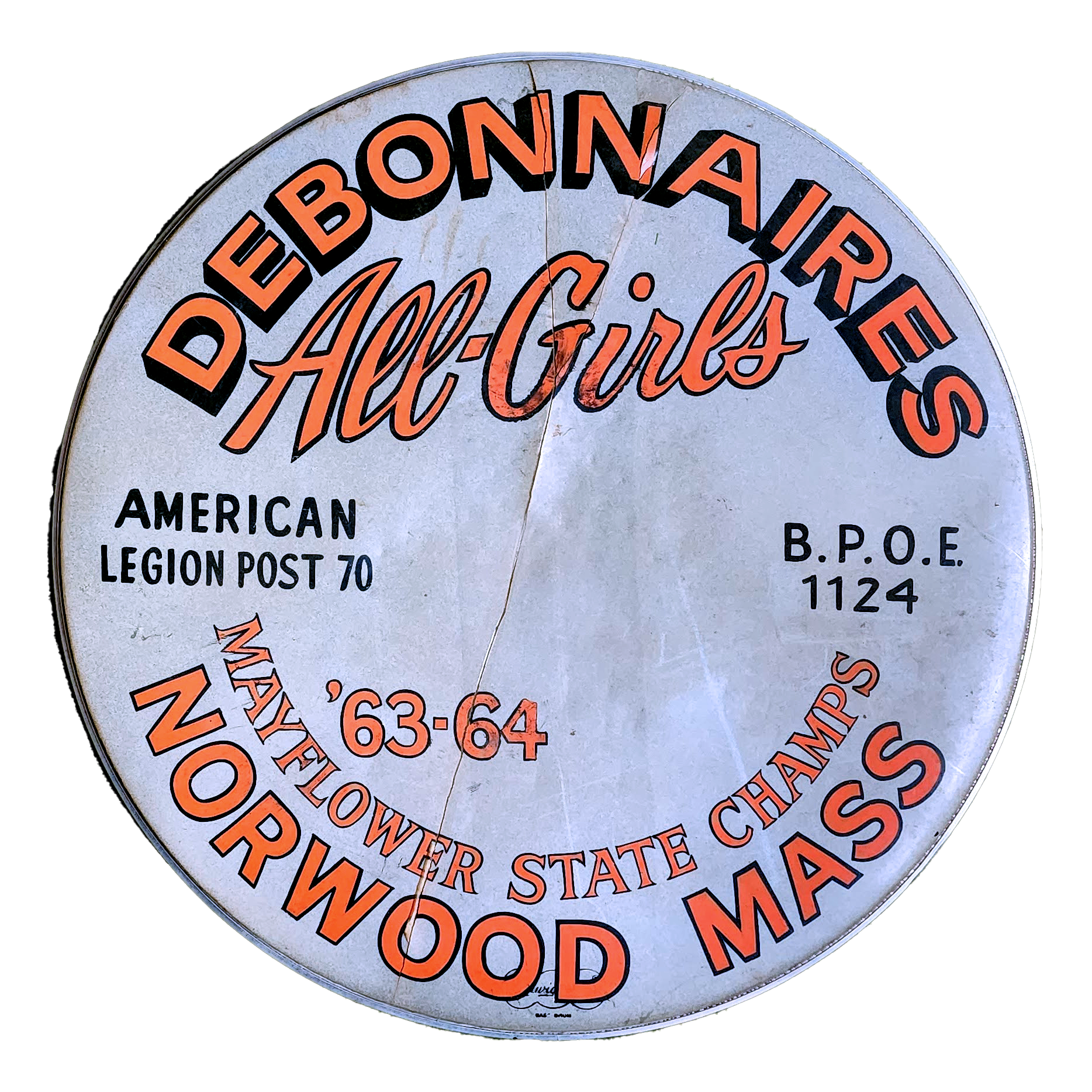
Wonderful Women (or Girls) of Norwood-The Norwood Debonnaires
-
J. Stearns Cushing Pens Letter In Support of Norwood Brass Band-This Day in Norwood History-May 20, 1899

This Day in Norwood History-May 20, 1899-J. Stearns Cushing Pens Letter In Support of Norwood Brass Band
-
History of the First 25 Years of the Norwood Brass Band-This Day in Norwood History-May 31, 1891
Striking up the band! Published in 1891, this retrospective looks back at the first 25 years of the organization known today as the Norwood Brass Band. From its humble 1866 beginnings at the South Dedham engine house to playing Boston’s St. Patrick’s Day parades and purchasing $50 uniforms, discover the evolution of a local musical…
Discover more from Norwood Historical Society
Subscribe to get the latest posts sent to your email.