

Italian spaghetti? Irish stew? Kosher pickles? German hot dogs? Swiss cheese? Hawaiian pineapple? French-fried potatoes? Danish pastry? Chinese chow mein?
It sounds like the exotic menu of a high-end international restaurant, but it actually reflects the diverse offerings served up in school cafeterias across the nation as President Lyndon B. Johnson proclaims National School Lunch Week. The annual observance is designed to promote public awareness of the national school lunch program’s profound value to children, families, agriculture, industry, and the country as a whole.
Still the Best Bargain Around
Established in 1946 in the wake of World War II to safeguard children’s health and encourage the consumption of domestic agricultural goods, the school lunch remains the ultimate bargain for students. While a balanced meal costs between 50 and 55 cents to prepare, it is priced for students at just 25 to 30 cents.
Members of the modern “Now generation” who might otherwise attempt to survive on a chocolate candy bar, a bottle of soda, and a bag of potato chips instead receive one-third of their minimum daily nutritional requirements right in the school cafeteria.
“Training in nutrition and proper food habits is a major factor in the development of the child,” points out Mrs. Lois M. Carley, cafeteria supervisor for the Needham Public Schools.
Local Cafeteria Operations and the Power of Pizza
Across neighboring towns, school lunch programs report enthusiastic participation:
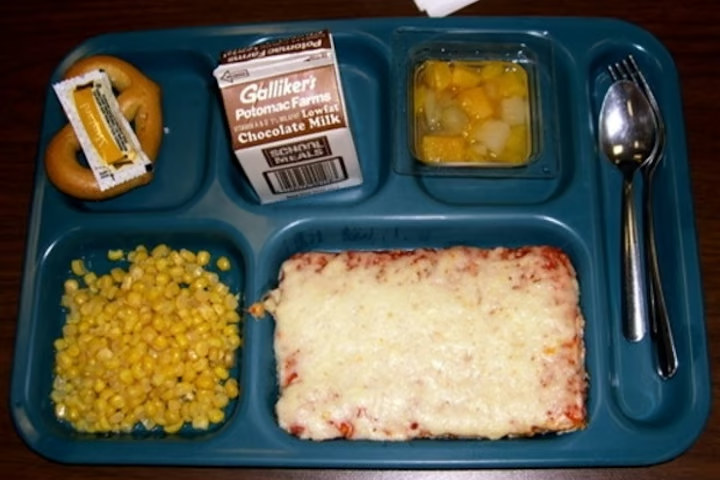
- Norwood: Norwood school lunch supervisor Mrs. Madlynne Connolly notes that children are “notoriously poor eaters in the morning.” To counter this, the town provides a nutrition-packed hot lunch. Charging just 25 cents per meal (while most surrounding towns charge 30 cents), Norwood serves hot lunches at the high school and the Callahan Elementary School. During September, an average of 934 students purchased lunches daily. However, Mrs. Connolly points out one notable exception: on days when pizza was featured as the main course, lunch sales surged to 1,384 hungry fans. Excluding labor costs, the town subsidized the program by only $30 a week to keep it running smoothly.
- Needham: Students take full advantage of the hot lunch program, with 597,349 meals and 970,517 pints of milk served last year.
- Westwood: Going a step beyond lunch, Westwood introduced a student-council-backed breakfast program served between 7:00 and 7:30 a.m. Out of 2,900 students, over 2,000 purchase the 30-cent hot noon meal. Cafeteria supervisor Miss Margueritte Knight reports favorites ranging from pizza to submarine sandwiches, with 32,000 hot lunches and 53,000 bottles of milk sold last month alone.
- Medfield: Supervisor Mrs. Irene Todd notes growing participation, with more than 1,350 of the town’s 2,185 students buying lunch daily, helping children’s nutrition and assisting parents pressed for time in the mornings.
- Wellesley: Students enjoy a choice between a complete hot meal for 30 cents or a soup, salad, and sandwich combination for 35 cents, with nearly 2,500 daily sales. Over 150 students also buy a la carte breakfasts featuring cereal, juice, milk, hot chocolate, doughnuts, or Danish rolls.
- Dedham: Supt. James Dunne reported a sharp drop in lunch sales due to double sessions at Dedham High School, which forced high schoolers to stay late and junior high afternoon students to arrive early—slashing daily sales from 1,200–1,300 down to roughly 450–500 on a good day.
Archival Note: This article has been dynamically reconstructed from the original public record print archives of the Patriot Ledger
-
Willett School Overcrowding And Parent Protests-September 5, 1974

Angry parents confront the Norwood School Committee over severe overcrowding at the Willett School, while officials address elementary enrollment spikes and pedestrian safety.
-
Youth Enriched at Summer School-August 13, 1974

Directing over 600 local students, Norwood’s public summer school program completed its 30-day session, highlighting strong popularity for enrichment classes in arts and trades alongside vital remedial and special education tutoring.
-
Norwood School Committee Votes to Relocate School Administration Offices-August 1, 1974
The Norwood School Committee voted 5-2 to relocate central school administration offices to the Winslow School, pending cost estimates from Superintendent Philip O. Coakley.
-
Uncertainty Looms Over Norwood Junior High South Opening Date-July 12, 1974

After three years of double sessions following a 1971 fire, Norwood officials faced the possibility of further delays for the new Junior High South.
-
Unfinished Junior High To Open On Schedule-July 8, 1974

Discover the construction history of the $4.5 million Junior High South project in 1974, detailing the challenges faced during the transition from the old Washington Street school.
-
School Board Rejects ‘Floating Principal’ Proposal-July 03, 1974
The Norwood School Committee held a contentious session on the evening of July 2, 1974, where, following two weeks of deliberation and a lengthy 90-minute executive session, the board voted 5-1 to reject a proposal to create a new administrative position titled “floating principal.“ The concept, initially championed by Committee Member Joseph M. Pentowski, was…
-
School Drop-In Centers Possible In Fall-June 24, 1974
Citing summer custodial constraints and a lack of air conditioning, town officials vote to survey local youths during the summer to prepare for a fall launch.
-
Proposal Would Combine High School and Henry O. Peabody School Facilities-October 4, 1973

The School Committee reviews a preliminary proposal to combine Norwood High School and Henry O. Peabody School facilities for a new career development and vocational program.
-
Public Schools Face Delays and Possible State Action on Mandatory Hot Lunch Program-August 31, 1973

Parents of elementary school students in Norwood will need to continue packing brown-bag lunches for the start of the academic year. School Superintendent Philip O. Coakley announced that the town will fail to meet the state-mandated September deadline for implementing a universal public school hot lunch program, exposing the municipality to potential legal action by…
-
Norwood High School Refines Open Campus Program in Second Year of Operation-October 2, 1972

Entering its second year, Norwood High School’s open campus system sees tighter corridor rules, sophomore restrictions, and expanded academic seminars while undergoing state-mandated evaluation.



Discover more from Norwood Historical Society
Subscribe to get the latest posts sent to your email.