
Director Marilyn Brion Guides 82-Member Regional Ensemble From St. Catherine’s 1940s Fife-and-Drum Roots to World Open Glory and a 100-Girl Recruiting Drive
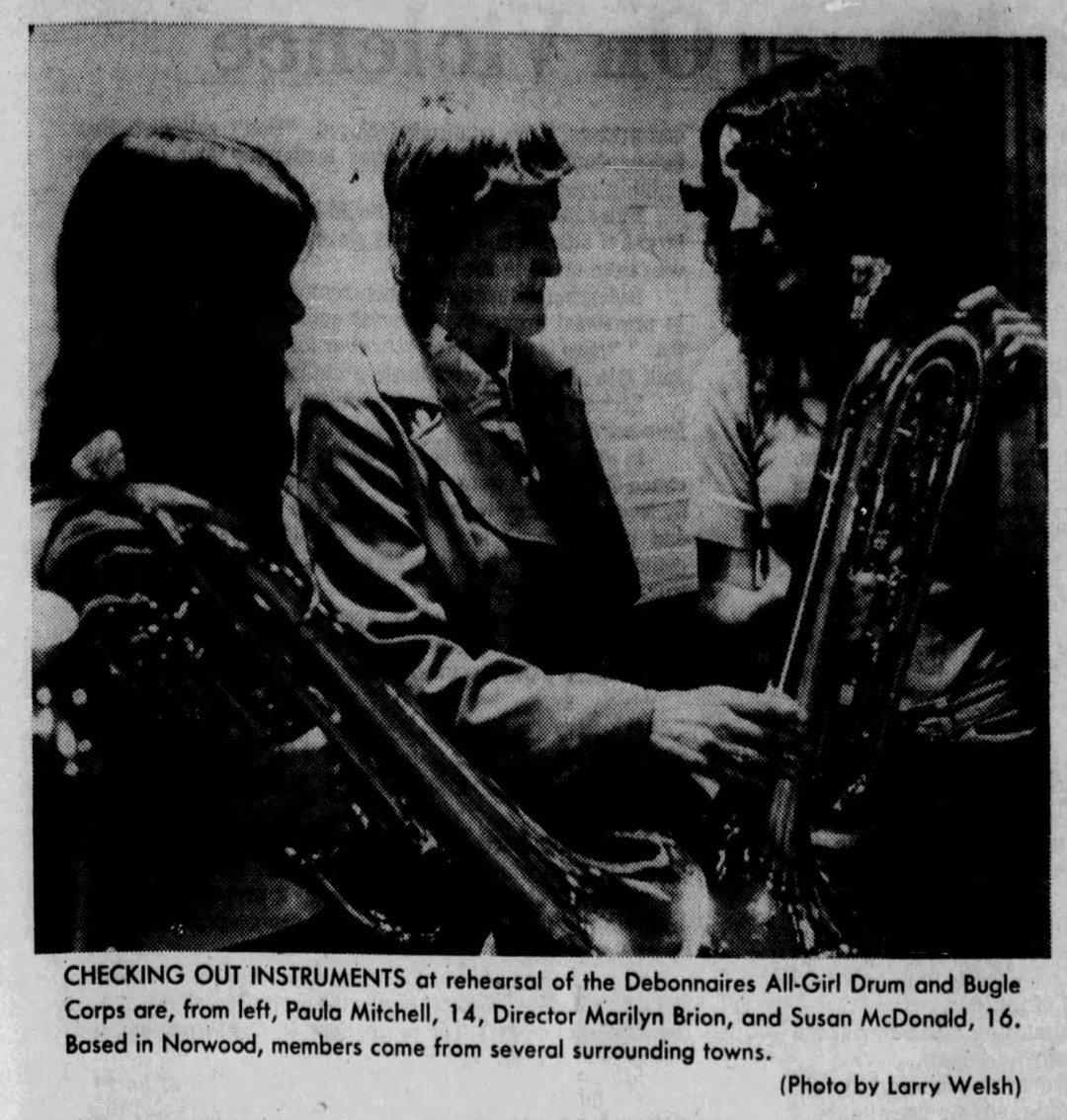
NORWOOD – When Norwood’s prizewinning Debonnaires All-Girl Drum and Bugle Corps marched crisply onto a parade route or competition field, its young musicians and color guard represented far more than a traditional musical ensemble. Profiled by Patriot Ledger staff reporter Nona Dearth on Monday, November 29, 1976—illustrated with a rehearsal photograph showing Paula Mitchell, 14, Director Marilyn Brion, and Susan McDonald, 16, inspecting instruments—the corps embodied a demanding, close-knit way of life that shaped generations of young women across the Neponset Valley.
“They learn not only music but coordination and sportsmanship,” observed Mrs. Brion, who had served as director for four years. “They develop self-confidence, learn to share responsibility, become organized young people. And they have fun.” Over the decades, those lessons carried Norwood’s ambassadors to showcase appearances and competitions at Disneyland, the Montreal Exposition, Chicago, Philadelphia, and Washington, D.C. Closer to home, the corps performed in roughly 12 New England competitions and 20 parades each year, alongside heartfelt community concerts at nursing homes, hospitals, the Wrentham State School, the Massachusetts Hospital School in Canton, local bazaars, and the opening day of Norwood Little League.
Rehearsing two or three nights a week at the Norwood Armory and the American Legion Hall, members ranging in age from 10 to 19 trained in horn, drum, and color-guard sections under hired professional instructors and dedicated volunteers, using instruments supplied by the corps. “You have to like it to be in it,” Mrs. Brion noted. “It requires a lot of dedication and hard work, especially for winter rehearsals. The fun time is in the summer during competitions and traveling. That’s when the winter work pays off.”
Drawing youth from Norwood, Canton, Westwood, Walpole, Dedham, and Sharon, the organization thrived on parent-run car pools, bake sales, recruitment drives, and chaperoning. One participating family boasted five daughters in the corps, while two other families—including that of Dedham father William Doty—had four daughters apiece marching in uniform. In a letter to the corps praising their annual performance for handicapped children at the Massachusetts Hospital School in Canton, Doty wrote: “These girls were a sight to behold. After performing they stayed and played with these kids who are not as fortunate as they are… When you watch them day after day, you begin to realize this is where the future of America lies.”
Norwood mother Lynda Pennie pointed out how proud younger brothers were of their older sisters, while Dedham resident Mary Frazier recalled how her husband’s admiration for the corps at a Norwood Lodge of Elks banquet inspired their 14-year-old daughter Linda—previously uninterested in music—to become an accomplished bugler, prompting younger sister Lee Ann to join the color guard and take up the mellophone.
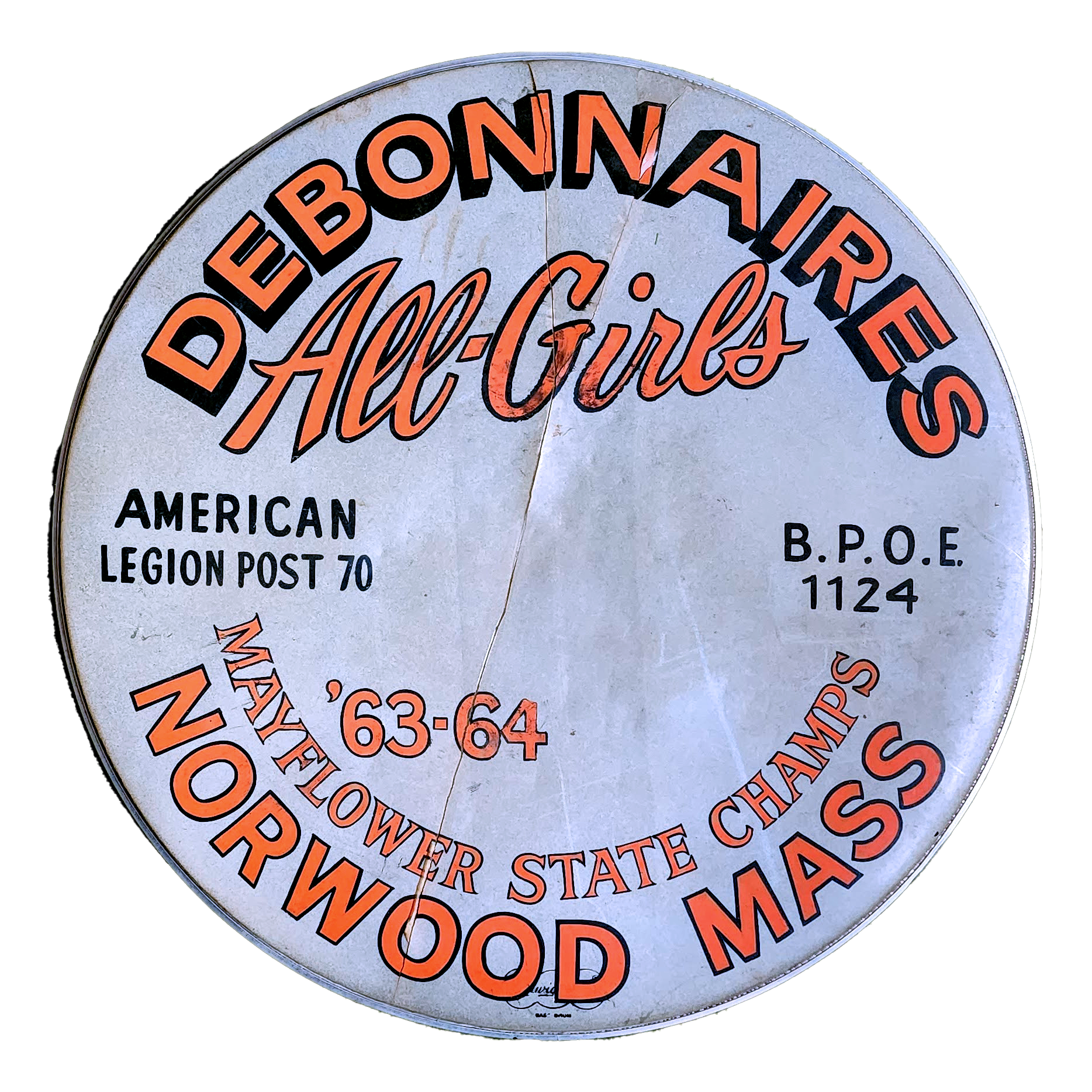
Tracing its heritage back to a co-ed fife and drum corps organized at St. Catherine’s Church in the 1940s, the group was transformed into an all-girl drum and bugle corps in 1955 by the late Wallace MacDonald under the joint sponsorship of the Norwood American Legion and the Norwood Lodge of Elks. After sweeping Class B records in just three years, the Debonnaires ascended to Class A, holding that elite tier for 14 years while becoming the first all-girl corps to win a World Open title, the first to capture an Eastern Massachusetts circuit contest in Class A, and five-time Mayflower Circuit champions. Following graduations and college departures at the close of the 1975 season, the senior and junior units merged—stepping down to Class C under mandatory reorganization rules—and stood at 82 members in November 1976 amid a recruiting drive to reach at least 100. Mrs. Brion estimated that more than 3,000 girls had worn the uniform since the corps began, many returning as mothers to volunteer: “Being a Debonnaire is a way of life that stays with you. It’s hard to let go.”
Source: The Patriot Ledger • Monday, November 29, 1976 • By Nona Dearth
“Many of them, now mothers, come back to help us as volunteers. Being a Debonnaire is a way of life that stays with you. It’s hard to let go.”
| Era / Milestone | Corps History & Competitive Achievements |
|---|---|
| 1940s | Founded as a co-ed fife and drum corps for boys and girls at St. Catherine’s Church in Norwood. |
| 1955 | Taken over by the late Wallace MacDonald and reorganized as an all-girl drum and bugle corps sponsored by the Norwood American Legion and Norwood Lodge of Elks. |
| 1958–1975 | Breaks Class B records in 3 years, spends 14 years in Class A, becomes first all-girl corps to win a World Open title and Eastern Mass. Class A contest, and wins 5 Mayflower Circuit titles. |
| 1975–1976 | Senior and junior units merge into Class C (82 members, ages 10–19) under Director Marilyn Brion with a recruiting drive toward 100 members. |
Archival Note: This article has been dynamically reconstructed from the original public record print archives of the Patriot Ledger
-
Wonderful Women (or Girls) of Norwood-The Norwood Debonnaires
Wonderful Women (or Girls) of Norwood-The Norwood Debonnaires
-
J. Stearns Cushing Pens Letter In Support of Norwood Brass Band-This Day in Norwood History-May 20, 1899

This Day in Norwood History-May 20, 1899-J. Stearns Cushing Pens Letter In Support of Norwood Brass Band
-
History of the First 25 Years of the Norwood Brass Band-This Day in Norwood History-May 31, 1891
Striking up the band! Published in 1891, this retrospective looks back at the first 25 years of the organization known today as the Norwood Brass Band. From its humble 1866 beginnings at the South Dedham engine house to playing Boston’s St. Patrick’s Day parades and purchasing $50 uniforms, discover the evolution of a local musical…
Discover more from Norwood Historical Society
Subscribe to get the latest posts sent to your email.