

⠀
The Norwood School Committee voted last night to begin a transitional first grade and modified kindergarten at the Balch School in September. Assistant Superintendent Umberto V.C. Napoleone said the need for the transitional first grade was brought to light when twenty-three kindergarten students failed to achieve a passing score on a kindergarten screening test administered last October. The Balch School produced the highest number of those not passing with 37, followed by the Callahan with 20, Aaron Guild with 19, Willett with 14, Oldham with 13, Cleveland with 9, and Prescott with 5.
Of the 23 Balch pupils who failed the screening test, only 16 were recommended for the transitional first grade, while others remained in kindergarten, were promoted to regular first grade, moved out of the district, or were placed in the modified kindergarten. Seven of the children came from families of limited English-speaking ability. Member Rudith M. Berkowitz was critical of the high absenteeism rate among resource personnel at the Balch School, noting that for a total of 80.5 days at the school, no teaching services were available from specialists due to absences. She stated, It’s possible that the children were being disserviced by that amount of absenteeism. Included in her motion to approve the pilot program was the stipulation that bilingual teachers be hired for school openings in September.
Member Richard W. Kief abstained from the vote after expressing reservations about the financial implications and a lack of cost estimates for additional transportation, noting, I’m frustrated because I support the transitional first grade but I’d like to know what we’re putting ourselves in for. Members were told there will be no additional staff increases to implement the program. Children selected for the modified kindergarten will aim to sharpen skills to bring them up to the level of regular classes. Umberto V.C. Napoleone also reported the results of last year’s testing in grades three through six using the California Test of Academic Achievement and the Short Form Test of Academic Aptitude, where 1,863 students were tested and 117 received an aptitude score of 85 or below.
In other high school actions, the board made it official that the high school will convert to an eight-period day in the fall, cutting back from the current nine-period schedule. The open campus will still be in effect for seniors and juniors, while sophomores will be restricted from leaving school grounds and scheduled during periods two through eight. Member Richard Joseph, whose presence was awaited for the official vote, endorsed the change.
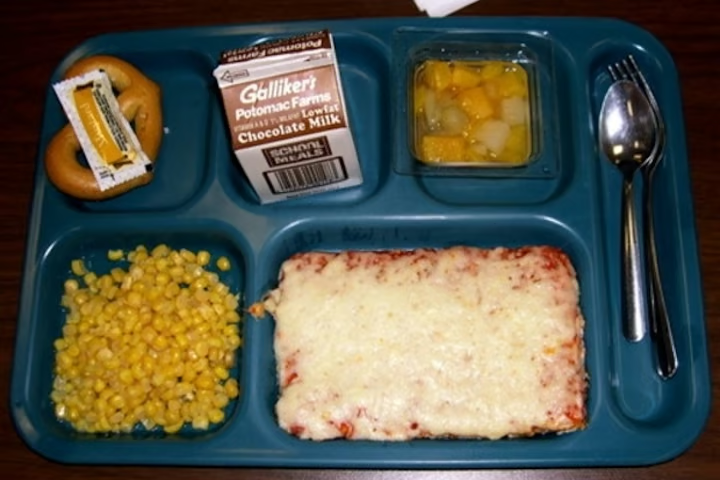
Additionally, senior citizens looking forward to low-cost hot lunches in the schools next fall are out of luck. Superintendent Philip O. Coakley told the school committee that there are currently no state or federal funds available to pay for the services administered by the state school food services department. The school department budget passed at the annual town meeting had included $7,200 to get the hot lunch program started under a proposal by the town’s Council on Aging, but business manager Lawrence Canter stated that the money will have to be turned back to the town if external funding cannot be secured.
Archival Note: This article has been dynamically reconstructed from the original public record print archives of the Patriot Ledger
More…
-
Youth Enriched at Summer School-August 13, 1974
Directing over 600 local students, Norwood’s public summer school program completed its 30-day session, highlighting strong popularity for enrichment classes in arts and trades alongside vital remedial and special education tutoring.

-
Norwood School Committee Votes to Relocate School Administration Offices-August 1, 1974
The Norwood School Committee voted 5-2 to relocate central school administration offices to the Winslow School, pending cost estimates from Superintendent Philip O. Coakley.
-
Uncertainty Looms Over Norwood Junior High South Opening Date-July 12, 1974
After three years of double sessions following a 1971 fire, Norwood officials faced the possibility of further delays for the new Junior High South.

-
Unfinished Junior High To Open On Schedule-July 8, 1974
Discover the construction history of the $4.5 million Junior High South project in 1974, detailing the challenges faced during the transition from the old Washington Street school.

-
School Board Rejects ‘Floating Principal’ Proposal-July 03, 1974
The Norwood School Committee held a contentious session on the evening of July 2, 1974, where, following two weeks of deliberation and a lengthy 90-minute executive session, the board voted 5-1 to reject a proposal to create a new administrative position titled “floating principal.“ The concept, initially championed by Committee Member Joseph M. Pentowski, was…
-
School Drop-In Centers Possible In Fall-June 24, 1974
Citing summer custodial constraints and a lack of air conditioning, town officials vote to survey local youths during the summer to prepare for a fall launch.
-
Public Schools Face Delays and Possible State Action on Mandatory Hot Lunch Program-August 31, 1973
Parents of elementary school students in Norwood will need to continue packing brown-bag lunches for the start of the academic year. School Superintendent Philip O. Coakley announced that the town will fail to meet the state-mandated September deadline for implementing a universal public school hot lunch program, exposing the municipality to potential legal action by…

-
School Board Reverses Vote, Keeps NorWest Woods Pupils at Oldham-August 29, 1972
In a reversal of a previous decision, the School Committee has voted to keep 46 elementary school children from the Nor-West Woods apartment complex at the Oldham School, rescinding a July 5 vote that would have transferred them to the Shattuck School. Superintendent Dr. Philip O. Coakley explained that the committee revoted on the matter…

-
Norwood Sets $38 Tax Rate on Court-Ordered 100% Property Valuation for 1972-August 16, 1972
Announcing a 1972 tax rate of $38 per $1,000 under a court-ordered 100 percent property valuation, Assessor Chairman James J. Drummey concluded a major reassessment by Cole, Layer and Trumble.

-
Junior High Alternate Estimates Sought-June 25, 1971
A sharp debate divides Town Manager Walter Blasenak and finance officials over mounting unappropriated architectural fees for Boston design firms.




Discover more from Norwood Historical Society
Subscribe to get the latest posts sent to your email.