
Beer Banned From Stands At Arena After Licensing Review
Background: A Popular Venue Under Scrutiny
By the early 1960s, the Norwood Arena had become one of the region’s busiest seasonal attractions, drawing crowds for stock‑car racing, demolition events, and weekend entertainment. With attendance rising, so did public attention to crowd behavior, parking congestion, and alcohol consumption at the grounds.
Although beer sales were permitted under state law, the Arena’s management operated under a local expectation of strict oversight. When reports surfaced that spectators were drinking in the stands, the issue quickly escalated into a matter for the Board of Selectmen.
📅 The Event
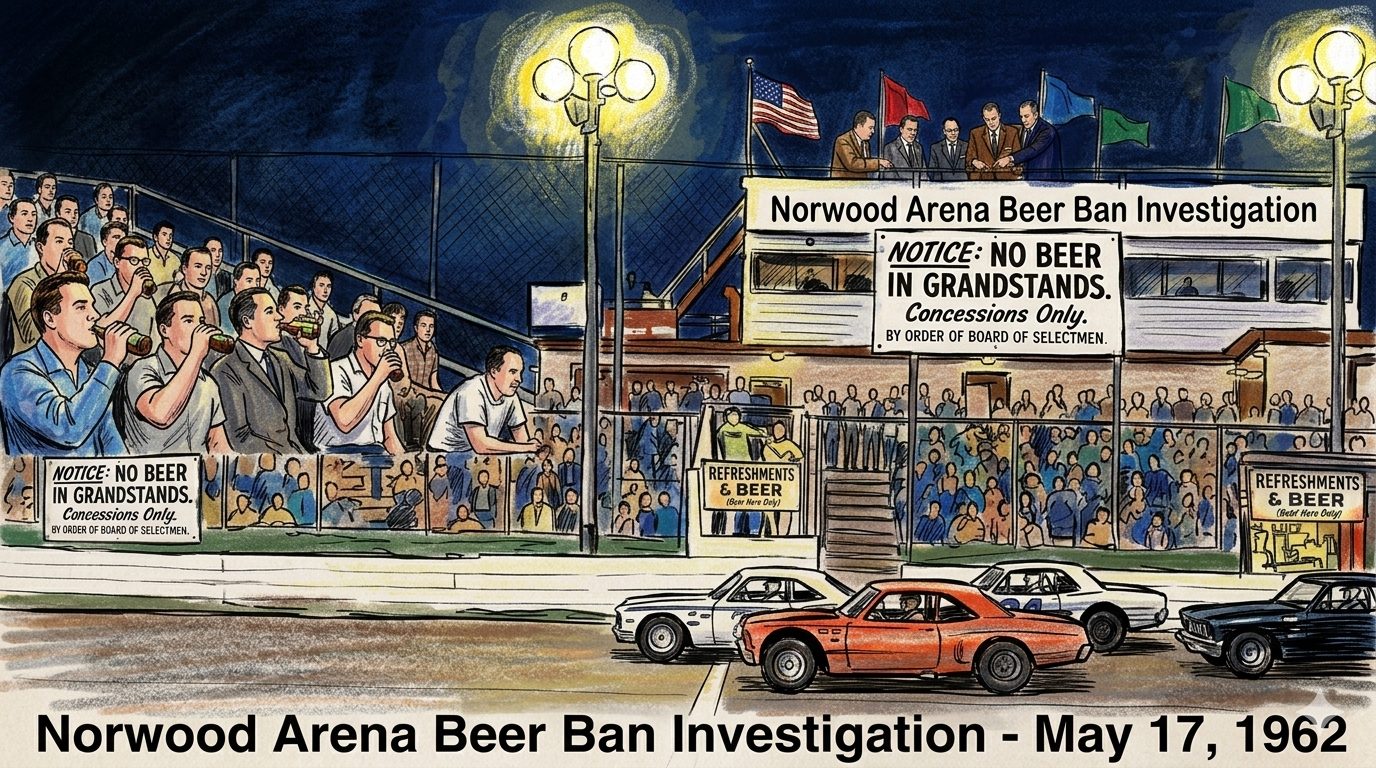
On this day, Norwood’s Board of Selectmen took decisive action regarding alcohol service at the Norwood Arena, ordering that beer be removed from the grandstand area pending a review of the venue’s compliance with local licensing rules. The decision followed concerns raised about whether beer was being sold or consumed in areas not covered by the arena’s approved license.
According to the report, officials stated that beer was “banned from the stands at the Arena” while the matter was investigated. Arena management cooperated with the inquiry, providing documentation and clarifying procedures for alcohol distribution during racing events.
🔍 What Prompted the Ban
Town officials had received complaints suggesting that spectators may have been consuming beer outside the designated, licensed refreshment zones. Although no violations were formally cited at the time of the ban, the Selectmen acted out of caution, emphasizing the importance of:
- Maintaining compliance with state and local alcohol regulations
- Ensuring safe crowd conditions during high‑attendance race nights
- Preserving the Arena’s long‑standing relationship with the town
The temporary restriction was described as a preventative measure, not a punitive one.
📑 Investigation & Exoneration
After reviewing the Arena’s operating procedures, interviewing staff, and confirming the boundaries of the licensed area, officials determined that the Arena had not violated its alcohol license.
The Ruling: Arena Exonerated
After reviewing the facts, the Selectmen concluded that the Arena had not violated its license.
“The Arena was cleared of the charge…”
The Selectmen noted that the Arena had acted responsibly and that the temporary ban had served its purpose by clarifying expectations and reinforcing best practices.
However, the Board took the additional step of banning beer from the stands entirely, regardless of who carried it there. This was not a punishment but a preventative measure intended to simplify enforcement and reduce ambiguity.
The New Rule: Beer Banned From Stands
The Selectmen issued a clear directive:
- Beer could be sold only at concession points
- No beer was allowed in the grandstand area under any circumstances
- Arena staff were responsible for enforcing the restriction
This policy aligned with growing statewide concerns about alcohol at large outdoor venues. It also reflected Norwood’s longstanding preference for orderly public events.
🏁 Why This Moment Mattered
The Norwood Arena was one of the town’s most popular entertainment venues, drawing large crowds for stock‑car racing and special events. Alcohol service was a longstanding part of the spectator experience, but it also required careful oversight.
This brief licensing dispute highlighted:
- The town’s commitment to orderly regulation
- The Arena’s willingness to cooperate with civic authorities
- The importance of maintaining public confidence in large‑scale events
It also demonstrated how quickly misunderstandings could escalate — and how efficiently they could be resolved when both sides worked collaboratively.
Text and images may have been created, edited, colorized, or digitally restored using AI tools such as Microsoft Copilot or Google Gemini. All content is reviewed for accuracy and historical integrity before publication by the Norwood Historical Society
Discover more from Norwood Historical Society
Subscribe to get the latest posts sent to your email.