
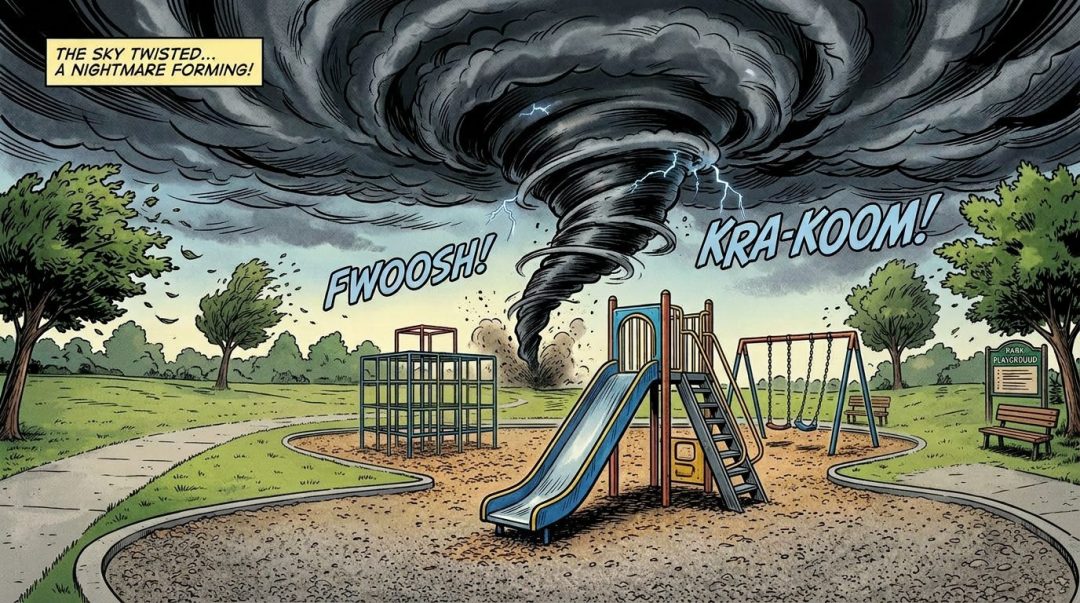

On the evening of Sunday, July 2, 1961, a volatile atmospheric disturbance swept across southern New England, bringing with it a chaotic sequence of heavy rain, hail, intense winds, and the appearance of rare funnel clouds.
The broader storm system was particularly destructive elsewhere in the region; the U.S. Coast Guard station at Salem, Massachusetts, reported heavy hail and confirmed five separate funnel cloud sightings along the North Shore. Furthermore, a tornado caused notable damage along a four-mile path in Salem, New Hampshire.
In Norwood, the tension in the atmosphere became manifest between 7:20 P.M. and 7:30 P.M. during this period of severe weather. The phenomenon was witnessed by two amateur meteorologists, John Anderson and Fred Chapman, who were tasked with observing thunderstorms for the U.S. Air Force Aerophysics Laboratory located at Blue Hill, Massachusetts. According to their official logs, Mr. Anderson observed the funnel cloud at 7:25 P.M., followed by Mr. Chapman at 7:30 P.M. Numerous local residents also observed the formation, which occurred amid a backdrop of intense, dark clouds.
Meteorological conditions were highly unusual leading up to the event. Observers noted a rare cloud formation known as “mamma to cumulus” occurring just minutes prior to the funnel’s development. Specifically, two sections of a stratocumulus cloud base were observed to begin revolving around a common center. The report detailed that “the counterclockwise whirl appeared to lower from the cloud base but no pendent cloud was visible.” Mr. Chapman was able to document this rare, swirling structure on 8 mm movie film, capturing a visual record of the event. The funnel dissipated at approximately 7:32 P.M., and the entire cloud mass proceeded to move away from the area in an east-southeasterly direction.
The formation was immediately followed by a deluge of extremely heavy rain and a severe electrical storm. Observer Anderson carefully tracked the precipitation, recording 0.52” of rainfall during a intense 46-minute period. The severity of the weather was attributed to a combination of high dew points and a daily maximum temperature that reached 90 degrees F, creating the instability required for such a spectacular, albeit alarming, display of nature.
Archival Note: This article has been dynamically reconstructed from the original public record print archives of the Patriot Ledger
More…
-
Norwood Burglars Visit Four Places-This Day in Norwood History-October 20, 1913
Large Property Damage for Little Booty. Police Later Recover Some of the Loot in Freight Car. NORWOOD. Oct 19—Three stores in the Sanborn Block, corner of Washington and Vernon sts., the business center of Norwood, were visited by burglars some time early this morning. All were entered from a court in the rear, but the…

Discover more from Norwood Historical Society
Subscribe to get the latest posts sent to your email.