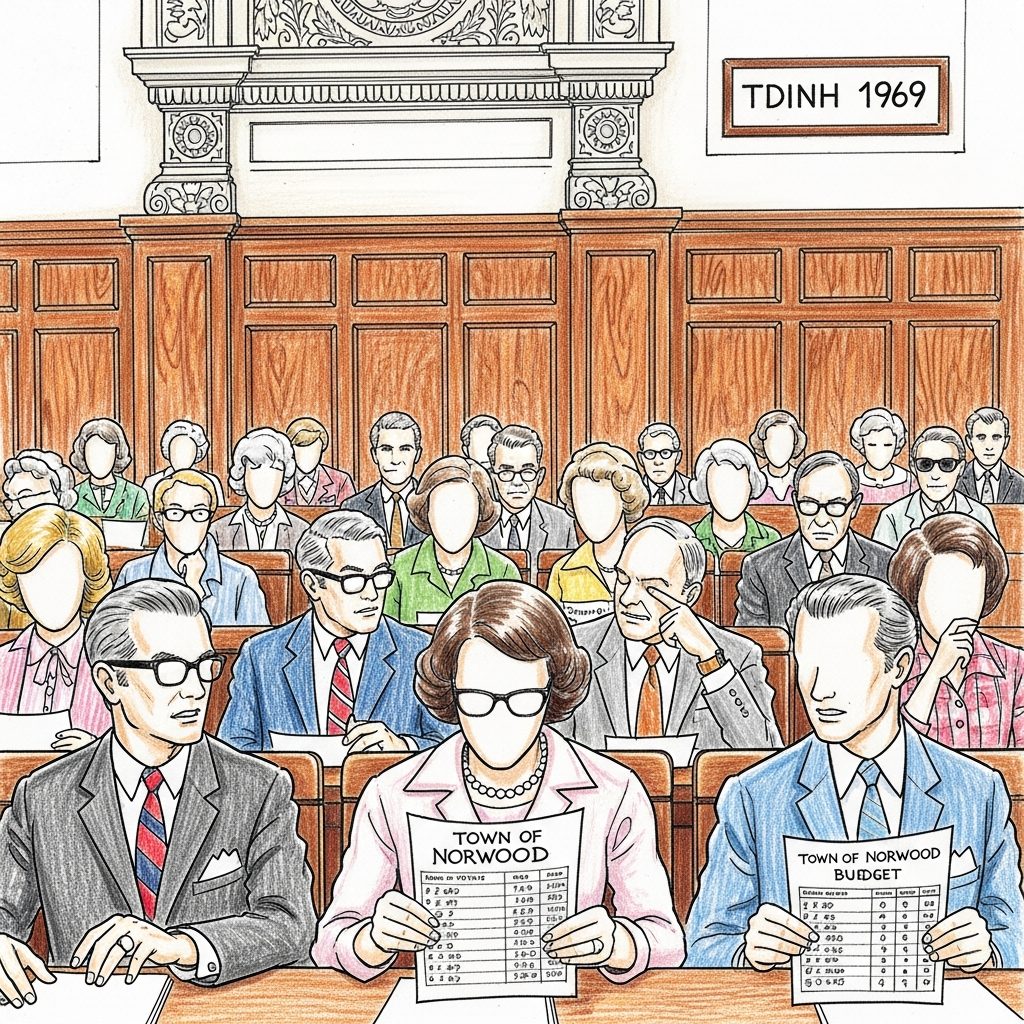
On May 20, 1969, the annual Norwood Town Meeting entered its final night with a sense of urgency and fatigue, yet also with the unmistakable gravity that comes when a community decides its financial future. By the time the gavel fell, representatives had approved more than $13.2 million in appropriations—an unprecedented figure that reflected both the town’s rapid growth and the rising costs of municipal services in the late 1960s.
The evening opened with a sobering estimate from Finance Commission Chairman George T. Mahoney, who warned that the newly approved spending could raise the town’s tax rate by roughly $15, bringing it to $91 per thousand. He stressed that this was only a projection, noting that the final number depended on the state’s forthcoming “cherry sheet” reimbursements. “We may know by next week,” he said, emphasizing that only then could he calculate the precise tax rate for 1969.
One of the largest single votes of the night was the approval of $1.2 million for the police and fire departments, reflecting a 7 percent pay increase for employees in both departments—even though wage negotiations were still underway. The vote underscored the town’s commitment to public safety during a decade when municipal labor costs were rising nationwide.
But the most contentious issue of the night centered on a $21,800 cut made the previous week to the school administrators’ salaries. The cut had been intended to limit raises to 7 percent, rather than the 15 percent originally proposed. Shortly after the meeting began, Mrs. Judith M. Berkowitz, a member of the School Committee, moved for reconsideration. Her motion was seconded by Henry W. Diggs, also of the school board.
Speaking forcefully in support of restoring the funds, School Committee Chairman Charles C. Saraca warned that the town was effectively asking the board to “break a contract.” He asked the representatives, “How would you like it if your employer broke an agreement with you?” Saraca cautioned that failure to restore the money would “surely” result in a lawsuit from the administrators’ bargaining agent and could expose the town to a 25 percent penalty if it lost in court.
Town Counsel Walter J. Gotovitch had already warned the meeting that “the courts, without exception, have upheld the return of the money deducted.” Even so, the representatives overwhelmingly defeated the motion to reconsider. School officials hinted that they might find a way to restore the salaries within the same general budget category, but no commitment was made.
With the controversy set aside, the meeting moved through a long list of appropriations, including:
- $2.6 million for the Electric Light Department
- $409,055 for the Water Department
- $162,854.42 for the Morrill Memorial Library
- $16,650 for parks maintenance
- $72,905 for playgrounds, including $18,300 in improvements to Hawes Brook Pool
- $90,900 for recreation
- $113,668 for cemeteries
- $123,859 for veterans’ benefits
- $208,753 for the retirement fund
- $1.06 million for interest and debt
- $37,000 for insurance
- $55,000 for the reserve fund
- $750 for airport administrative expenses
- $16,929 for miscellaneous items, including Christmas decorations
Representatives also added $50,000 to the recommended $400,000 tax‑offset account.
Beyond the general budget, Town Meeting approved nearly $900,000 in additional expenditures, half of which would reduce the amount needed to be raised through taxes. These included:
- $6,235 for unpaid bills prior to December 31, 1968
- $3,600 toward rent for buildings used by veterans’ groups
- $9,000 for Chapter 90 highway maintenance
- $34,500 for Chapter 90 highway construction
- $36,000 for workmen’s compensation
- $105,000 for insurance premiums for certain town employees
- $65,000 for the stabilization fund (bringing it to $300,000)
- $5,000 for medical expenses for police and firefighters
- $208,352 for Blue Hills Regional High School
In a notable policy shift, representatives voted 69 to 15 to allow firefighters to live outside Norwood, ending a long‑standing residency requirement.
The meeting also approved several major infrastructure projects tied to Norwood’s expanding industrial corridor along University Avenue. These included:
- $200,000 for underground duct work for Polaroid Corporation
- $39,000 for extending electric service toward Canton Street
- $20,000 for added service to Eaton Village
- $222,000 for over 4,000 feet of 16‑inch water pipe
- $5,000 for a future water connection with the Metropolitan District Commission
These improvements were expected to yield substantial tax revenue. Polaroid alone was projected to bring in $1 million per year. Additional development by Glacier Sand & Gravel, National Lead Co., and Admiral Corp. promised further returns.
Because of reimbursements from private firms and utilities, Chairman Mahoney estimated the net cost of these projects at only $163,000, calling it a “very substantial return” for Norwood.
By the end of the night, Town Meeting had authorized $582,000 in borrowing and approved a record‑breaking $13,252,004.60 in total appropriations—about $7.3 million of which would be raised through property taxes.
The article closed with several community notes, including an announcement that Norwood High School Principal John F. Monbouquette would speak about his recent trip to Eastern Europe at the annual honors banquet on June 3 at The Lord Fox in Foxboro. The Morrill Memorial Library also announced its Memorial Day weekend hours and upcoming summer schedule.
It was a night that captured the full complexity of Norwood in 1969: a town balancing rising costs, expanding industry, labor tensions, and the everyday civic rhythms that define community life.
Text and images may have been created, edited, colorized, or digitally restored using AI tools such as Microsoft Copilot or Google Gemini. All content is reviewed for accuracy and historical integrity before publication by the Norwood Historical Society
Discover more from Norwood Historical Society
Subscribe to get the latest posts sent to your email.