

Study Committee Evaluates Automatic Voting Machines and IBM 360 Computer Options Following Rise in Post-1960 Election Costs
The merits of a proposal to trial lease 45 automatic voting machines at a cost of some $600 are under consideration by town officials. While the machines may speed tabulation, officials are not certain that they facilitate actual voting. They question whether the machines can accommodate the heavy turnout which occurs between the hours of 5 and 8 p.m. A Jamestown, N.Y., firm has offered the town a year’s lease of 45 machines for $8,820 plus a $1,560 charge for transportation. Should the town decide to purchase the machines, the rental fee would be applied to the total cost of $86,200.
This proposal is under consideration by town committees as a possible solution to costs of elections on the rise since 1960 when the state ruled that the counting of ballots can begin only after the polls close. Tabulating the vote has become increasingly difficult and costly in terms of workers while voter demand for early results has increased. The town report indicates that in 1964 Norwood paid $8,592 in salaries to 125 election workers and $1,757 for meals. In the presidential election of that year the polls closed at 8 p.m., but the results were not tallied until 7:45 a.m.
The firm’s report states that the machines reduce the number of workers needed by half because the ballots are already totaled when the polls close. However, it takes 45 minutes to set up each machine before the polls open. Also, automatic voting machines are in use throughout Connecticut, Rhode Island, New York, and Boston. Natick switched to voting machines this year. The report notes that Norwood is “the largest town where everyone votes in a single place” and suggests that if machines are adopted consideration be given to precinct voting to avoid crowding the armory. According to town officials, precinct voting would require a great deal of advance planning to determine which area will vote heavily and where workers are needed. The firm has offered to train election workers and custodians as well as voters in the use of the machines if the town decides to lease them.
Another solution under consideration is electronic voting tried in a Braintree town election last spring and used on the West Coast. Prices given in Braintree of $200 a machine indicate it would cost Norwood about $37,000 to provide one for every 75 voters as required by state law. The initial electronic election, however, would require programming a computer to election use at a cost of some $600. Once this is accomplished, because the voter “key punches” his own ballot, a computer consultant indicates it would cost $45 to rent a local IBM computer for an hour. An IBM 360 could tabulate 14,000 ballots in 14 minutes, according to the consultant. There are 14,200 registered voters in Norwood. Legislation is expected to be introduced in the General Court this year allowing towns to use this method of voting. Members of the study committee are Walter Blasenak, town manager; Bartley Connolly, town clerk; Dr. Philip O. Coakley, school superintendent; and Harry Butters, selectman. In a progress report to the selectmen, the committee said it would submit a final report in December after a “hard look at the difficulties of this election.”
Thirty-two eighth graders from the Norwood Junior High School representing all the eighth-grade social studies classes took a field trip to the site of the reconstructed Old Sturbridge Village recently. Touring the village in three groups, the students were instructed in the history of the old buildings and of the village. Reporting on their trip to their respective classes were: Carolyn Post, Joseph Maienza, Mary Heslin, Edward Mistler, Patricia Rizzo, Debra Weatherhead, Jonathan Taube, Eileen McAvoy, Jeffrey Rizzo, and Diane Fenton. Also taking part in the field trip were Frank Loquidaro, Philip St. Cyr, Deborah Freytag, Donald Adamo, Shirley Maroney, Guy Cisternelli, Carla Bayides, Ronald Thomson, Bonnie Lowe, Lorraine Buck, Deborah Carey, Wayne Holway, Carlton Monnacco, Eric Newman, Thomas Murphy, Marianne Wohler, Judith Rukstalis, Michael Houston, William Peterson, Richard Chrzanowski, Roy DeCelle, and Mario Guariello.
Diplomas and awards were presented recently to teachers and students alike at the Henry O. Peabody Vocational School in Norwood. Miss Marguerite Sicurella, Miss Louise Ulrich, and Miss Bertha Tarallo, all instructors in the beauty culture department of the school, were awarded diplomas upon completion of a Clairol Technical Training Seminar in advanced phases of hair coloring. Presentation of the Clairol Gold Crown Post Graduate Certificates were presented at the Sheraton Plaza Hotel in Boston by the Clairol district representative. Two students in the business department won the Gregg Company’s Alphabetic Filing Certificate Award. Those who qualified for the award were Valerie Crocetti and Marilyn Feeley. Joyce Anderson and Alice McArdle will be awarded Gregg filing charms for achieving perfect scores on the test.
The Henry O. Peabody School held its elections for officers of its Student Co-Operative Association recently. Elected to fill the post of president of the group, to which all members of the school belong, was Raymond Laramee, with Eileen Burke elected as vice president, Barbara Tower as secretary, and Paul Rondeau elected as treasurer. All four are seniors at the school. The school, a state-aided vocational institution under the direction of Miss Ruth Shea, offers career training to both undergraduates and postgraduates. For undergraduates there are food services and dressmaking trades combined with academic courses. Postgraduate courses include one-year courses in beauty culture, business, food service, dressmaking, and practical nursing.
Voting Modernization & Town Activities Overview
Election Machine & Computer Study
- Automatic Voting Option: 45-machine lease ($8,820 plus $1,560 transit; $86,200 purchase option)
- Electronic / IBM Option: Key-punch ballots tabulated via IBM 360 (14,000 ballots in 14 minutes)
- Study Committee: Walter Blasenak, Bartley Connolly, Dr. Philip O. Coakley, Harry Butters
Schools & Vocational Leadership
- Junior High Field Trip: 32 eighth graders visited reconstructed Old Sturbridge Village
- Henry O. Peabody School: Directed by Ruth Shea; student officers Raymond Laramee, Eileen Burke, Barbara Tower, Paul Rondeau
- Professional Training: Clairol hair coloring certificates & Gregg filing awards presented
Archival Note: This article has been dynamically reconstructed from the original public record print archives of the Patriot Ledger
-
Republican Lee Says He’ll Challenge Romney-July 9, 2005

Discover the 2005 campaign launch of Norwood’s own Gary M. Lee, who aimed to bring his 17 years of municipal experience to the Massachusetts State House.
-
Norwood Republican Town Committee Chairman David Tuttle Resigns Following 1992 Election-November 23, 1992

Norwood Republican Town Committee Chairman David Tuttle resigned in November 1992 after 3.5 years as Judy Lawton, Michael Bergeron, Frank Powers, and Mitch Pentowski planned next steps.
-
John Rogers Wins 12th Norfolk Representative Seat After Knocking on 12,000 Doors-November 4, 1992
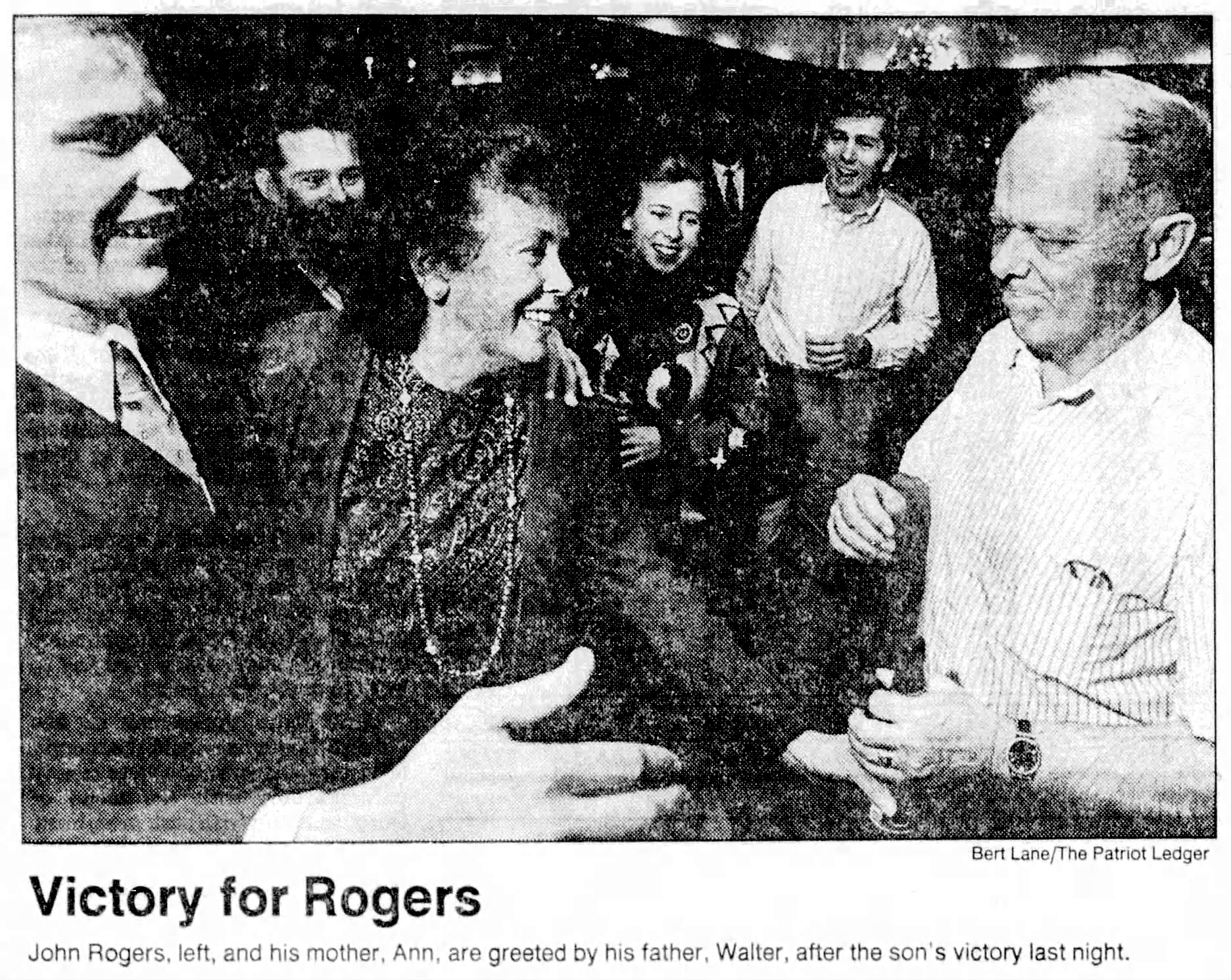
Blasting through a tough campaign with three worn-out pairs of wingtip shoes, legislative aide John Rogers defeated Joseph Pentowski to win the 12th Norfolk District representative seat.
-
House Candidates Campaign at Nahatan Village Ahead of September 15 Primary-August 26, 1992
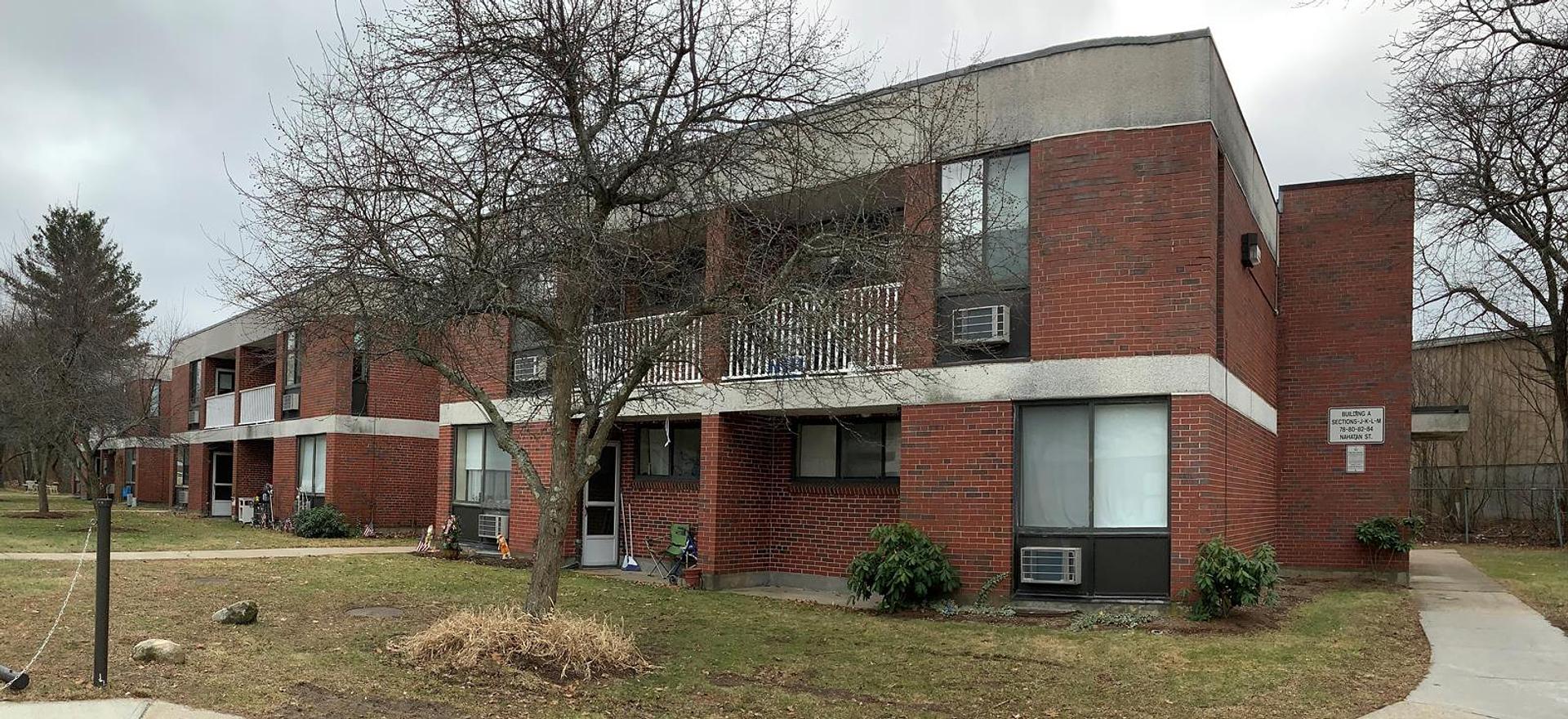
Democratic primary candidates for state representative John Rogers, John Lydon, and Helen Abdallah Donohue squared off at a Nahatan Village forum governed by new Norwood Housing Authority rules.
-
Mitch Pentowski Announces 1992 Republican Bid for Norwood House Seat-September 5, 1991

School Committee member and local insurance broker Joseph “Mitch” Pentowski announced yesterday that he will enter the 1992 Republican primary race for state representative, marking a shift from his lifelong status as an independent voter to join the GOP by the end of the week. Pentowski, 61, described his conversion to the Republican Party as…
-
Selectman Butters Defends Public Dispute with Town Manager and Police Chief as a Power Struggle-October 5, 1990
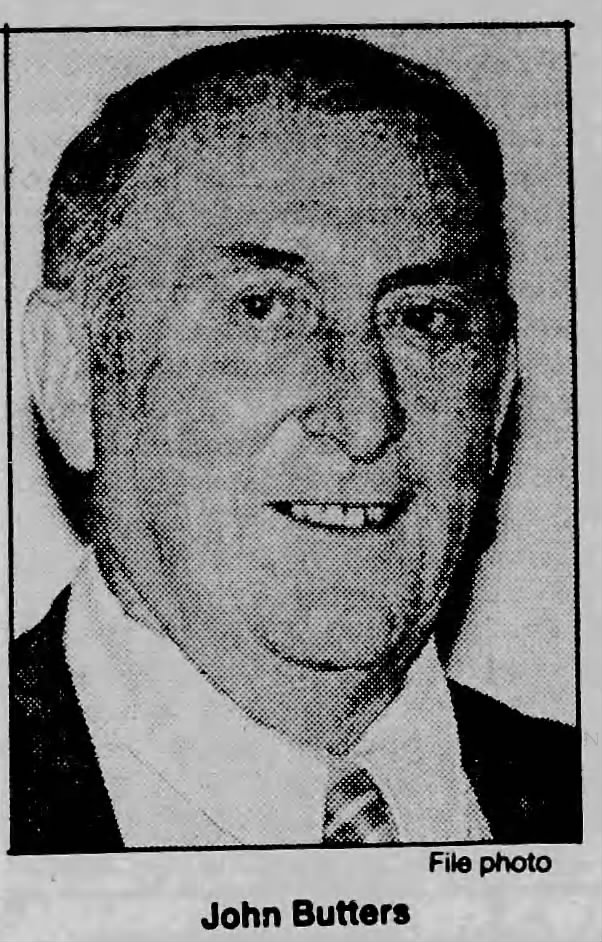
Norwood Selectman William Butters defends his clash with Town Manager John Carroll and Police Chief George DiBlasi as a struggle over administrative power.
-
Republican Gubernatorial Candidate Steven Pierce Outlines Economic Plan to Neponset Valley Chamber of Commerce-September 12, 1990
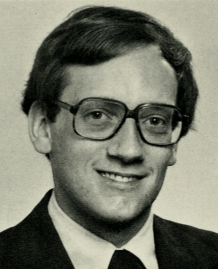
Republican gubernatorial candidate Steven Pierce outlines his small-business platform to the Neponset Valley Chamber of Commerce at Concannon’s Village.
-
Thomas Riolo Defends Auto Dealer Campaign Contributions Amid Criticisms from Incumbent William Keating-October 12, 1988
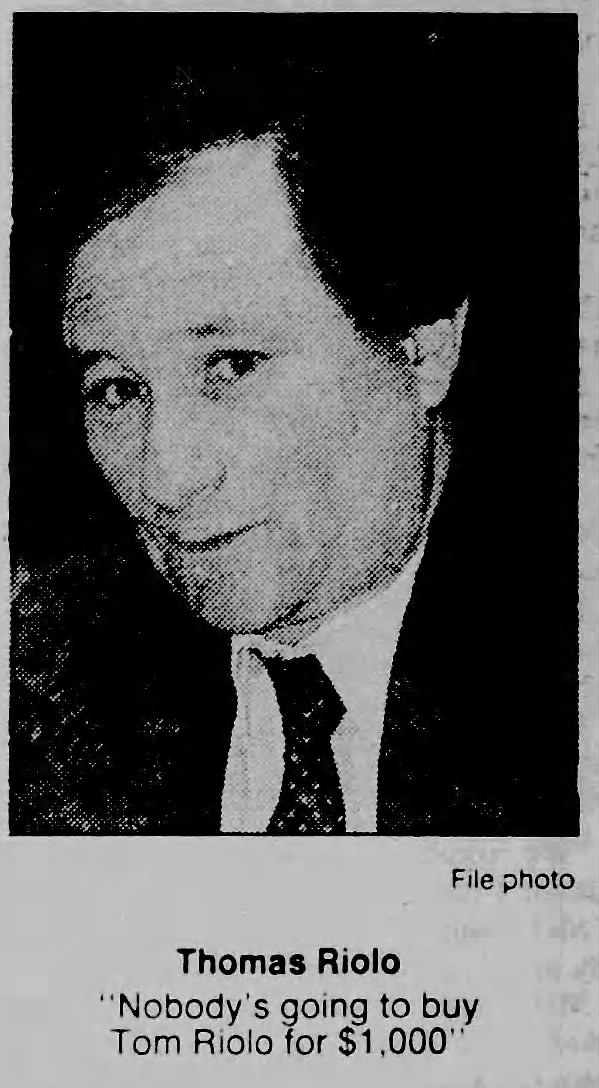
Norwood Selectman and Senate challenger Thomas Riolo defends accepting campaign donations from local auto dealers, pushing back against opponent William Keating’s criticism.
-
High Voter Turnout Surprises Officials as State Rep. Gregory Sullivan Defeats Challenger Timothy J. McDonough-September 16, 1988
An unexpectedly high 45 percent voter turnout drives state Rep. Gregory Sullivan to a primary victory over School Committee member Timothy J. McDonough.
-
Norwood GOP Calls for Reform Amid Statewide Fall-Out-November 11, 1986
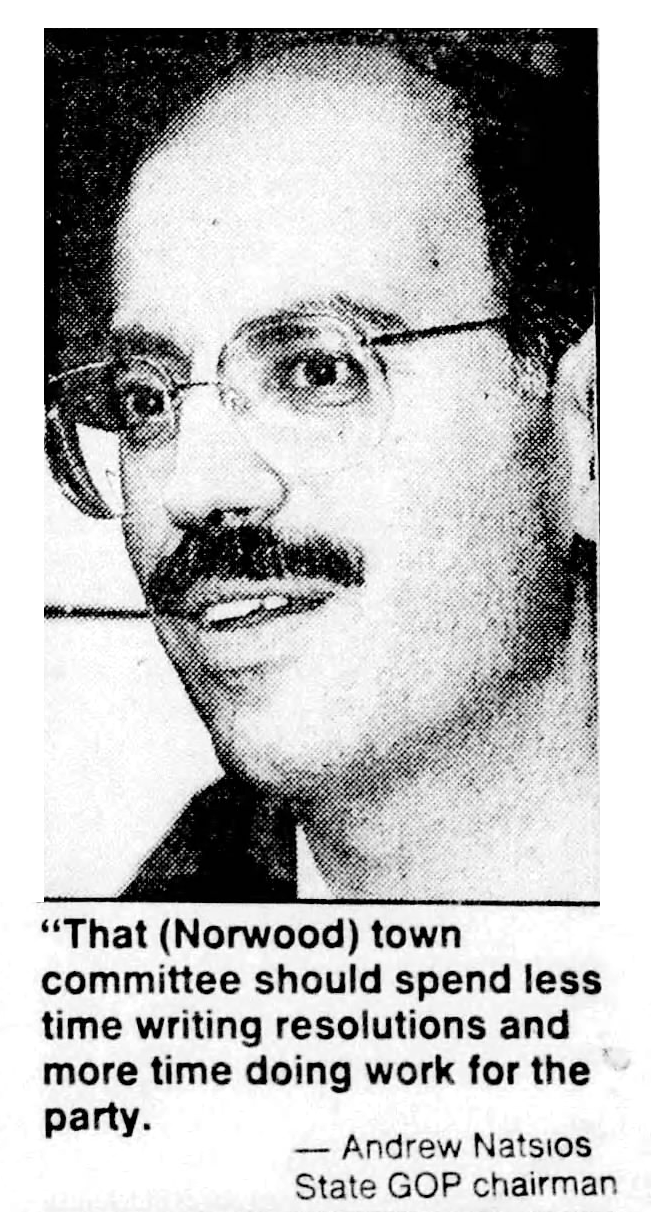
Local Republican leaders Ben Bush and William Pudsey adopted a resolution calling for an end to “club politics,” prompting a sharp rebuke from outgoing State GOP Chairman Andrew Natsios.
Discover more from Norwood Historical Society
Subscribe to get the latest posts sent to your email.