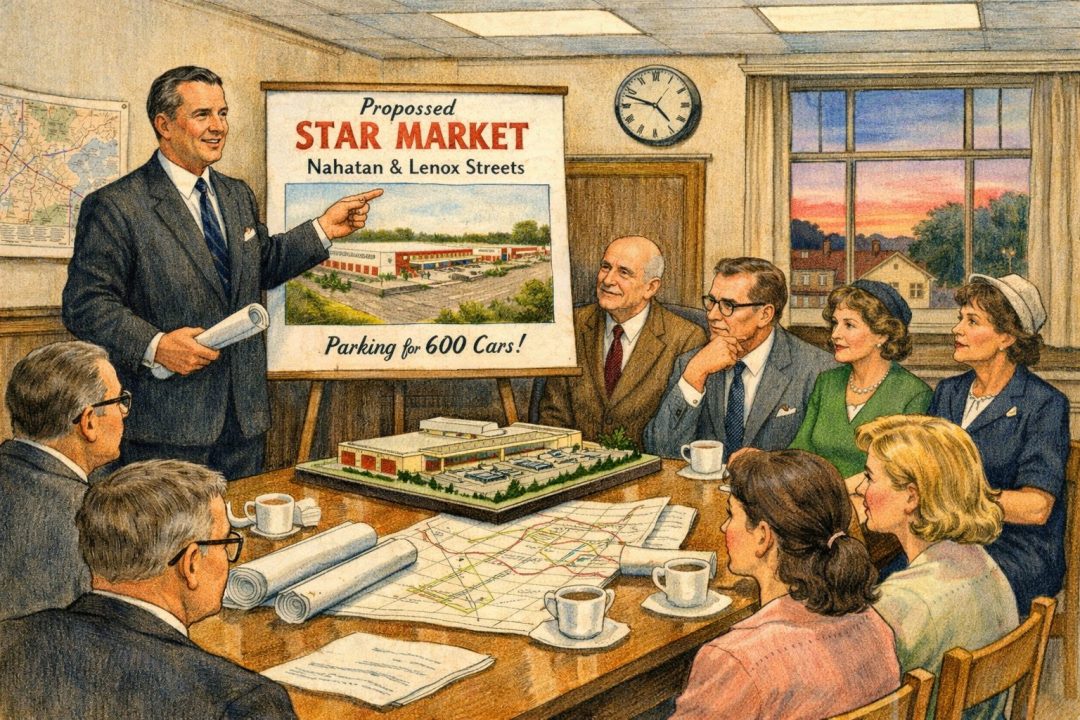
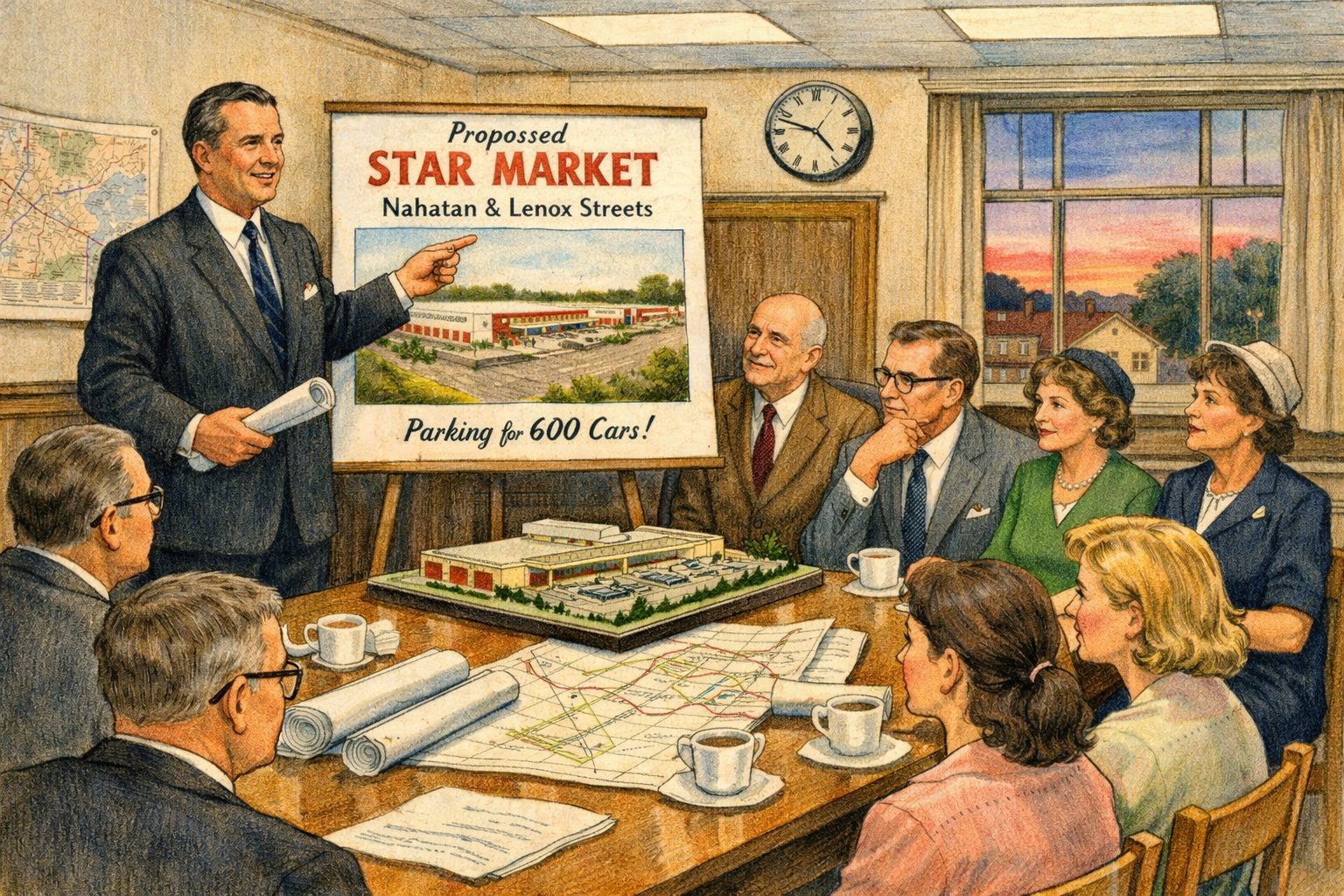
On a mild spring evening in May 1957, the future of retail in Norwood quietly shifted. At a meeting of the town’s Committee on Industrial Development, representatives from the rapidly expanding Star Market Company unveiled plans for what they described as a “modern shopping center” at the corner of Nahatan Street and Lenox Street—a project they hoped to break ground on before summer’s end.
The announcement came from Clarence Woodman, the company’s manager of real estate development, who arrived with rolled blueprints, traffic studies, and a confident vision of what Norwood’s commercial future could look like. Star Market, already a recognizable name across Greater Boston, was in the midst of a post‑war expansion boom. New stores were rising in Cambridge, Auburndale, Woburn, and Winchester, and now the company had set its sights on Norwood.
Woodman told the committee that the Norwood store would employ approximately 75 people, a significant addition to the town’s mid‑century workforce. He emphasized that the project was not simply a supermarket but a full shopping complex—an early example of the suburban retail centers that would soon reshape American consumer life.
A Carefully Engineered Site
The proposed development covered a large triangular parcel bordered by Nahatan Street, Lenox Street, and Rock Street, with the rear of the property abutting the Holliston Mills. The plans called for:
- A 27,000‑square‑foot Star Market
- An additional 51,000 square feet of retail space for smaller stores
- Parking for 621 cars
- A dedicated employee parking area
- Two new access points on Rock Street
- A traffic‑control plan including police details during rush hours
In 1957, this was ambitious—almost futuristic. The idea of a single location where families could buy groceries, pick up dry cleaning, shop for clothing, and park without circling downtown blocks was still novel. Norwood’s commercial core along Washington Street was thriving but congested. The Star Market proposal promised convenience, modernity, and suburban ease.
Woodman stressed that shopping centers did not drain business from existing merchants. Instead, he argued, they stimulated local commerce, drawing more people into town and increasing overall spending. The committee listened closely; Norwood had long balanced its industrial identity with a desire to remain a vibrant retail hub.
A Promise to Be “Good Neighbors”
Perhaps anticipating concerns from residents near Lenox and Rock Streets, Woodman assured the committee that Star Market intended to be “good neighbors.” The company pledged:
- No parking along residential edges
- Landscaping buffers
- Traffic mitigation
- A clean, well‑lit, well‑managed property
The tone was diplomatic, but the message was clear: Star Market wanted Norwood’s support, and they were willing to earn it.
A Glimpse of Norwood’s Future
For residents in 1957, the project represented more than a new place to buy groceries. It symbolized Norwood’s transition into the post‑war suburban era—an era defined by automobiles, convenience shopping, and the rise of national retail chains.
The shopping center would eventually reshape the flow of daily life:
- Families would drive to Nahatan Street for weekly shopping trips.
- Teenagers would gather at the smaller storefronts.
- Workers from the nearby mills would stop in for lunch or errands.
- The town’s tax base would grow.
In the broader sweep of Norwood’s history, the Star Market development marked a turning point—one that aligned the town with the mid‑century American ideal of modern suburban living.
Provenance Note
This reconstruction is based on reporting from the Norfolk County Free Press, May 16, 1957.
Text and images may have been created, edited, colorized, or digitally restored using AI tools such as Microsoft Copilot or Google Gemini. All content is reviewed for accuracy and historical integrity before publication by the Norwood Historical Society
Discover more from Norwood Historical Society
Subscribe to get the latest posts sent to your email.