

Twenty-Year Veteran Calls for Doubling Workforce From 40 to 81 Men, Replacing 1951 Loader, and Funding $10,000 Water System Study
NORWOOD – Outdated machinery, cramped storage yards, and a workforce slashed nearly in half since the late 1950s had pushed Norwood’s Department of Public Works to a breaking point, Public Works Superintendent Albert E. Casey warned in November 1970. Reported in The Patriot Ledger on Friday, November 20, 1970, the 20-year DPW superintendent outlined a sweeping list of manpower, equipment, rubbish-collection, and water-infrastructure needs—explaining that he was forced daily to pull crews off routine maintenance to handle emergency repairs.
While emphasizing that he appreciated Norwood’s fiscal constraints and was not “moaning or wailing about these things,” Casey pointed out the political reality of underfunded public works: “when the rubbish isn’t collected or the leaves aren’t picked up, who gets the criticism?” Leafing through his correspondence to illustrate the strain, Casey cited complaints ranging from a Hawes Brook service station reporting standing water in the street due to overfilled water standpipes—required to maintain system pressure—to holiday season inquiries asking whether his crews could install municipal Christmas lighting without the extra contract labor hired the previous year.
Casey noted that he could not even tally the department’s full budget because public works accounts were scattered across multiple town appropriations rather than consolidated like other departments. Still, he stood firm behind his two-year-old request to Board of Selectmen to expand his crew from 40 men to 81 men—pointing out that Norwood had employed a 71-man DPW force in 1957 before a “no-hire, no-fire” attrition policy took hold, whereas comparable neighboring Needham fielded a 105-man staff with dedicated division superintendents for highways, sewers, water, and forestry, and Wellesley’s highway division alone outnumbered Norwood’s entire DPW. “I haven’t any such back-up people,” Casey said. He also renewed his request for a roughly $20,000 front-end loader to replace a 1951 machine, allowing the town to relegate its 1960 loader to backup duty instead of spending $7,000 on repairs.
Refuse collection and water distribution faced equally urgent pressures:
- Rubbish & Leaf Collection Costs: Relying on just three men to handle parking-meter upkeep, street-sign fabrication and installation, and overflow rubbish duties, Casey noted that Norwood’s monthly rubbish pickup—normally spread over three weeks using 12 men and four trucks—had required 14 men, five trucks, and Saturday overtime crews of six men and two trucks to clear heavy autumn leaf bags. With the state’s open-burning ban driving demand for more frequent pickups, Casey estimated annual collection costs would climb from roughly $35,000 (monthly) to $70,000 (twice monthly), $76,000 (every other week), or $140,000 for weekly service—which would require four additional trucks and about eight more workers.
- $10,000 Water System Study: Casey urged Town Meeting to revive a $10,000 engineering study of Norwood’s water network—previously placed on the November 5 Special Town Meeting warrant but indefinitely postponed because the Municipal Light Department needed funds to cover a wholesale power rate hike by Boston Edison Co. Warning of “strangulation in our system because of small piping,” Casey criticized what he called a municipal policy of “robbing Peter to pay Paul (other departments),” insisting: “What’s licked them before hasn’t been desire, but money. That’s a banker’s point of view, though. My approach would be, ‘What do you want?'”
1970 Norwood DPW Equipment, Water & Rubbish Costs Adjusted to 2026 Dollars
Inflation-adjusted using U.S. Bureau of Labor Statistics CPI data ($1.00 in Nov. 1970 ≈ $8.48 in 2026)
| 1970 Public Works Budget / Capital Item | 1970 Cost | 2026 Equivalent |
|---|---|---|
| New Front-End Loader (Replacing 1951 Model) | ~$20,000 | ~$169,600 |
| Major Overhaul Repairs for 1960 Front-End Loader | ~$7,000 | ~$59,360 |
| Water Distribution System Engineering Study | ~$10,000 | ~$84,800 |
| Annual Rubbish Collection (Current Monthly Schedule) | ~$35,000/yr | ~$296,800/yr |
| Annual Rubbish Collection (Twice Monthly / Biweekly) | $70,000–$76,000/yr | ~$593,600–$644,480/yr |
| Annual Rubbish Collection (Proposed Weekly Schedule) | ~$140,000/yr | ~$1,187,200/yr |
Archival Note: This article has been dynamically reconstructed from the original public record print archives of the Patriot Ledger
More…
-
Dispute Over Tax Records Ends Amicably-September 6, 1984
Former town official Thomas DiFrancia receives requested airport tax assessment records from Town Counsel Justin C. Barton during a selectmen’s meeting, ending a bitter access dispute.
-
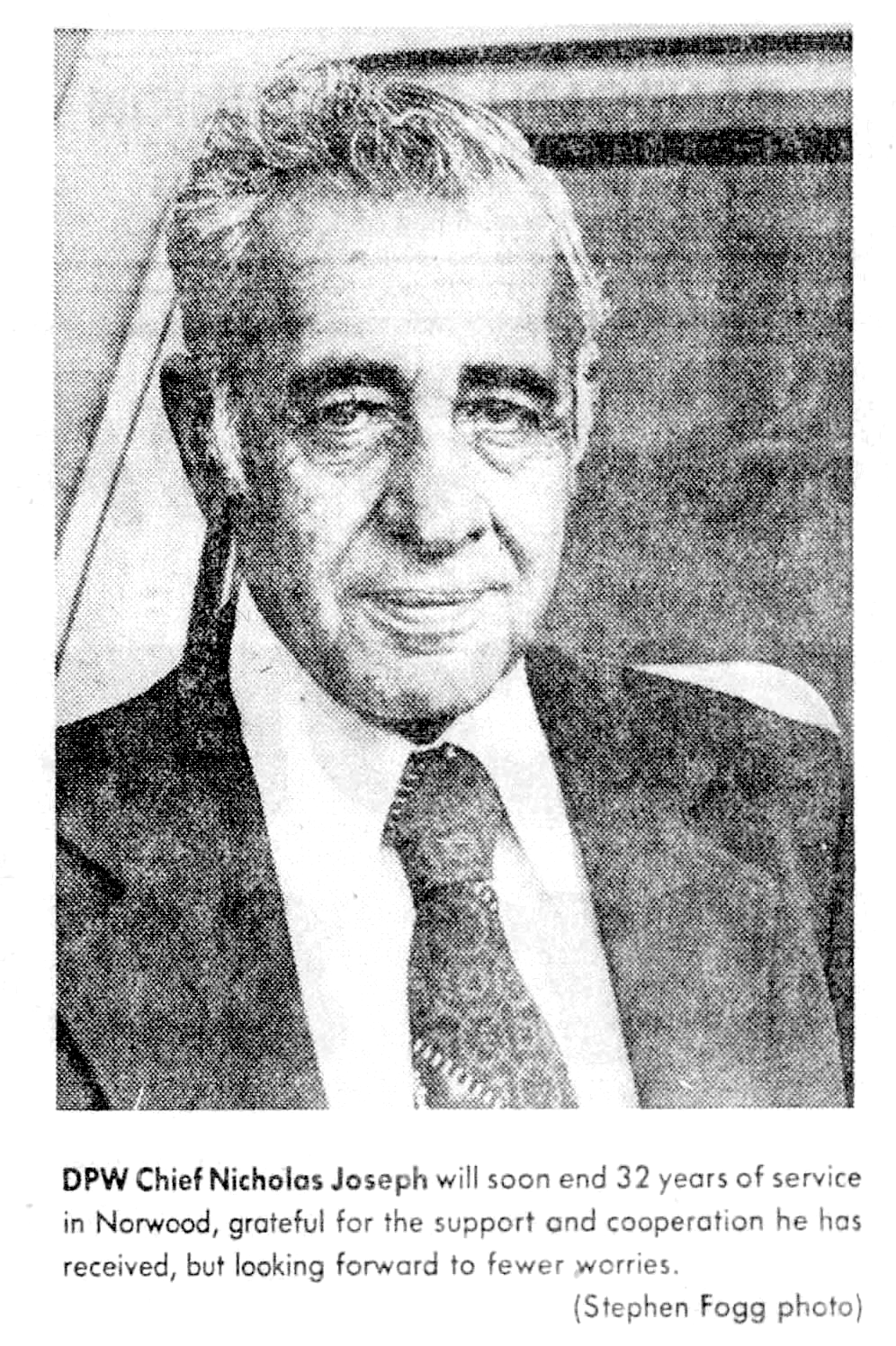
Retiring DPW Superintendent Nicholas Joseph Reflects on 32 Years of Municipal Service in Norwood-October 25, 1979
After 32 years of managing Norwood’s infrastructure, DPW Superintendent Nicholas Joseph is retiring, leaving behind a legacy of fiscal prudence and hands-on municipal leadership.
-
Webber, Mogan See No Conflict In Holding Dump Job, Board Post-July 18, 1977
Norwood was abuzz with controversy in the sweltering summer of 1977. At the epicenter of this maelstrom was Kenneth E. Webber, a stalwart employee of the Department of Public Works and an integral member of the Board of Health. The allegations of a possible conflict of interest had been swirling like a tempest, with many…
-
Norwood Town Dump Recycling Program Generates Modest Revenues-July 25, 1974
Norwood’s fledgling municipal recycling operation at the town dump generated just $1,915 in 1973 from the resale of salvaged materials such as glass bottles, newspapers, tin cans, tires, and old appliances. According to Town Manager John P. Morgan, despite the modest financial return—which trailed far behind neighboring Wellesley’s $15,000 annual recycling yield—he remained optimistic about…

-
Norwood Dump Committee Considers Fee Scale for Commercial Rubbish Collectors—September 13, 1971
Norwood dump committee explores commercial user fees for industrial rubbish haulers to conserve landfill space, while $130,000 in state funds is released for the Pleasant Street bridge.
Discover more from Norwood Historical Society
Subscribe to get the latest posts sent to your email.