
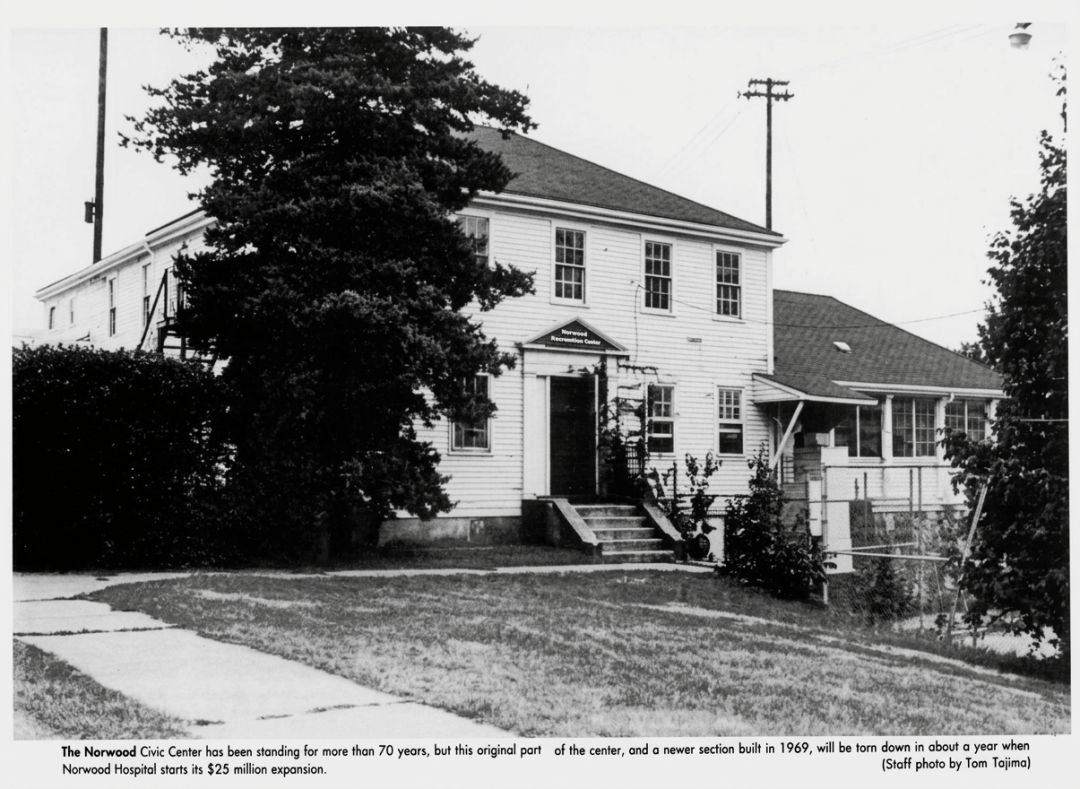
Board Approves Property Sale Article for Jan. 3 State Certificate of Need Deadline While Voting to Ask Town Meeting for New Recreation Study Committee
NORWOOD – The intertwined questions of Norwood Hospital’s proposed expansion onto the municipal Civic Center property and where to rebuild the town’s public recreation facilities were placed squarely before a December 13, 1976 special town meeting following a divided session of the Board of Selectmen on Tuesday night, November 16, 1976. Reported by Patriot Ledger correspondent Marion Earley, selectmen voted to place an article on the special town meeting warrant authorizing the sale of the Civic Center land to the hospital—a step needed in time for hospital officials to submit a Certificate of Need application to the state by January 3, 1977.
When discussions turned to planning replacement recreation facilities, however, selectmen and their advisory study committee fractured in multiple directions. Heeding the study committee’s recommendation to hire professional planners, Selectman Joseph Wall moved to request a $4,000 reserve fund transfer to retain outside consultants. That motion was defeated after Selectman Walter I. Dempsey argued for broader citizen participation, successfully moving instead to ask the December 13 special town meeting to appoint a dedicated committee to survey residents and determine what facilities Norwood wanted and where they should be built. “This is a gigantic problem that should be solved by as much of the town as possible – that’s a town meeting,” Dempsey stated. “If it is a town meeting committee, town meeting will most likely support its findings.”
Study Committee Disbands Amid Confusion as Hospital Warns Delay Costs $167,000 Monthly
The selectmen’s vote immediately drew sharp concern from Rudith Berkowitz of the existing hospital study committee, originally established by the late Selectman Charles L. Rich in August 1975. “I don’t see how the hospital is going to be able to get a certificate of need or town meeting get a vote the way we are proceeding,” Berkowitz said. Although the study committee recommended approving the Civic Center transfer and agreed to submit a written report listing alternative sites—building on a list compiled months earlier by Town Engineer Robert Hamilton—the panel disbanded amid confusion over its mandate. Berkowitz noted that committee members believed the town should cooperate with the hospital while ensuring replacement facilities matched town needs at a site of Norwood’s choosing, but said the panel lacked strong direction from its chairman, Selectmen Chairman Joseph F. Curran, and could not act decisively until hospital trustees formally voted on October 27 to pursue the land.
Curran candidly admitted he “did a lousy job chairing the committee,” yet opposed forming yet another panel: “Selectmen can make a recommendation for replacement facilities with the help of professional planners. Another committee will only add to the confusion.” Further muddying the waters, Selectman William F. Butters—a vocal opponent of the hospital’s expansion plan—joined Dempsey in voting for the town meeting study committee, suggesting its first task would be evaluating the feasibility of transferring the property at all and raising the prospect of postponing the Civic Center sale article. Contacted after the meeting, Hospital Administrator David P. Buchmueller warned that postponing the sale would cost the hospital $167,000 per month in construction inflation or reduced facilities, stressing that trustees needed “an indication it has substantial interest in the property” before filing their January 3 state application.
Independent Replacement Appraisals Awaited as Hospital Outlines Economic Benefits and Site Constraints
In a companion report, Buchmueller told a two-hour briefing of roughly 40 town officials and town meeting members at the hospital that selectmen and hospital leaders would meet the following Tuesday to compare independently commissioned appraisals calculating the full replacement cost—rather than mere market value—of the Civic Center complex. Buchmueller expressed optimism that if the two appraisals landed within $50,000 of each other, both sides could quickly agree on a sale figure; a wider gap would trigger compromise negotiations. The hospital’s architectural firm, The Architects Collaborative of Cambridge, was preparing multiple estimates factoring in 1977 construction costs, central-location land value, and optional upgrades such as a regulation-size gymnasium and Olympic-size swimming pool—though Buchmueller noted the hospital was committed only to funding the replacement of existing Civic Center amenities.
During the briefing, Buchmueller and Hospital Trustees President John C. Fuller emphasized that Norwood Hospital had no ready fallback option if Town Meeting rejected the Civic Center sale. “We are back to the drawing boards,” Fuller remarked. Buchmueller dismissed complete relocation of the hospital as financially “out of the question,” called expanding onto the corner of Linden Street, Guild Street, and Broadway a “desperation move” covering less than half the Civic Center’s acreage, and noted that splitting departments onto a separate site was an undesirable last resort. When an attendee suggested building on idle railroad land between Broadway and Lenox Street connected via tunnels, Buchmueller noted Town Manager John P. Mogan was investigating that parcel’s status. Addressing concerns over removing potentially taxable land from town rolls, Buchmueller countered that an expanded hospital would create 300 new jobs generating roughly $2.5 million in annual wages, far outweighing any foregone tax revenue.
1976 Hospital Expansion Figures Adjusted to 2026 Dollars & Site Legacy
Inflation-adjusted using U.S. Bureau of Labor Statistics CPI data ($1.00 in Nov. 1976 ≈ $5.64 in 2026)
| 1976 Estimate / Proposal | 1976 Amount | 2026 Equivalent |
|---|---|---|
| Projected Annual Wages From 300 New Hospital Jobs | $2,500,000 | ~$14,100,000 |
| Estimated Monthly Cost of Project Delay | $167,000 / mo. | ~$941,880 / mo. |
| Appraisal Settlement Tolerance Threshold | $50,000 | ~$282,000 |
| Defeated Reserve Fund Request for Planners | $4,000 | ~$22,560 |
Archival Note: This article has been dynamically reconstructed from the original public record print archives of the Patriot Ledger
Discover more from Norwood Historical Society
Subscribe to get the latest posts sent to your email.