
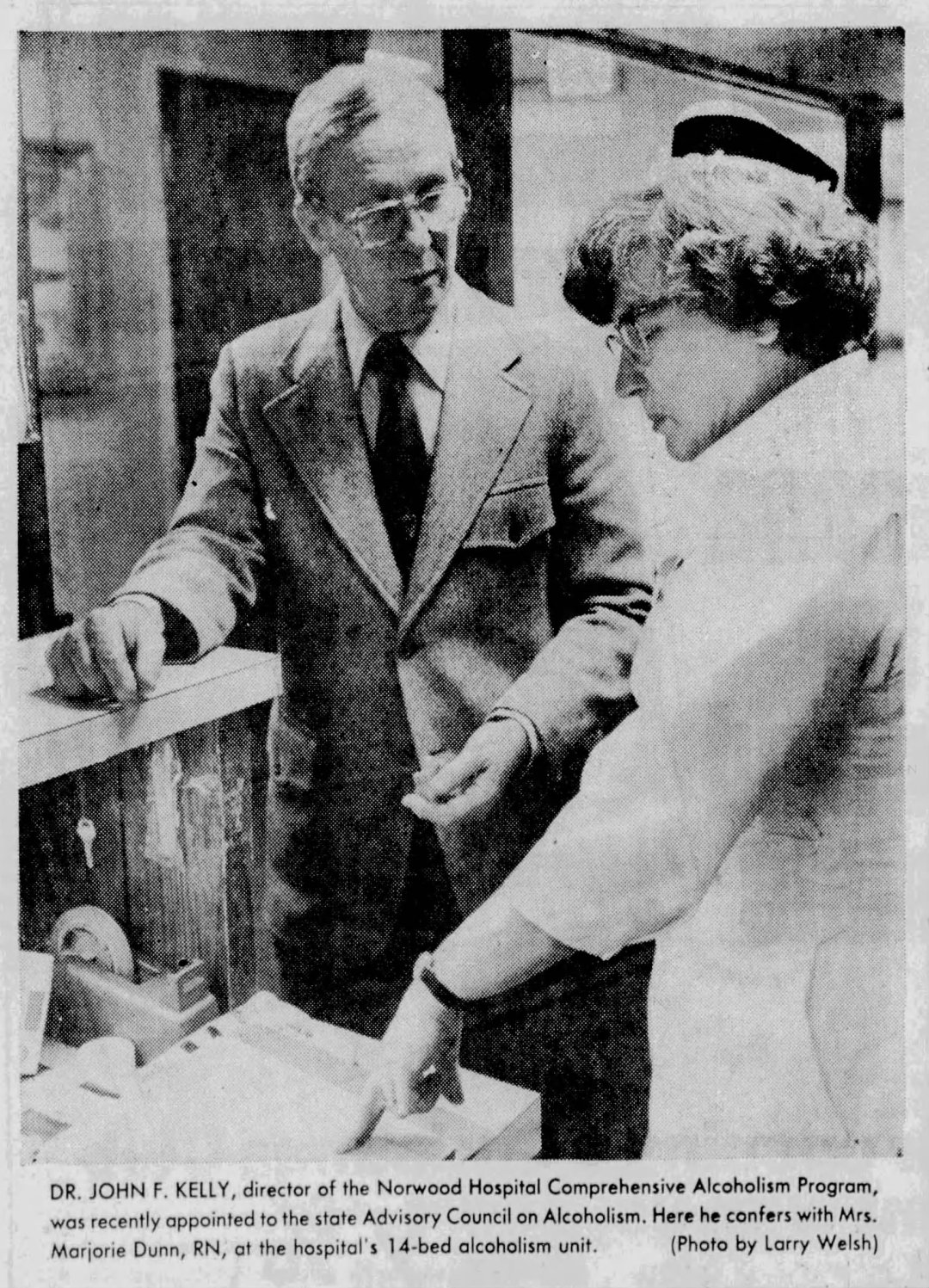
Appointed by Gov. Michael S. Dukakis to the State Advisory Council on Alcoholism, the Norwood Hospital Program Director Urges School Education and Family Therapy
NORWOOD – Alcoholism—what Dr. John F. Kelly called “this horrible disease”—was no longer an illness that society could afford to sweep under the rug, and as administrative director of the Norwood Hospital Comprehensive Alcoholism Program, Dr. Kelly was working to make it a priority of public concern through classroom education and expanded therapy. Featured in The Patriot Ledger on Friday, November 25, 1977, by staff reporter Nona Dearth—accompanied by a photograph by Larry Welsh showing Dr. Kelly conferring with Mrs. Marjorie Dunn, RN, inside Norwood Hospital’s 14-bed alcoholism unit—the report examined Kelly’s mission following his appointment by Governor Michael S. Dukakis to the Massachusetts Advisory Council on Alcoholism.
Bringing local clinical leadership to the statewide council, Dr. Kelly emphasized both the massive economic burden of alcohol abuse and its far deeper human toll. Nationally, alcoholism was estimated to cost American industry at least $8 billion annually in lost productivity through absenteeism, inefficiency, and workplace accidents, with 5 to 10 percent of the workforce experiencing an alcohol problem. Yet as Dr. Kelly noted, financial figures told only part of the story; the human cost in fractured families, broken homes, and lost personal pride was immeasurable. Across Massachusetts, roughly 300,000 individuals suffered from alcoholism—representing approximately one million residents when including family members needing support to rebuild their lives—a figure growing as teenagers and youngsters as young as the sixth grade increasingly turned to alcohol “for kicks.”
“To make any inroads into this problem of alcoholism, we have to get into primary prevention,” Dr. Kelly stated. “This means going into the schools, training teachers how to handle it, reaching the kids even down to kindergarten. It’s a very subtle program.” Alongside primary prevention in public schools, Kelly advocated vigorously on the state council for early intervention—reaching individuals with drinking problems and their relatives long before family life became unbearable. In doing so, he sought to dispel pervasive myths surrounding alcoholism, particularly the belief that a person had to “hit bottom” before stopping drinking.
“In 90 percent of the families that come to us at Norwood Hospital the alcoholic is still drinking and functioning to a degree,” Dr. Kelly explained. “But early intervention is not a question of just reaching the drinker but also reaching the family so they can cope with this horrible disease.” Whereas earlier generations of medical and social professionals focused almost solely on “treat[ing] the casualties,” Norwood’s comprehensive approach treated the physical and emotional injuries suffered by family members as an equally urgent priority. “Early intervention can prevent a lot of suffering,” Dr. Kelly observed. “But the long range effort has to be a decrease in drinking problems. You have to teach the youngsters the importance of responsible drinking, if they are going to drink.”
Although the 1973 decriminalization of alcoholism in Massachusetts had opened the door for the Advisory Council to introduce modern treatment programs, Dr. Kelly pointed out sharp funding constraints. For 1978, the council operated on an $8.2 million budget, with $5.8 million directed toward statewide detoxification centers—where patients remained for an average of three days to “dry out,” an approach Kelly warned held limited long-term value without a structured, family-involved outpatient program—and the balance funding halfway houses and similar facilities. Almost no funding remained for primary prevention after state officials turned down a $95,000 primary prevention request. “Compared to the taxes the state takes in on the sale of alcohol, what we get is peanuts,” Dr. Kelly commented. Despite the funding shortfall, having witnessed genuine rehabilitation among patients treated at Norwood Hospital’s 14-bed alcoholism unit through therapy and compassionate support, he remained optimistic and determined not to give up on conquering “this horrible disease.”
Source: The Patriot Ledger • Friday, November 25, 1977 • Byline: Nona Dearth • Photo: Larry Welsh
“In 90 percent of the families that come to us at Norwood Hospital the alcoholic is still drinking and functioning to a degree. Early intervention is not a question of just reaching the drinker but also reaching the family so they can cope with this horrible disease.”
| 1977 Public Health & Budget Figure | 1977 Amount | 2026 Equivalent |
|---|---|---|
| Estimated Annual U.S. Industrial Losses From Alcoholism | $8,000,000,000 | ~$42,400,000,000 |
| 1978 Massachusetts Advisory Council on Alcoholism Budget | $8,200,000 | ~$43,460,000 |
| State Allocation for Detoxification Centers (1978 Budget) | $5,800,000 | ~$30,740,000 |
| Rejected State Primary Prevention Program Request | $95,000 | ~$503,500 |
Archival Note: This article has been dynamically reconstructed from the original public record print archives of the Patriot Ledger
More Norwood Hospital Stories
-
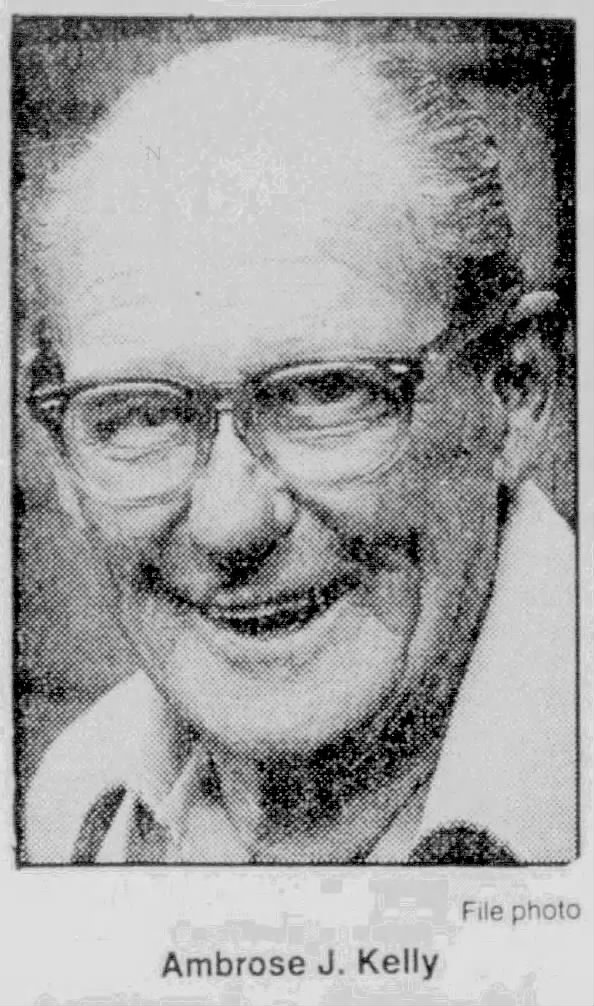
Ambrose Kelly Renews Criticism Over Norwood Hospital Civic Center Purchase-September 17, 1979
Former Finance Commissioner Ambrose J. Kelly revives opposition to Norwood Hospital’s purchase of the Civic Center, arguing promised replacement facilities have not materialized
-
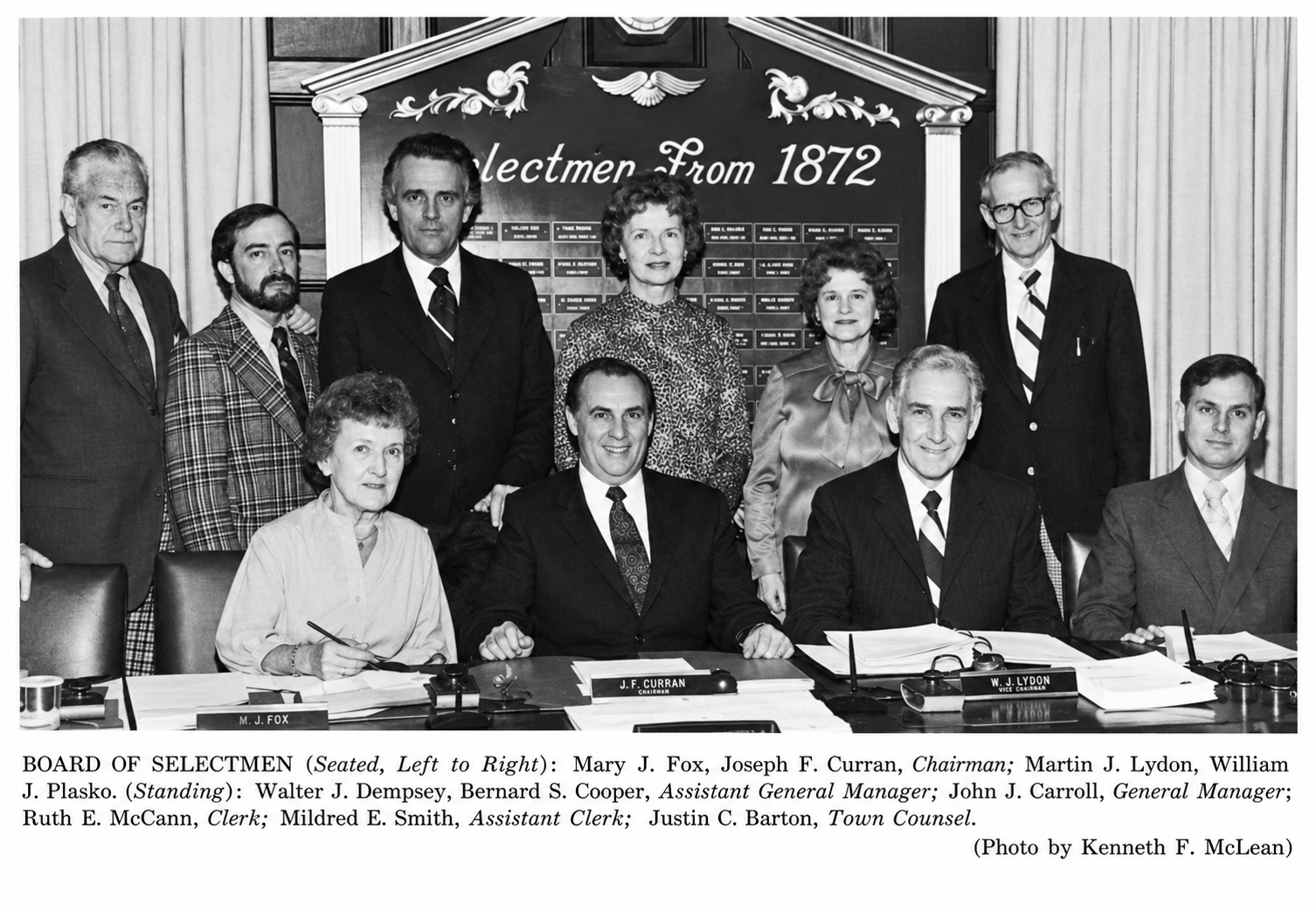
Chemical Concerns at Buckmaster Pond; Selectmen Tighten Fuel Storage Rules-September 12, 1979
Town Manager John J. Carroll reports a borderline concentration of tetrachloroethylene in the Buckmaster Pond well in Westwood, prompting caution on upcoming water infrastructure investments.
-
Zoning Board of Appeals Set to Review Norwood Hospital Expansion Plans Following Purchase Agreement-August 17, 1979
Building Inspector John E. Grover confirmed that Norwood Hospital must secure zoning board special permits for its Civic Center expansion as officials prepare for an August 23 groundbreaking.

-
Aaron Guild School Leased to Norwood CETA Consortium and EdCo for One Year-August 1, 1979
Norwood selectmen voted unanimously to lease the closed Aaron Guild School for one year to the Norwood CETA Consortium and the Educational Collaborative of Greater Boston (EdCo) for $148,000.

-
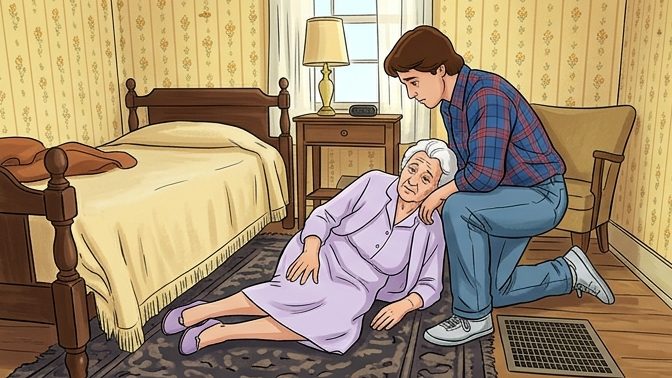
Rescued by Neighbor: Norwood Woman Survives 5-Day Ordeal-July 9, 1979
Discover the heroic story of Jim Rossetsky, an orderly at Norwood Hospital, who discovered his 65-year-old neighbor injured in her bedroom after she had been trapped for five days.
-
Norwood Couple Questions Legality of New Access Road Built Next to Their Sumner Street Home-August 8, 1978
Anita and Joseph Fraone questioned the legality of a new bulldozer-cleared access road beside their 99 Sumner St. home during a Norwood Planning Board meeting.
-
Hazardous Shooting Incident On Route 1-July 22, 1978
On July 22, 1978, Stephen Pacheco was sought after a van was struck by gunfire near the Norwood-Canton exit.

-
Norwood Selectmen Uphold Fire Department Staffing Levels Amid Labor Disputes-July 12, 1978
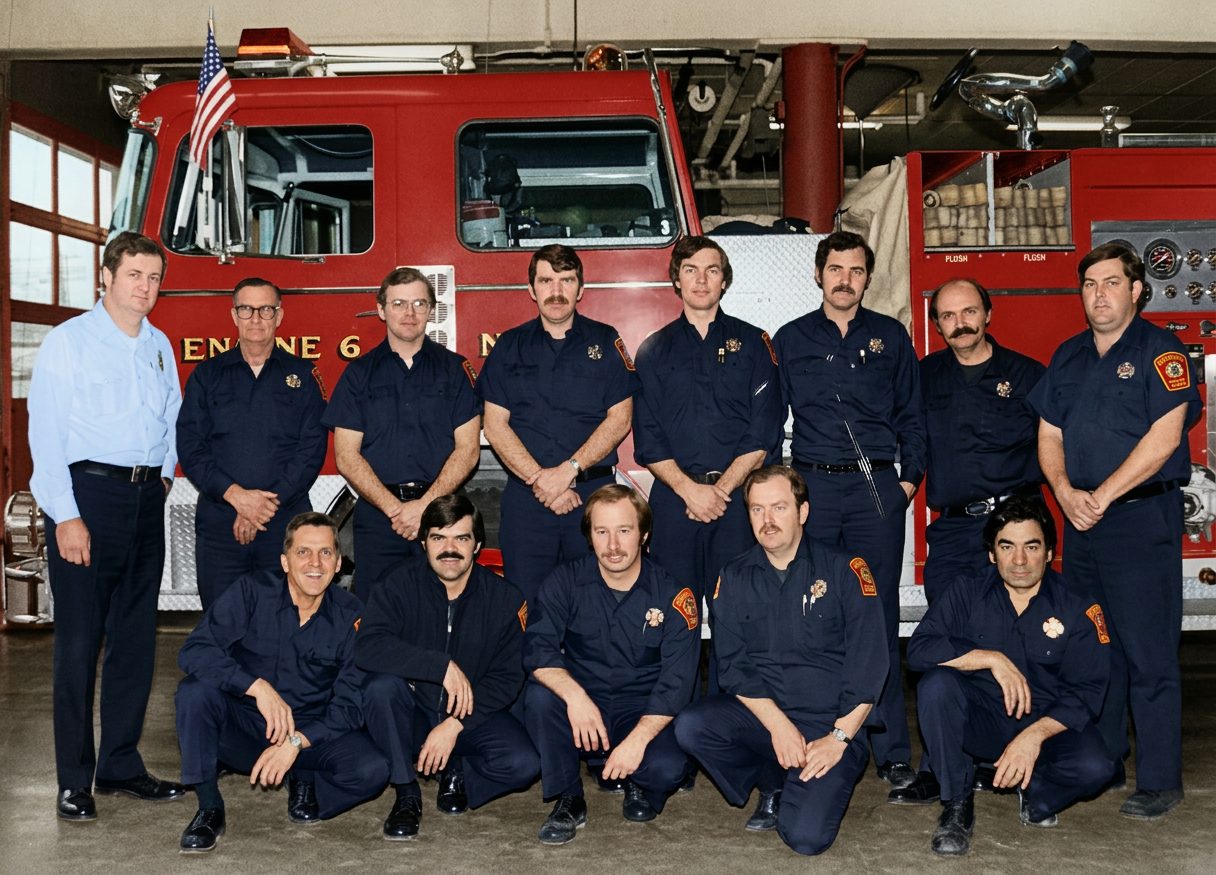
Fire Department Manning Shifts and Physical Exam Standoff On July 12, 1978, the Norwood Board of Selectmen stepped directly into a complex municipal and labor dispute, voting 3–1 to reaffirm a long-established minimum manning policy of 13-man shifts within the Norwood Fire Department. The decision effectively determined that any budgetary economies or cost-cutting measures targeted…
-
Some Cold Facts Could Save A Life-June 20, 1978
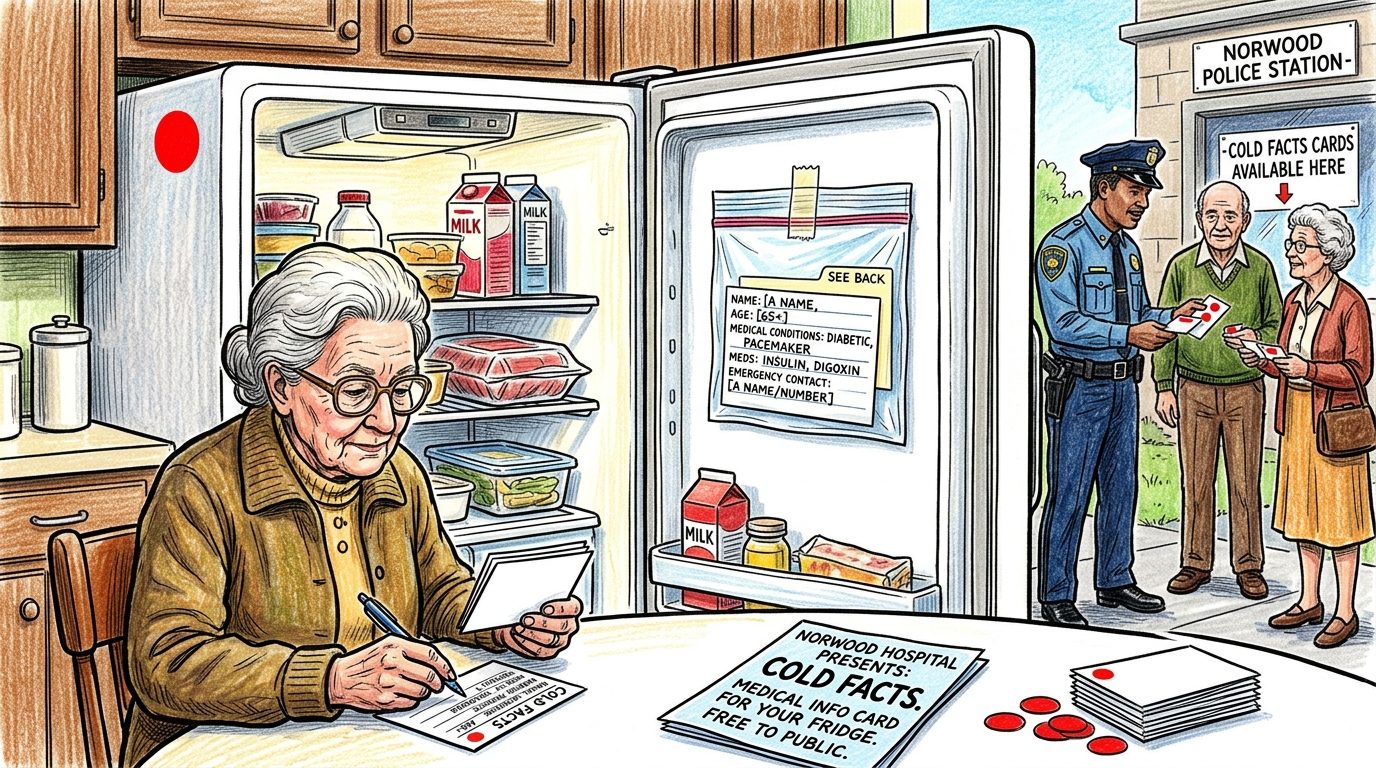
Norwood Hospital distributes free emergency medical indicators via local police stations and senior hubs.
-
Resident Jeannette Troiano Proposes Voluntary Smoke Detector Program to Norwood Selectmen-November 16, 1977
Following the defeat of a $190,000 townwide smoke detector article, Norwood resident Jeannette M. Troiano urged selectmen and local civic groups to consider a voluntary bulk-purchase program.
Discover more from Norwood Historical Society
Subscribe to get the latest posts sent to your email.