
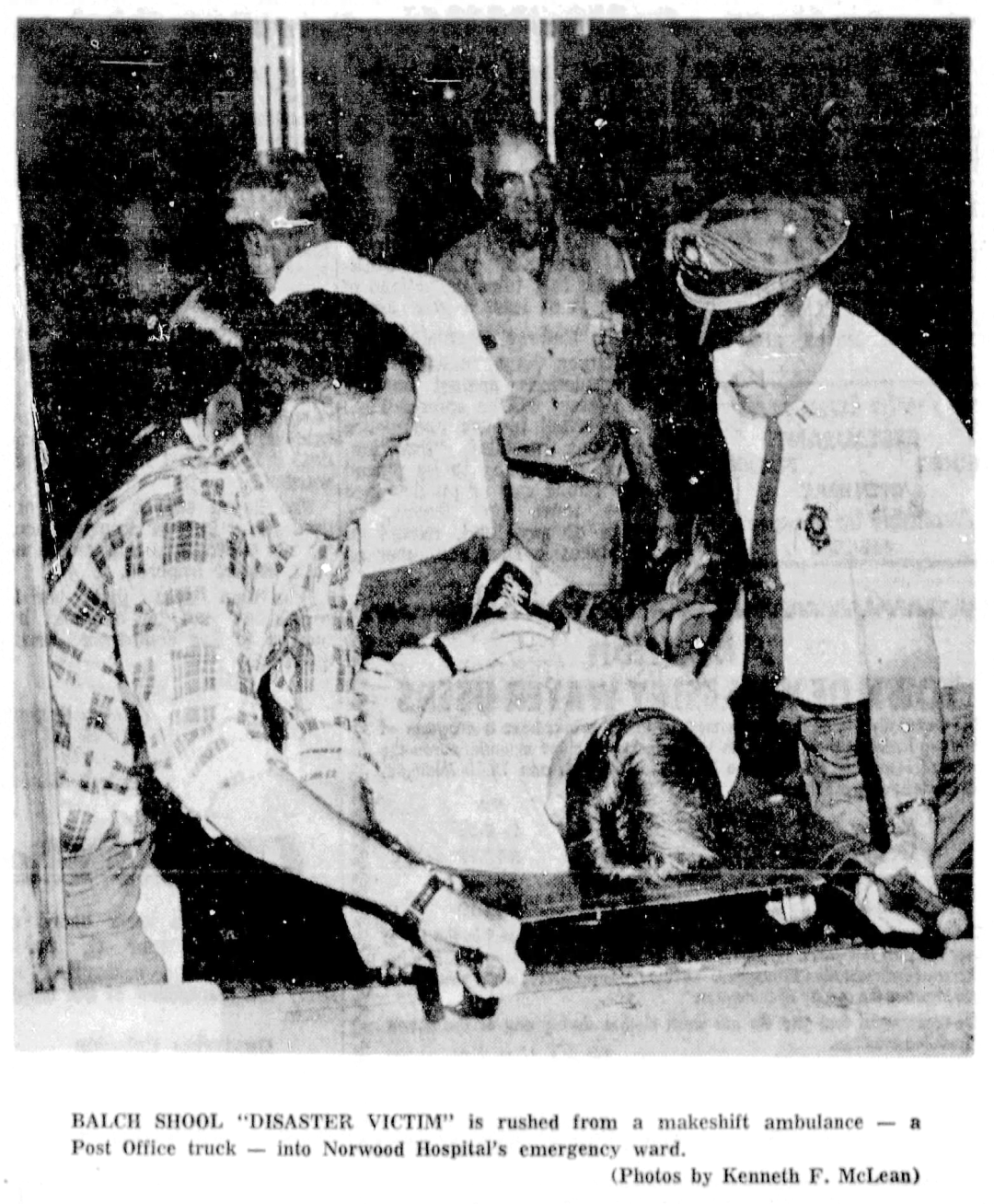
For most people, Thursday afternoon began normally and calmly. But at 3:21 p.m., the report came across the wire: the Balch School on Washington Street had suddenly collapsed, leaving 20 elementary school students with severe simulated injuries requiring immediate medical intervention.
Fortunately, the crisis was entirely fictitious—a carefully plotted surprise mass-casualty drill designed by the hospital administration to satisfy a Joint Commission on Accreditation of Hospitals requirement for a written disaster plan and regular operational rehearsals.
Mobilizing the Emergency Response
As soon as Civil Defense Director Joseph McAuliffe notified local authorities, the hospital shifted immediately into a “Code 11” disaster plan. Public nurses, administrative clerks, janitors, security police, and laboratory technicians raced to man their assigned alert posts.
Transporting the “victims” required a coordinated fleet, including a police ambulance, two Post Office trucks, a Red Cross vehicle, and the Norwood Recreation Department station wagon. Captain John P. Souza directed security personnel as they picked up the casualties from the disaster site at five-minute intervals, rushing them to the hospital’s emergency entrance.
Volunteers Play Their Parts
The volunteer “victims” were 20 members of Boy Scout Troop 83, who had assembled earlier at 3:00 p.m. at the Balch School to be outfitted with realistic masks, splints, bandages, and theatrical makeup applied by McAuliffe and an assistant.
Once inside the emergency ward, experienced doctors and nurses stood ready to triage. Women from the medical records department rushed out with index cards to tag the youngsters and record vital details. While most scouts maintained solemn expressions—including one boy whose face featured a chillingly realistic simulated wound with congealing blood—others couldn’t resist a bit of banter.
Eleven-year-old Mark Maienza, strapped into a chair after joking he had a broken back, tried to talk his way into keeping his makeup mask: “Halloween is coming,” he cajoled. Another scout, rolled through on a stretcher, yelled to a friend, “Hey, Bob. Hi. They already fixed me,” to which his companion cheerfully shouted back about imaginary internal pains before being dispatched straight to the operating room.
Smooth Execution and Sweet Rewards
Medical oversight for the drill was managed by co-chairmen Drs. Arthur Klein, Louis A. Sieracki, and Martin L. Bradford, while assistant hospital administrator Donald S. Broas served as co-coordinator alongside McAuliffe. Broas noted that while staff knew a drill was expected sometime that day, only a few key personnel knew the exact timing.
The medical staff performed efficiently: even Walpole physician Dr. Jan Skancky rushed from his crowded office upon hearing the emergency alert, checked in, and then returned to his patients once his role was complete. By 3:45 p.m., all mock victims had been completely evacuated from the Washington Street area, and by 4:05 p.m., every participant had been diagnosed, treated, and processed.
Declaring the exercise an absolute success, Broas remarked, “The real purpose of this drill is to teach people to move and to fill out forms… Of course we’re better under real conditions, like the Walpole riot last year. But the drill was a success.”
With their mission officially completed at 4:15 p.m., the hardworking Boy Scouts were treated to a well-earned reward in the hospital cafeteria: ice cream and cookies.
Archival Note: This article has been dynamically reconstructed from the original public record print archives of the Patriot Ledger
More Norwood Hospital Stories
-
Hostage Taken in Robbery, Officer Shot, 2 Arrested-This Day in Norwood History- September 7, 1974
This Day in Norwood History- September 7, 1974-Hostage Taken in Robbery, Officer Shot, 2 Arrested
-
Proposed Land Swap Between Norwood Civic Center and Hospital Expansion Site Generates Mixed Reactions-August 17, 1974
Candidate Francis J. Keady proposed trading the Norwood Civic Center for the hospital’s 24-acre Walpole expansion site, drawing skepticism from town manager John P. Mogan and selectman Joseph W. Wall.
-
Midday Fire at 12 Vernon Street Sends 21 Firefighters to Norwood Hospital-August 8, 1974
A fast-moving basement fire at 12 Vernon Street caused $16,000 in damage and sent 21 firefighters to Norwood Hospital for smoke inhalation and heat-related injuries.
-
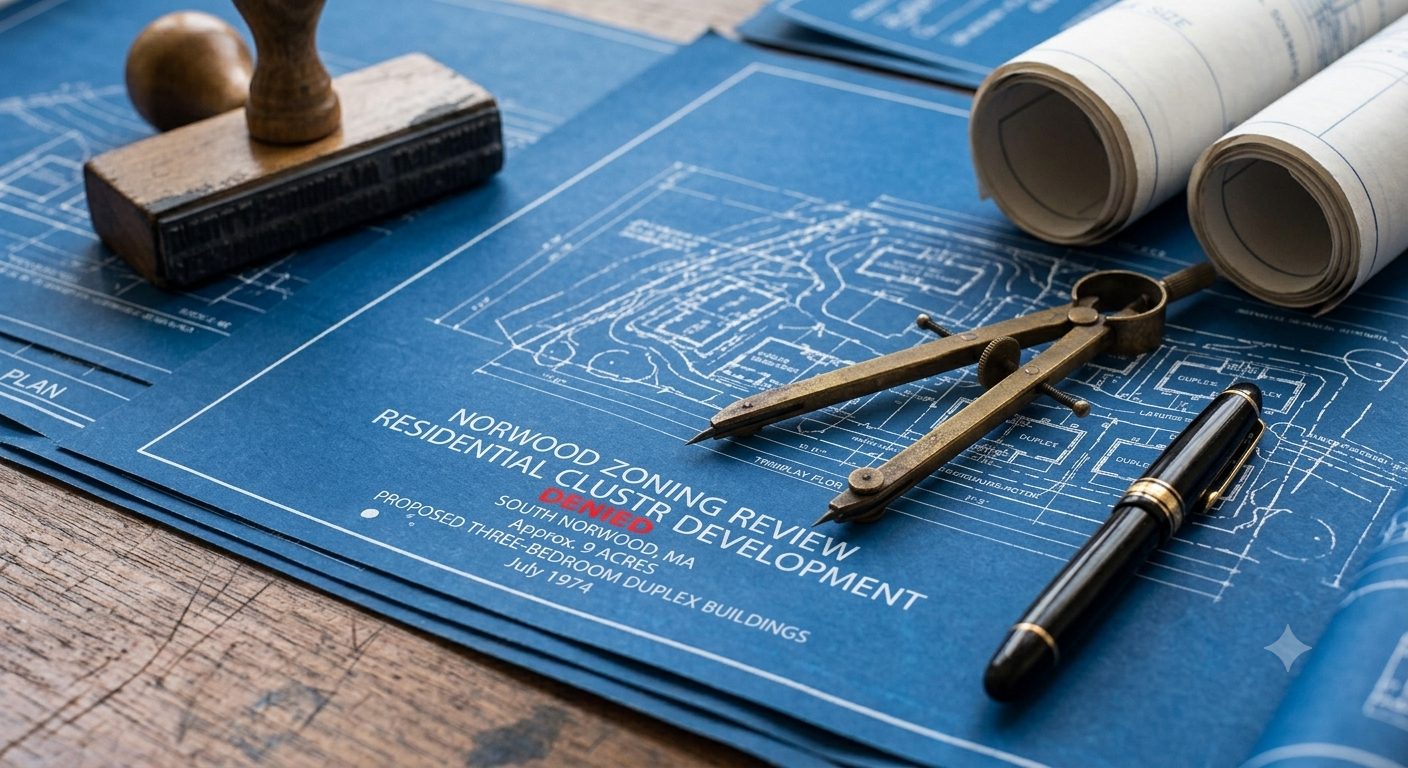
Norwood Appeals Board Denies Permit For South Norwood Development-July 27, 1974
The Norwood Appeals Board rejected a nine-acre duplex development by Hobbs Realty Trust due to severe flooding risks, drainage issues, and emergency vehicle access concerns.
-
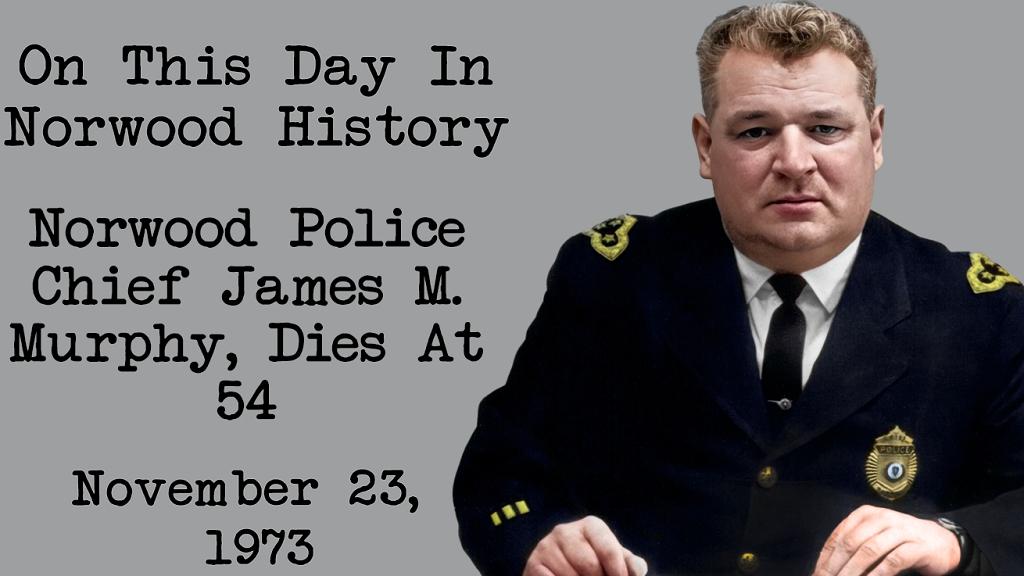
Norwood Police Chief James M. Murphy Dies At 54-November 23, 1973
Norwood Police Chief James M. Murphy, 54, died yesterday at Norwood Hospital, where he was admitted Thanksgiving Day after a heart attack. Chief Murphy, a Norwood police officer for 33 years and police chief for 10 years, was one of the state’s youngest police chiefs when appointed in 1963. A funeral Mass will be said…
-
Norwood Hospital to Combat Suburban Drinking Crisis-October 24, 1973
As Norwood Hospital’s new alcoholism coordinator, Joan Gallagher partners with local police and employers to address the hidden crisis of suburban alcoholism across the 11-town region.

-
Norwood Board Weighs Alternatives For Two Lyman Place Houses-October 17, 1973
Rewritten Narrative Feature A Town Divided Over Municipal Property The future of two Lyman Place houses—purchased by Town Meeting for $25,000—remains completely unresolved following a tense and ultimately inconclusive joint meeting between the Board of Selectmen, the Youth Commission, and representatives from the Pulse hotline. Situated near the public works yard, the properties were initially…

-
Budget-Minded Norwood Officials Form Committee to Trim Overweight Town Report-August 2, 1973
Following a record 580-page centennial town report costing $6,800, Norwood town manager John P. Mogan and local officials formed a special committee to cut extraneous material and reduce future printing costs.
-
Police-Fire Substation Proposed for Old South Norwood Theater Site-November 6, 1972
Led by Selectman William F. Butters, Norwood officials are moving to demolish the former South Norwood theater on Washington Street to construct a new public safety substation.
-
First Male Graduate Breaks Tradition at Peabody Practical Nursing School-August 28, 1972
David Thurber of Austin Street breaks tradition as the lone male among 32 graduates to become the Henry O. Peabody School’s first male licensed practical nurse.
Discover more from Norwood Historical Society
Subscribe to get the latest posts sent to your email.