

As school doors swung open for the new academic term, Norwood High School officially launched an ambitious and innovative “open campus” plan, though initial participation drew a select group of students. Out of approximately 1,600 enrolled high school students, 122 pupils—representing less than 10 percent of the student body—signed formal agreements to participate in the experimental program on opening day.
Structure, Objectives, and Community Involvement
Spearheaded by Principal John F. Monbouquette, assistant superintendent for the secondary level John Donovan, and a dedicated staff advisory committee on school policy, the open campus initiative was designed to maximize the utilization of school facilities for an anticipated peak enrollment of 2,150 students by September 1974 while fostering greater personal responsibility among young adults.
Key structural and operational features of the program include:
- Extended Day Schedule: The traditional seven-period academic day was expanded into a nine-period schedule, unlocking roughly 60 additional learning spaces per period and temporarily alleviating severe classroom overcrowding.
- Unscheduled Time and Off-Campus Privileges: Students with unscheduled class periods are permitted to leave school grounds to go home, engage in approved work-study programs, or participate in community volunteer initiatives at local institutions such as Norwood Hospital, nursing homes, and the Wrentham State School for retarded children. On-campus students utilize the enlarged library media center or departmental resource centers for independent study.
- Mini-Courses and Cultural Enrichment: To engage students’ diverse interests, the curriculum incorporates short “mini-courses” taught by community members, alongside expanded auditorium programming featuring films, guest speakers, and performing arts panels.
- Strict Accountability Contracts: To ensure safety and liability protection, participating students and their parents were required to sign formal contracts absolving the town from responsibility for mishaps occurring off school grounds while reaffirming strict academic and behavioral expectations. School officials noted that roughly 100 parents had not yet returned signed contracts, placing those students on the standard traditional schedule pending formal authorization.
Archival Note: This article has been dynamically reconstructed from the original public record print archives of the Patriot Ledger
More…
-
School Drop-In Centers Possible In Fall-June 24, 1974
Citing summer custodial constraints and a lack of air conditioning, town officials vote to survey local youths during the summer to prepare for a fall launch.

-
Proposal Would Combine High School and Henry O. Peabody School Facilities-October 4, 1973
The School Committee reviews a preliminary proposal to combine Norwood High School and Henry O. Peabody School facilities for a new career development and vocational program.

-
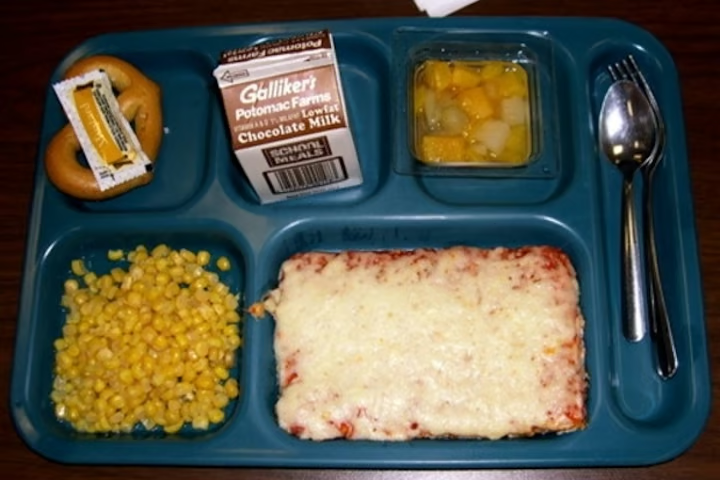
Public Schools Face Delays and Possible State Action on Mandatory Hot Lunch Program-August 31, 1973
Parents of elementary school students in Norwood will need to continue packing brown-bag lunches for the start of the academic year. School Superintendent Philip O. Coakley announced that the town will fail to meet the state-mandated September deadline for implementing a universal public school hot lunch program, exposing the municipality to potential legal action by…

-
Norwood High School Refines Open Campus Program in Second Year of Operation-October 2, 1972
Entering its second year, Norwood High School’s open campus system sees tighter corridor rules, sophomore restrictions, and expanded academic seminars while undergoing state-mandated evaluation.

-
Andy Scafati Recalls 40 Seasons in Athletics Ahead of Norwood Retirement-September 7, 1972
Longtime Norwood High School athletic director Andy Scafati reflects on 40 years in sports and the remarkable expansion of the town’s athletic programs as he prepares to step down.

-
School Board Reverses Vote, Keeps NorWest Woods Pupils at Oldham-August 29, 1972
In a reversal of a previous decision, the School Committee has voted to keep 46 elementary school children from the Nor-West Woods apartment complex at the Oldham School, rescinding a July 5 vote that would have transferred them to the Shattuck School. Superintendent Dr. Philip O. Coakley explained that the committee revoted on the matter…

-
Norwood Sets $38 Tax Rate on Court-Ordered 100% Property Valuation for 1972-August 16, 1972
Announcing a 1972 tax rate of $38 per $1,000 under a court-ordered 100 percent property valuation, Assessor Chairman James J. Drummey concluded a major reassessment by Cole, Layer and Trumble.

-
Norwood Jr. High Offered Land At $9,500 An Acre-September 30, 1971
The Norwood School Committee recommends the Endean area in Walpole as the site for a new junior high school, facing sharp questioning from town meeting members over rising costs and site shifts.

-
Norwood High School Launches Innovative Open Campus Plan for Fall Term-September 8, 1971
Norwood High School opens the fall term by launching an innovative open campus and extended-day program designed by Principal John F. Monbouquette to foster student responsibility.
-
Junior High Alternate Estimates Sought-June 25, 1971
A sharp debate divides Town Manager Walter Blasenak and finance officials over mounting unappropriated architectural fees for Boston design firms.




Discover more from Norwood Historical Society
Subscribe to get the latest posts sent to your email.