Employees Are Peaceful

The early days of May 1904 found the town of Norwood caught in the quiet but unmistakable tension of a labor dispute that had swept across the New York, New Haven & Hartford Railroad system. While negotiations elsewhere were marked by secrecy and guarded statements, the situation in Norwood carried its own distinct character — a mixture of uncertainty, guarded optimism, and the unmistakable presence of outside forces brought in to maintain order.
The trouble had begun when several crafts across the railroad system pressed for wage increases. Boiler makers had already walked out, car workers were debating whether to strike, and machinists across the line were weighing their options. But in Norwood, the story took a different turn. Here, the machinists at the local shops received word from union representatives in New Haven, Connecticut that the company had offered a wage increase of 6⅔ percent, and — crucially — that this offer had been accepted.
It was enough to avert a strike.
The machinists, who had been preparing for the possibility of walking out, instead remained at their posts. Their acceptance of the company’s terms brought a measure of stability to the Norwood shops, even as other crafts continued their negotiations. The blacksmiths, who were widely expected to join the machinists in a sympathetic strike, also stayed on the job. By evening, it was reported that the company had extended to them terms similar to those accepted by the machinists, though no formal announcement had yet been made.
Still, the atmosphere in town was far from calm.
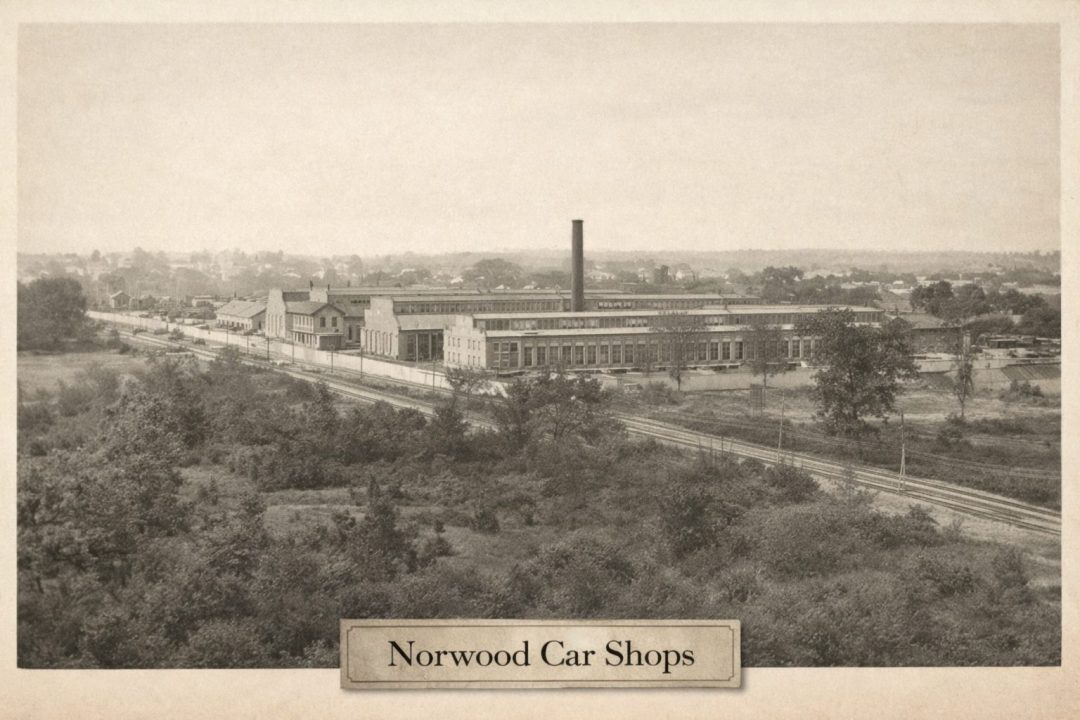
Even as the machinists returned to work, the company moved swiftly to reinforce its position. The force of nine Italian laborers brought into the shops the previous day was expanded to twenty‑four, a clear signal that the railroad intended to keep operations running regardless of union decisions. At the same time, the nine detectives who had arrived in Norwood were joined by fifty special railroad police, expected to take up duty in the car shops at Norwood Central the following morning.
Their presence did not go unnoticed.
Residents passing through the area saw the unmistakable signs of an “armed truce,” as the newspapers called it — a situation in which both sides held their positions, neither willing to escalate, neither ready to concede. The company’s decision to bring in outside labor and a sizable police force suggested that it was preparing for the possibility of broader unrest. The unions, meanwhile, continued to deliberate, with the machinists’ acceptance of the raise offering only partial relief.
The broader labor conflict remained unresolved. Across the system, car workers were still demanding a 15 percent wage increase, and their ultimatum — originally set to expire at 5 p.m. the previous day — had been withdrawn but not abandoned. The company continued to insist that wages would be raised only to match the standard paid by connecting roads, a position that fell short of the workers’ expectations.
But in Norwood, at least for the moment, the crisis had eased.
The machinists’ acceptance of the company’s offer meant that the local shops would continue to operate without interruption. The blacksmiths’ decision to remain at work suggested that they, too, might soon reach an agreement. And while the presence of detectives and special police lent an air of unease to the town, the day ended without confrontation.
For the people of Norwood, the events of May 6–7, 1904 were a reminder of the delicate balance between labor and management — a balance that could shift quickly, and one that often depended on decisions made far beyond the borders of the town. Yet in this case, Norwood’s machinists had secured a modest but meaningful victory, one that kept the shops running and the men employed, even as the larger struggle continued.
As the sun set over Norwood Central, the newly arrived special railroad police prepared to take their posts. Their presence underscored the company’s determination to maintain control, but it also highlighted the uncertainty that still lingered. The car workers had yet to decide their course, and the blacksmiths were still in talks. The broader labor dispute remained unresolved, and the company’s actions suggested that it was bracing for further developments.
Yet for the machinists — and for Norwood — the immediate danger had passed. The shops would remain open. The men would remain at work. And the town, for now, would remain calm.
🟦 The Machinist’s Ledger: 1904 vs. 2026
In 1904, the Norwood industrial landscape was dominated by the hum of the Winslow Bros. & Smith Tannery and the Plimpton Press. A Machinist during this era was a highly skilled Laborer, yet their daily life was governed by a vastly different economic reality than today’s Technicians.
To understand the civic texture of Norwood in 1904, one must look at the purchasing power of that $15.00 paycheck. The Machinist likely walked to work from a Triple-Decker on Washington Street or Morse Street, as Vehicles like the Oldsmobile Curved Dash were luxury toys for the Industrialists.
| Necessity (1904) | 1904 Price | 2026 Inflation-Adjusted Value | Modern Price (Approx.) |
| Gallon of Milk | $0.28 | $9.65 | $4.50 |
| Pound of Steak | $0.12 | $4.14 | $9.00 – $15.00 |
| Standard Bicycle | $12.00 | $414.00 | $350.00 |
| Monthly Rent | $10.00 | $345.00 | $2,400.00 |
While the Machinist of 1904 spent a massive percentage of their Wages on Food and Fuel (coal), their Housing costs were significantly lower relative to their income than the modern resident. However, the 1904 Laborer lacked Electricity, Indoor Plumbing in many cases, and the Medical Technology that we consider standard today.
What This Meant for Norwood
The 1904 economy fostered a “walkable” Town density. Because Transportation was limited to Streetcars or the New York, New Haven and Hartford Railroad, Infrastructure was built around the Factory gates. Today’s Machinist likely commutes via Automobile from surrounding Towns, reflecting a shift from a localized Labor community to a regional Economic hub.
Discover more from Norwood Historical Society
Subscribe to get the latest posts sent to your email.