
“I never voted against Henry before, but I can’t afford him any longer,” one elderly resident remarked at the polls, capturing the sentiment of many older voters who turned out in force to oust 18-year School Committee member Henry W. Diggs in Norwood’s first recall election in 40 years.
Voter Turnout and Campaign Strategies
The convergence of a large turnout of financially strapped older taxpayers and the defeat of Diggs—widely regarded as one of the most respected members of the school board in recent history—vividly demonstrated the intense public anger over rising property taxes and school spending. Recall drive leader John W. Hayes and fellow town meeting members orchestrated a targeted campaign appealing directly to Norwood’s large elderly demographic, capitalizing on pre-election projections of a $5 minimum tax rate hike that would siphon an additional $150 from the average homeowner.
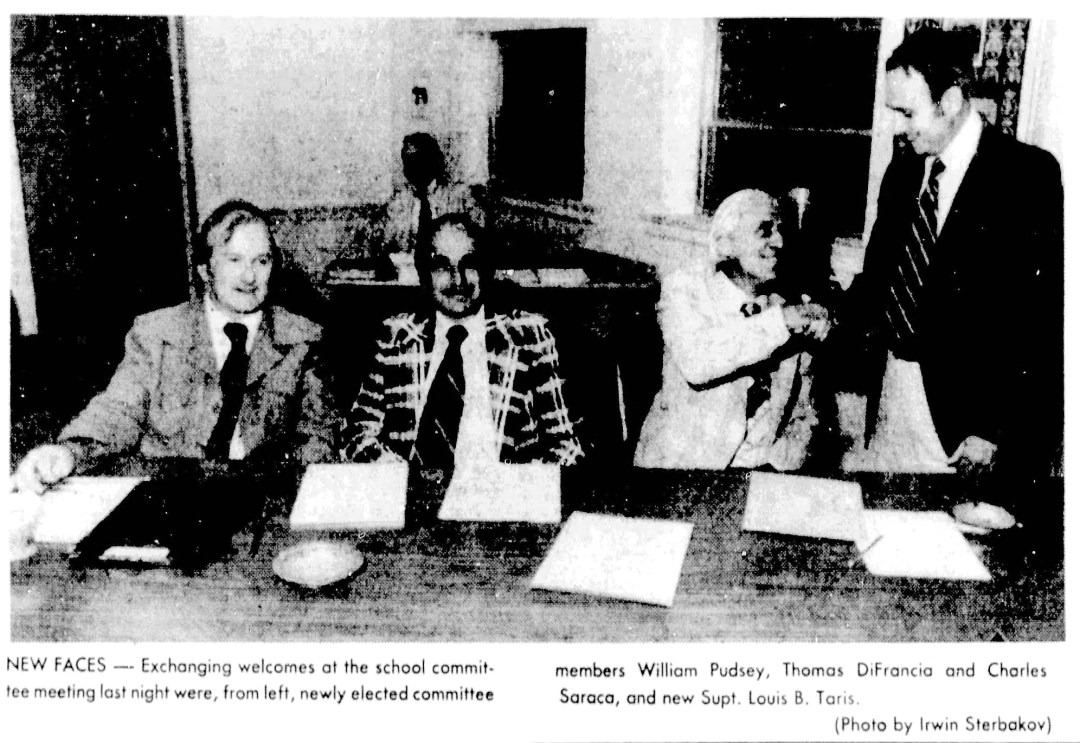
The strategy paid off at the ballot box, producing an upset that shocked political observers. While organizers anticipated defeating incumbents John H. Chisholm or Richard W. Kief, few foresaw the defeat of Diggs, who lost by a narrow margin of just five votes to challenger Thomas DiFrancia. Alongside DiFrancia, challengers Charles C. Saraca and William Pudsey successfully swept into office, replacing the recalled incumbents.
Fiscal Debate and Future Political Fallout
The recall stemmed from bitter budgetary battles earlier in the spring and summer between the Finance Commission and the School Committee. Following the wave of taxpayer revolts sparked by California’s Proposition 13, the town meeting slashed $618,000 from the school budget, citing a 300-pupil enrollment drop (and 1,500 fewer students since peak attendance in 1970) against a 6 percent budget increase. The school board initially resisted cuts beyond 10 teacher positions and refused to close an elementary school, prompting the taxpayer-backed recall movement.
Defeated members argued they were victims of “Proposition 13 hysteria,” maintaining that educational quality would suffer from the budget cuts. Meanwhile, public employees decried the election results, warning that public workers would be forced to subsidize broader economic pressures.
With the first recall concluded, attention immediately shifted to a second scheduled recall election on October 24 targeting the remaining four school committee members—Rudith M. Berkowitz, Joan H. Cuff, William F. Egan, and Joseph M. Pentowski—coinciding with the special election for the late Selectman Joseph W. Wall‘s vacant seat. Remaining incumbents planned to campaign on their records as compromisers, promising tighter spending controls and a commitment to closing a school in the upcoming academic year.
Archival Note: This article has been dynamically reconstructed from the original public record print archives of the Patriot Ledger
More…
-
Closing of the Everett School Causes Overcrowding Emergency-November 3, 1923
Closing of the Everett School Causes Overcrowding Emergency-This Day In Norwood History-November 3, 1923

-
First Election Under New Town Manager Government-This Day In Norwood History-January 18, 1915
NORWOOD CASTS ITS BIGGEST VOTE All ‘’Charter Committee” Candidates Elected. Appropriations Put Over to Adjourned Town Meeting Feb 25. NORWOOD, Jan 18 — The first town election under the new Town Government act took place today. There was a contest for the Board of Selectmen, and the largest vote of any annual town meeting was…

-
Norwood Schools To Open Sept 6 With Large Increase in Pupils and Many Changes-This Day in Norwood History- August 21, 1911
Many Changes Made in Norwood Teaching Force Supt of Schools Austin H. Frittz has announced that the schools of Norwood will open for the fall term Wednesday, Sept 6. It is expected that the attendance on the opening day will be the largest in the history of the town. To accommodate the anticipated increase in…
-
Frank B. Boyden Not Compelled to Send Son to Public School-This Day In Norwood History-January 17, 1910
DECIDES FOR FATHER. Action Brought by Norwood Committee Against Frank B. Boyden. Can the Norwood School committee compel Frank E. Boyden, the 12-year-old son of Frank B. Boyden of Pleasant st, to attend school, and if it can, should it oblige Mr. and Mrs. Boyden to send the boy to the public schools, was left…

-
Letter To The Editor About School Board Nominee Cornelius Callahan-This Day In Norwood History-February 25, 1904
To the Editor of the Norwood Advertiser. Mr. Editor: I desire to call the attention of the voters of Norwood, to a few facts concerning C. M. Callahan, Esq., nominee for the school board. Mr. Callahan is a native of the town, a product of our public schools, and an energetic, and ambitious young man.…

-
Father Sues Town for $15,000 Because Proper Conveyance is Not Provided to School-November 22, 1895
WANTS HIS CHILDREN CARRIED. This town is all in a ferment again over the so-called Gillin case. Away back in 1889 Rev George Hill, who was then chairman of the school board of Norwood, authorized Mr. James J. Gillon, who resides near the Dedham borderline and three miles from the nearest normal school house, to…
-
John Gillin Wants Children Carried to School-This Day In Norwood History-January 8, 1895
Their Father Now Wants Damages Because Their Conveyance is Not Suitable. NORWOOD, Jan 8— Three suits, aggregating $15,000, have been brought by Mr. John Gillin, who resides in the Ellis district, against the town. Each suit is for $5000 and is brought as guardian for his three minor children for alleged damages, caused by the…

-
Should Norwood Hire a School Superintendent?-This Day in Norwood History-June 7, 1890
June 8, 1890- The question of hiring a superintendent was raised at a lively town meeting. The following March, town meeting, empowered Mr. Maurice J. O’Brien , principal of the Everett School, to act in the capacity of Norwood’s first superintendent of schools.

-
Celebration of the Incorporation of the Town of Norwood-This Day In Norwood History-March 6, 1872
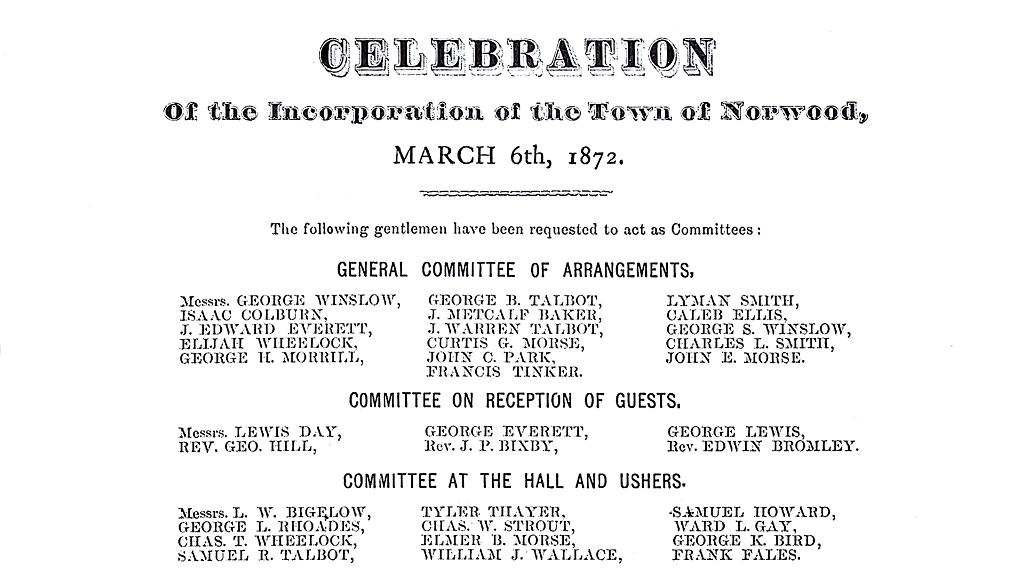
NORWOOD THE VICINITY OF BOSTON. The New Town or Norwood. The inhabitants of this new town, which formerly has been known as South Dedham, last evening celebrated the formal incorporation of the town; Messrs. George Winslow, Isaac Colburn, J. Edward Everett, Elijah Wheeloek, George H. Morrill, George B. Talbot, J. Metcalf Baker, J. Warren Talbot,…
Discover more from Norwood Historical Society
Subscribe to get the latest posts sent to your email.