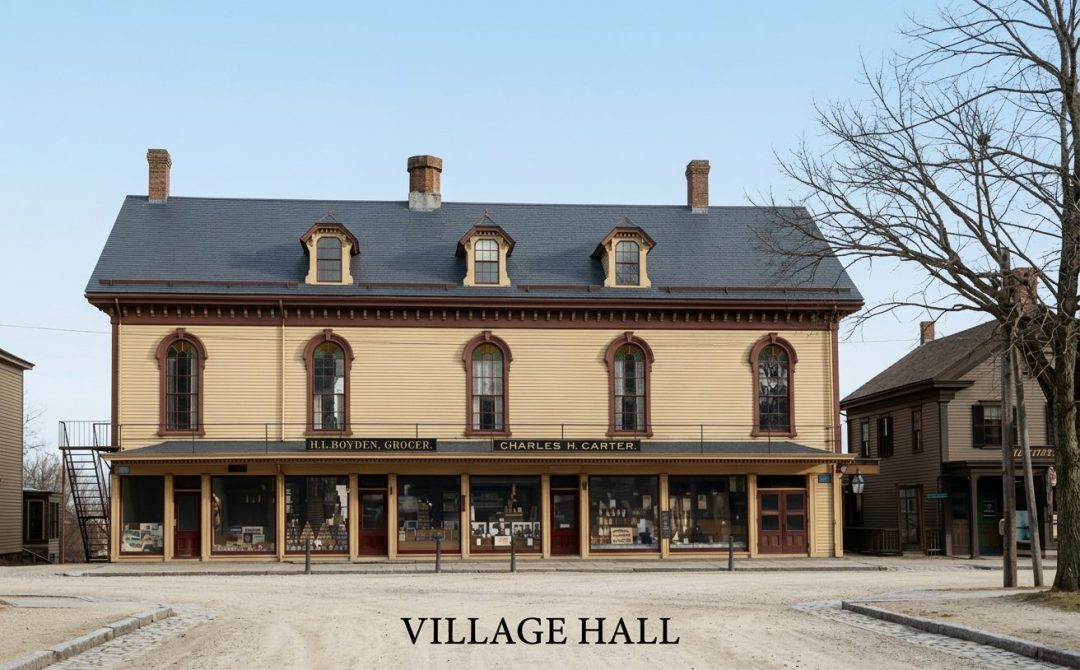
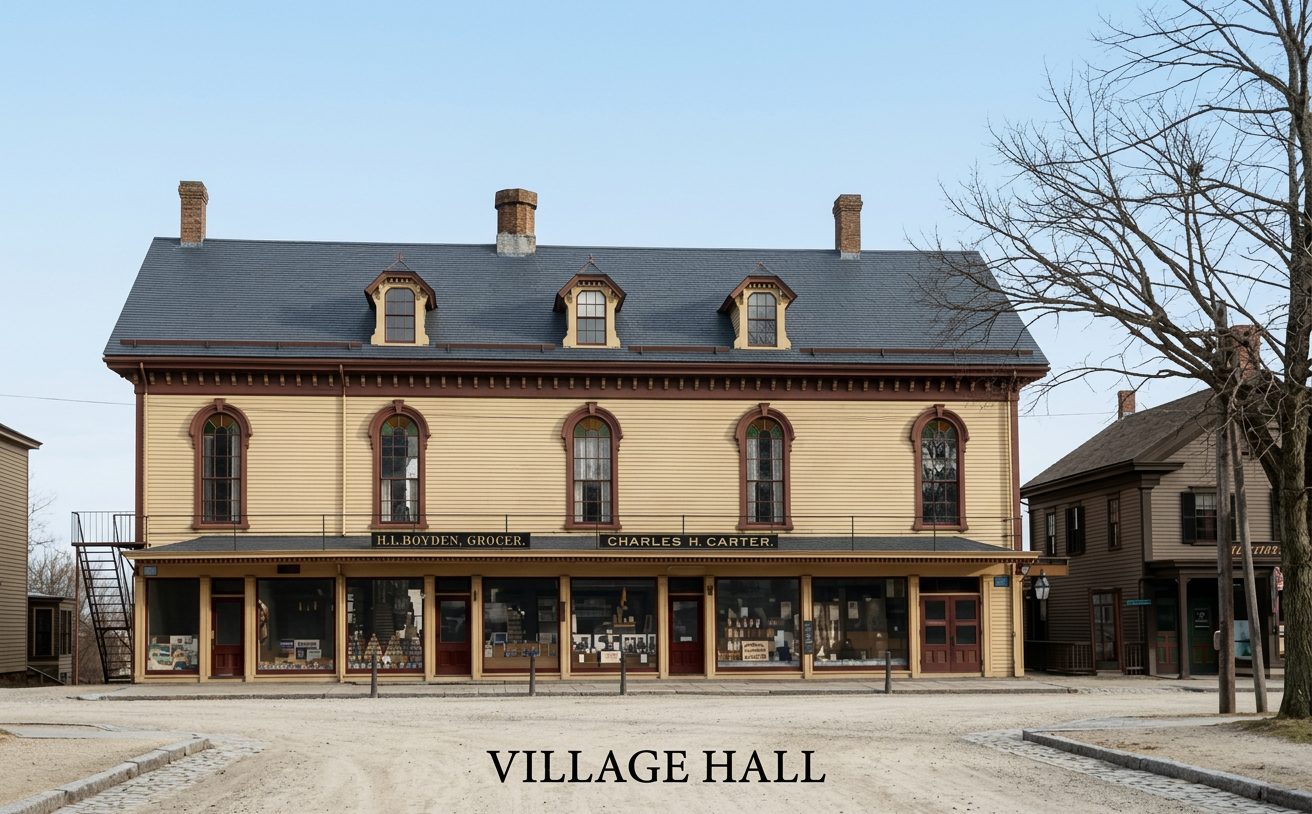
On July 23, 1963, The Patriot Ledger reported that the historic former village hall in Norwood would almost certainly fail to reach its upcoming centennial anniversary, having been officially condemned earlier in the week by the Board of Selectmen following formal recommendations from Building Inspector Henry J. Cronan and Fire Chief Irving J. Dobson. The aging three-story gray frame structure—originally erected between 1865 and 1868 on Washington Street before the town of Norwood was officially incorporated in 1872—faced imminent demolition after decades of heavy municipal, commercial, and industrial use. Over its long existence, the building accommodated a remarkable array of enterprises and community organizations, ranging from the Orient Lodge of Masons—who first purchased the property—to its later use as a warehouse storing surplus synthetic fibers and industrial materials for the United Waste Company.
According to William J. Upham, former president of the Norwood Historical Society, the storied lifespan of the building is divided distinctly into two chapters: its early years at its original location and its later history following its relocation to Broad Street. In its heyday, William J. Upham recalled, the structure served as the bustling civic anchor of the community. The ground floor housed the local post office—where residents famously sorted through mail collectively—alongside a general grocery store and Bigelow’s. An exterior staircase provided access to the second-floor assembly room, which functioned as Norwood‘s original venue for early town meetings, high school graduation ceremonies (including William J. Upham‘s own class of 1899), church fairs, and regular community gatherings. During times of crisis, such as when the Universalist Church burned down, the hall opened its doors to shelter congregation services.
As the community expanded, the building underwent significant physical and administrative transitions. Around 1900, to accommodate the planned extension of Cottage Street, the entire structure was physically moved to its new site on Broad Street, where historical and commercial uses intertwined. The Masons continued to meet in an ell extending off the main hall, a space that also doubled as the town library for many years, while the upper-floor rooms were leased to various local organizations. Before the Norwood Messenger moved into the facility in 1923 to support its expanding publishing operations, the building served as headquarters for the Boston Piano Supply Company. In 1916, when the Masons sold the property to George F. Willett to be utilized as a stable, the building was appraised at $27,500. Now, with safety hazards mounting, falling slate threatening pedestrians, and structural deterioration making preservation unfeasible, the landmark that once stood at the heart of community life faces imminent demolition, captured through a photograph by Kenneth F. McLean as it awaits its final chapter.
Archival Note: This article has been dynamically reconstructed from the original public record print archives of the Patriot Ledger
More…
-
Norwood’s History-1930’s-The Norwood Theater
The Norwood Theater was designed by famed local architect William G. Upham and originally opened on August 31, 1927. Designed for motion pictures, it features a stage for live music and theatrical performances. Upham designed several other buildings in Norwood, including the 1926 Norwood High School building, Odd Fellows Hall, The Norwood Post Office, and…
-
Landmark Torn Down-August 13, 1975
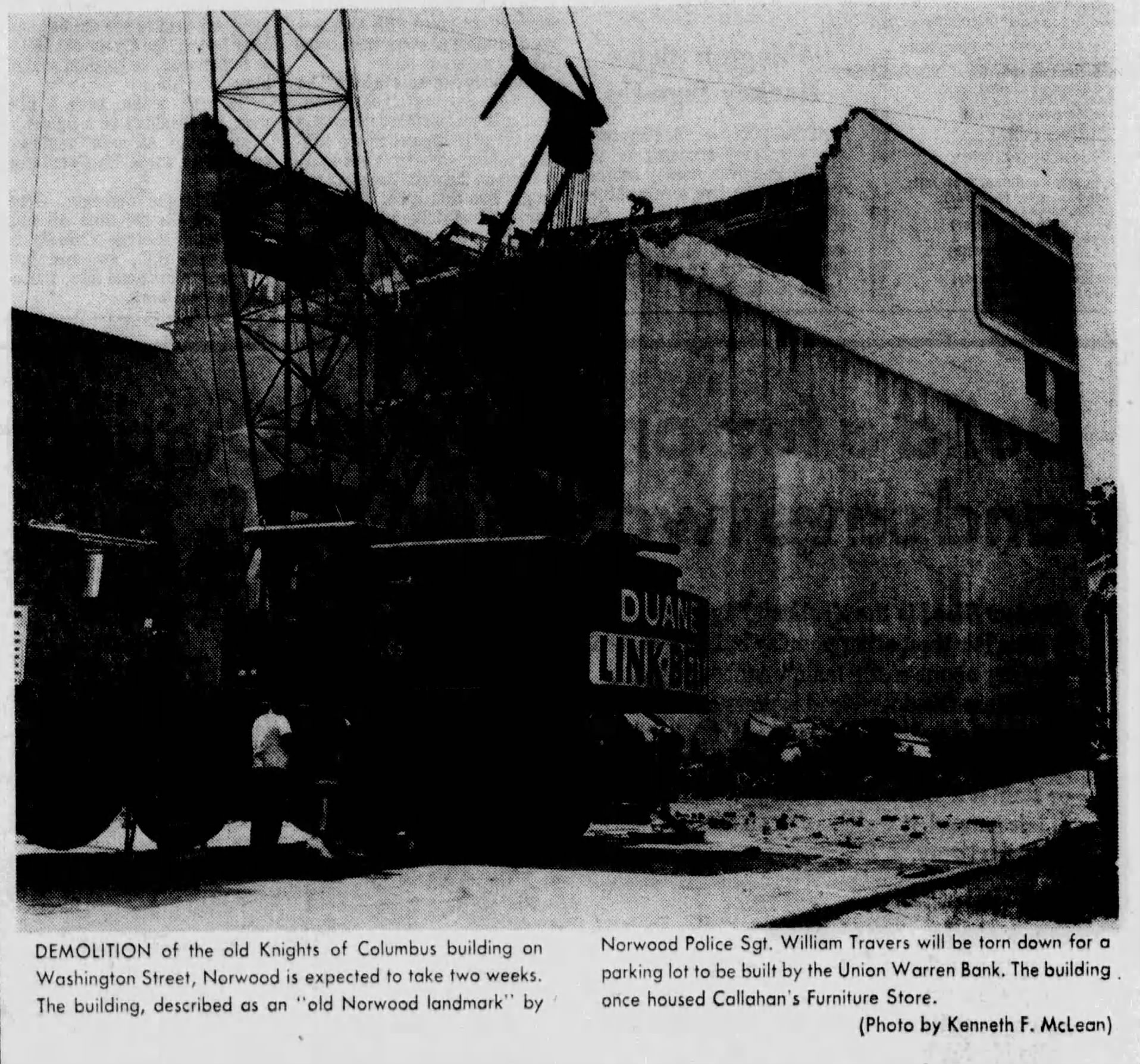
DEMOLITION of the old Knights of Columbus building on Washington Street is expected to take two weeks. The building, described as an “old Norwood landmark” by Norwood Police Sgt. William Travers will be torn down for a parking lot to be built by the Union Warren Bank. The building once housed Callahan’s Furniture Store. (Photo…
-
100th Birthday Unlikely for Norwood’s Historic Village Hall-July 23, 1963
Norwood’s historic former village hall on Broad Street is slated for demolition after being condemned by the Board of Selectmen.
Discover more from Norwood Historical Society
Subscribe to get the latest posts sent to your email.