Norwoods Opportunity
More Business In Sight
The Time To Act Is NOW!
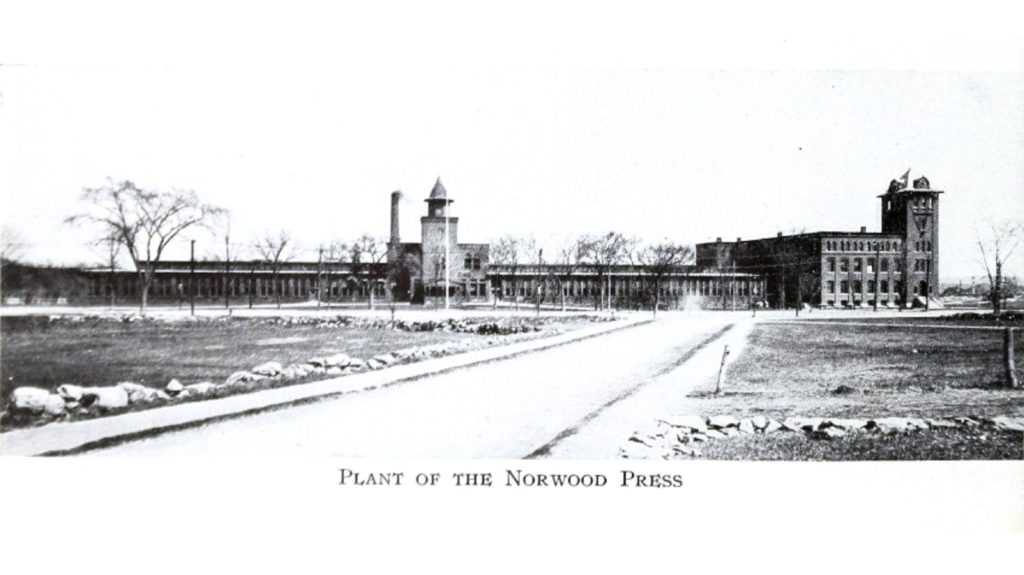
In the years following its incorporation, Norwood had long sought to expand its commercial base and strengthen its taxable property. Its public‑spirited citizens understood that the town possessed the land, the transportation access, and the civic ambition necessary to attract new industry. What they lacked was the right opportunity — a business that was clean, reputable, and capable of providing stable employment to local residents.
That opportunity, the article argued, had finally arrived.
A group of established Boston firms — not unknown outsiders, but citizens already in our midst, respected for their character and stability — had expressed interest in relocating major portions of their operations to Norwood. The proposal was described as the most promising industrial opportunity the town had seen since its incorporation. The businesses were quiet, clean, and profitable, and would draw their workforce from Norwood’s own population, strengthening both home industry and local trade.
The article emphasized that any town in Massachusetts would “eagerly embrace” such a chance, noting that for every dollar Norwood invested, it would receive two in return. The three enterprises seeking relocation were:
1. H. M. Plimpton & Co., Bookbinders
Located on Congress Street, Boston, the firm employed about 90 hands, with a weekly payroll of $900 and an annual business increase of 25 percent. They operated out of four separate locations and wished to consolidate into a single facility. They proposed constructing a brick building either 100×60 feet, three stories high, or 300×60 feet, one story high, with plans to expand as business grew. They were prepared to move to Norwood as quickly as the town responded favorably.
2. J. S. Cushing & Co., Book Printers
Based at 192 Summer Street, Boston, the company employed 125 workers with a weekly payroll of $1,600. With electrotyping added, payroll would rise by $250, employing an additional 16 workers. They planned to begin operations in Norwood with a small force, expanding as workers could be found or relocated. Notably, Cushing & Co. offered to establish a type‑setting school in Norwood immediately for any residents seeking employment.
3. Berwick & Smith, Printers
Operating from the same Boston location, they employed 40 workers with a weekly payroll of $600, and also reported a 25 percent annual increase in business. They proposed moving one‑third of their plant and 20 or more workers to Norwood as soon as a suitable building was ready.
These firms, the article stressed, were “all good men, and all good business,” requiring intelligent and reliable help — the kind Norwood could provide.
In return, they asked only for an eligible location: a gift of land near the railroad, essential for handling large freight shipments. Their combined investment in buildings alone would exceed $100,000. For Norwood, the cost of providing the land would be only a fraction of that amount, yet the resulting taxable property would yield $2,000 annually, not counting the broader economic stimulus.
The article urged Norwood’s progressive citizens to discuss the matter, ask questions, and soon hold a public meeting to determine how best to secure what it called “the prize.” No business committee, it argued, could find a better opportunity.
A particularly suitable parcel of land near the railroad was available. If developed, it would repay its cost through increased taxes within a few years. The article concluded with a call to action: Norwood could better afford to give away vacant land to attract factories than to leave it idle. With “a little business thought and courage,” the town could fill itself with “the hum of new life.”
This appeal foreshadowed the industrial transformation that would soon define Norwood — especially its rise as a national center of printing and book production.
Norwood Advertiser
-
Ethnic Enclaves
Many of Norwood’s new residents came from other countries and through chain migration, many of their friends and families were encouraged to come to Norwood. These new immigrants settled near others who had come from the same country or shared similar cultures. This created little ethnic enclaves within the town of Norwood. These little communities…

-
Bibliography & Sources
Bibliography: Alberta, Paul M. Inside Norwood. Norwood, MA: The Town of Norwood, 1994 “Binding Books by Hand Pays Well After Time.” The International Bookbinder: a Journal Devoted to the Interests of Bookbinders of the United States and Canada, Vol. XIV, No. 7. Indianapolis, IN: The International Bookbinder, Publishers, July 1913 Blair, Karen J. Clubwoman as…
-
End of an Era
For over eighty years, Norwood’s printing industry was an important part of the fabric of the town. It not only made the town known as the printing center of the United States, but It provided jobs to thousands of people over the years. The people who came to work those jobs came from all over,…

-
Colonial & Georgian Revival
These “revival” styles became vastly popular at the turn of the century, and were popular from 1880 to 1955. These styles emphasized academic replication of historical styles, most often European in origin. These homes were most often rectangular in form with gabled, hipped, and even on occasion gambrel rooflines. The center entrance was often marked…

-
Swedeville: Välkommen! Tervetuloa!
When Norwood was established in 1872, it was largely an agricultural village. Town planners who wanted to build-up the town, created incentives for business to settle here. Many companies eagerly accepted Norwood’s enticements and built companies that remained in the town for decades. These newly established companies needed laborers, and many recent immigrants answered the…
-
Women on the Front Lines
There were women who worked in the printing presses in Norwood. A few had positions in management, but most worked on the floor. Clara Berwick, Jane Williams and Ligia Carlson all worked for thirty years at their jobs. Clara Berwick was the president of Berwick & Smith, Jane Williams worked for the Plimpton Press as…

Discover more from Norwood Historical Society
Subscribe to get the latest posts sent to your email.